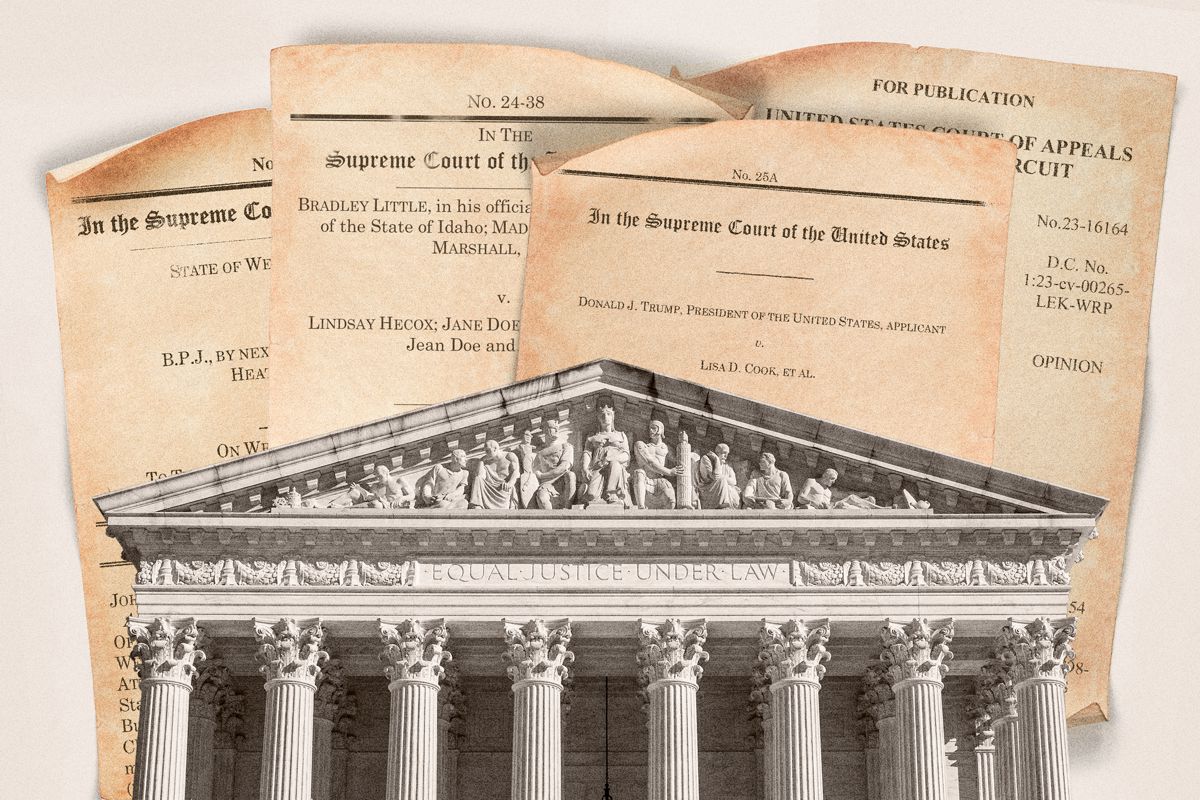


The justices are poised to tackle complex legal questions about gender, gun rights, and the president’s ability to fire people.
The Supreme Court will resume oral arguments the week of Jan. 12, taking on cases dealing with girls’ athletics, gun laws, and the president’s attempt to fire a member of the Federal Reserve.
Here are the top cases to watch.
| 1. Girls’ Sports |
| 2. Hawaii’s Gun Law |
| 3. Trump’s Fed Firing |
1. Girls’ Sports
The Supreme Court on Jan. 13 will hear arguments in two cases—West Virginia v. B.P.J. and Little v. Hecox—that focus on West Virginia’s and Idaho’s laws barring males from competing in female sports. The eventual ruling is expected to tackle key questions about how federal law and the Constitution treat sex and gender.
Both states faced hurdles in federal appeals courts, which held that their laws classified individuals based on their sex and “transgender status.” They also indicated that those types of classifications violated the equal protection clause of the 14th Amendment, which generally directs states to apply the law equally to everyone regardless of particular characteristics.
While courts have sometimes allowed states to treat certain groups of people differently, legal classifications based on sex and other characteristics have also been rejected. That’s because when courts determine whether to uphold a state law, they weigh certain factors, such as whether the state has an important enough interest in using certain characteristics to classify individuals.
In both West Virginia’s and Idaho’s cases, the states have acknowledged that they classify people based on sex but that doing so is justified—specifically because they further important government interests in protecting equality in sports.
“On average, men are faster, stronger, bigger, more muscular, and have more explosive power than women,” Idaho told the Supreme Court. “For female athletes to compete safely and excel, they deserve sex-specific teams.”
West Virginia’s case has also led the Supreme Court to wrestle with a similar issue: whether athletics laws violate Title IX of the Civil Rights Act. That law, which prohibits sex-based discrimination in federally funded educational institutions, was cited by the U.S. Court of Appeals for the Fourth Circuit when it ruled against West Virginia in 2024.
That decision was wrong, West Virginia told the Supreme Court, because Title IX was focused on unequal treatment between the sexes rather than eliminating all sex-based distinctions.
Heather Jackson, whose male child was barred from participating in girls’ cross country and track teams, argued that West Virginia’s law was unreasonable. Part of Jackson’s argument is that puberty-delaying drugs have prevented her child from developing physiological, athletic advantages over girls.
Meanwhile, the student challenging Idaho’s law has attempted to withdraw from the dispute while pledging not to participate in women’s sports. The Supreme Court has deferred deciding on this attempt until after oral argument.
Beyond sex-based distinctions, the appeals courts raised a separate question about whether Idaho’s and West Virginia’s laws classify individuals based on “transgender status.” In other words, do the states target individuals based on that purported status rather than solely based on their sex?
So far, the Supreme Court hasn’t offered a definitive ruling on this issue, but multiple justices suggested in June that someone’s “transgender status” shouldn’t receive extra protection under the Constitution. Justices Samuel Alito and Amy Coney Barrett both said, among other things, that “transgender status” lacked the type of immutable characteristic held by other protected classes, such as race.