

The Jewish state’s prime minister said Trump would be awarded the Israel Prize, the first to a non-Israeli.
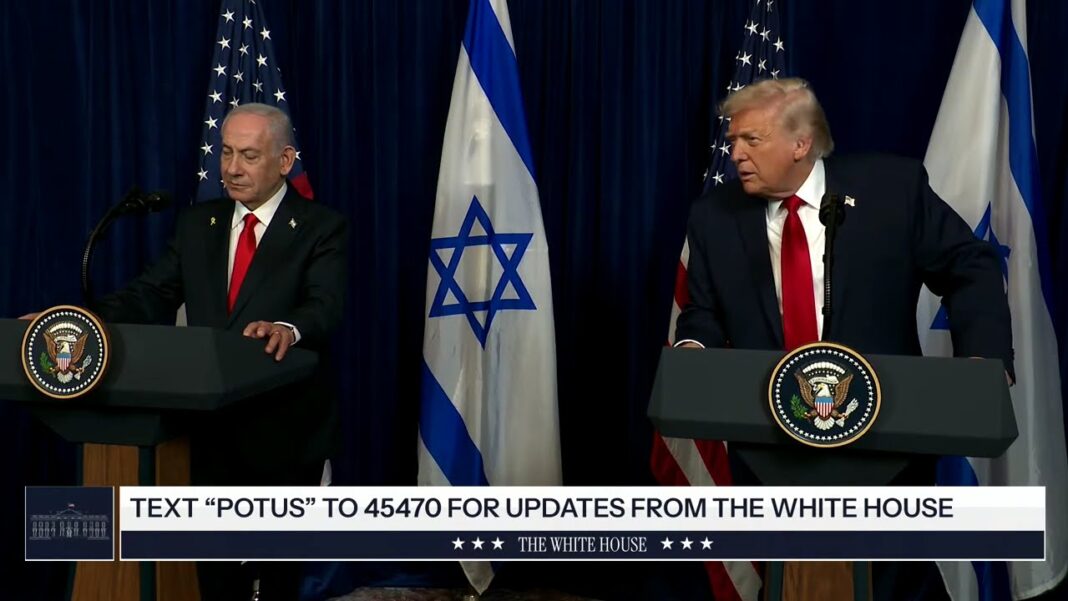
U.S. President Donald Trump hosted Israeli Prime Minister Benjamin Netanyahu at the U.S. leader’s Mar-a-Lago residence in Palm Beach, Florida, on Dec. 29, where the leaders discussed updates on the future of the Gaza Strip and continued security threats within the region around Israel.
Trump warned Iran not to resume pursuing a nuclear weapons program at the threat of subsequent strikes, said it would be “horrible” for Hamas if the terrorist organization doesn’t disarm, indicated that his first administration’s Abraham Accords peace agreement would be expanded, and offered some updates on relations with Turkey, Syria, and Lebanon.
At the start of the press conference, Netanyahu announced that, for the first time since the founding of the nation of Israel, his country would award its Israel Prize to a non-Israeli: Trump.
Here are five takeaways from Trump’s meeting with Netanyahu at Mar-a-Lago.
1. Israel Prize Awarded to Trump
Netanyahu said that Israel decided to “break a convention or create a new one” in awarding the Israel Prize to Trump. This would be the first time since the nation was founded in 1948 that the prize is being awarded to a non-Israeli, according to the prime minister.
Yoav Kisch, Israel’s minister of education, made the formal announcement over lunch on Dec. 29, Netanyahu noted, awarding it to Trump “for his tremendous contributions to Israel and the Jewish people.”
“I think it’s such a fitting thing, and it would honor us, obviously, Mr. President, if you could visit Israel on that occasion on her independence day,” Netanyahu said. “This reflects the overwhelming sentiment of Israelis across the spectrum.
“They appreciate what you’ve done to help Israel and to help our common battle against the terrorists and those who destroy our civilization.”
Given to individuals who have contributed heavily to Israeli culture or have displayed excellence in their field, the Israel Prize is the nation’s most prestigious and important award, according to The Hebrew University.
2. US President Warns Iran
Just two days before Trump’s meeting with Netanyahu, Iranian President Masoud Pezeshkian said the Iranian regime is engaged in a full-scale war with the United States, Europe, and Israel following Washington’s bombings of the nation’s nuclear facilities earlier this year.
On Dec. 29, Trump said he hopes Iran is not trying to rebuild its nuclear weapons facilities.
“Because if they are, we’re gonna have no choice but very quickly, to eradicate that build up,” the U.S. president said.
“I hope Iran is not trying to build up as I’ve been reading that they’re building up weapons and other things, and if they are, they’re not using the sites that we obliterated, but they’re using possibly different sites.”
Trump said his administration knows “exactly where they’re going, what they’re doing” and suggested that he prefers not to “waste the fuel” on another 37-hour trip sending U.S. B-2 Bombers to conduct another series of strikes on potential new Iranian nuclear facilities.
3. Hamas Must Disarm: Trump
Asked what the next steps would be for the United States if Hamas chooses not to disarm within the time it is given—a key part of the peace deal negotiated to end the war in Gaza—Trump said that it would be “horrible for them.”
“I don’t want that to happen, but [Hamas] made an agreement that they were going to disarm,” Trump said.
Trump suggested that other countries, beyond Israel, have told his administration that they are willing to “wipe out” Hamas if the terrorist group doesn’t disarm willingly first.
“If they say they’re going to disarm, that’s fine. If they say they’re not going to disarm, those same countries will go and wipe them out,” he said.
“We have 59 countries … that are outside of the Middle East … they want to go in and wipe out Hamas. They don’t want Israel. They don’t need Israel.”
By Jacob Burg