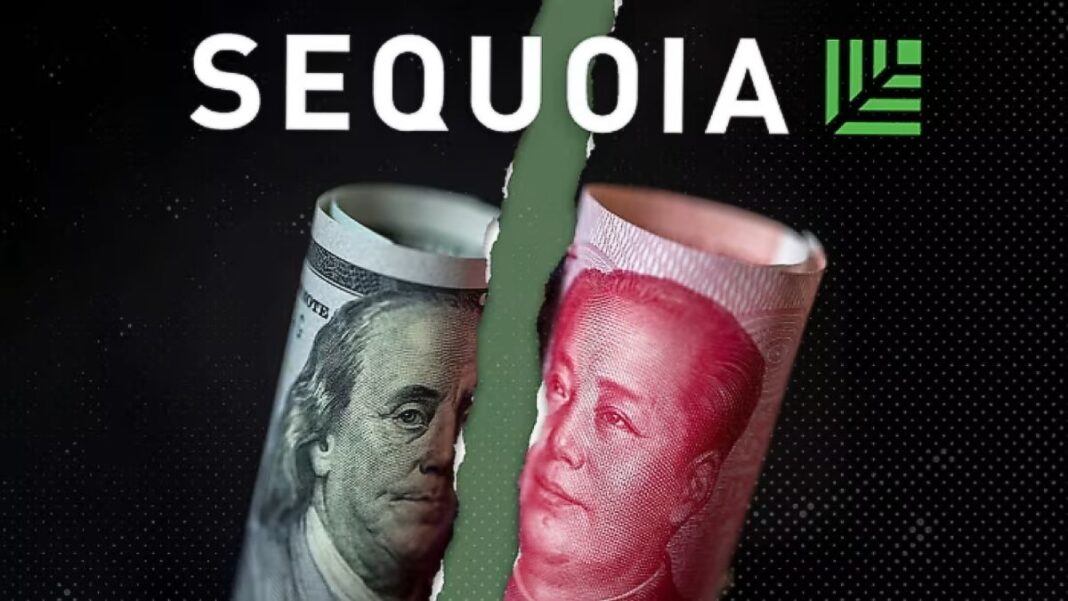


WASHINGTON, DC – Chairman Mike Gallagher (R-WI) and Ranking Member Raja Krishnamoorthi (D-IL) of the House Select Committee on the Chinese Communist Party today expanded a bipartisan investigation into U.S. venture capital firms investing in People’s Republic of China (PRC) high-tech by launching an inquiry into Sequoia Capital and Sequoia Capital China, following the announcement that the entities will split in early 2024. GGV Capital, another venture capital firm the Select Committee is investigating, recently announced a similar separation of its U.S. and PRC operations. The lawmakers request information about Sequoia’s investments into PRC artificial intelligence, semiconductor, and quantum computing companies, as well as the announced split.
In the letter the lawmakers write,“[S]plitting off its China business … is a step in the right direction. However, additional questions remain regarding how the split may affect flows of U.S. capital and flows of technological know-how from U.S. companies to foreign venture funds.”
The letter also discusses “investments in PRC entities have included certain investments that contributed to the CCP’s human rights abuses, the PRC’s military modernization, and its overall efforts to undermine U.S. technological leadership… Those deals support the CCP’s goals of ensuring technological supremacy and increasing the United States’ dependence on the PRC in critical technologies.”
Some of Sequoia Capital China’s problematic publicly known partnerships with Chinese companies, which are set to continue even after the split, include:
Investments in EverSec, a Chinese company developing AI for the People’s Liberation Army’s (PLA) warning platforms
Helping raise $700 million for 4Paradigm, a Chinese company building AI for PLA battlefield programs
Investments in DJI, a Chinese drone maker that facilitates the CCP’s surveillance and genocide of Uyghurs Muslims in China’s Xinjiang region
Investments in DeepGlint, a Chinese facial recognition firm blacklisted by the U.S. government and used by the CCP to track Uyghur Muslims and surveil the Chinese population
Investments and fundraising for ByteDance, the Chinese company that owns TikTok
As many as 40 investments in Chinese semiconductor companies since 2020
The lawmakers ask for names and information regarding each company based, or with significant operations, in China that are engaged in research or development in key technology areas that Sequoia Capital or Sequoia Capital China has invested in since 2010. Recently, the Select Committee asked for similar information from four other venture capital firms with significant investments in the PRC.
View a copy of the bipartisan letter to Sequoia below or read HERE.
Dear Mr. Botha and Mr. Viera,
We write to request information about Sequoia’s investments in artificial intelligence (AI), quantum computing, and semiconductor companies in the People’s Republic of China (PRC), and to better understand Sequoia Capital’s announcement that it would split from its China business—Sequoia Capital China—by March 2024. Neither entity has articulated the reasons for the split. But there is certainly a growing spotlight on Sequoia Capital China’s investments in PRC-based companies, including problematic companies with links to the PRC’s military and intelligence as well as to the Chinese Communist Party’s (CCP) human rights abuses.
By splitting off its China business, it appears likely that Sequoia will reduce the flow of American technological and managerial expertise from U.S.-based venture capital funds (VC) to such PRC-based companies, which is a step in the right direction. However, additional questions remain regarding how the split may affect flows of U.S. capital and flows of technological know-how from U.S. companies to foreign venture funds.
We therefore write to request additional information about Sequoia Capital and Sequoia Capital China’s PRC investments and Sequoia Capital’s plans to split from Sequoia Capital China.
For more than a decade, Sequoia Capital China’s significant U.S. dollar investments in PRC entities have included certain investments that contributed to the CCP’s human rights abuses, the PRC’s military modernization, and its overall efforts to undermine U.S. technological leadership. In the AI space, Sequoia Capital China has invested in EverSec, which serves as a “Cybersecurity Emergency Service Support Unit” for the CCP and has been contracted to develop an AI-enabled “cyber threat intelligent sensing and early warning platform” for the People’s Liberation Army (PLA). The firm also helped raise $700 million for 4Paradigm, a PRC AI company that the PLA contracted to develop battlefield management and command decision-making programs. Likewise, in the semiconductor space, Sequoia Capital China made as many as 40 investments in Chinese semiconductor companies in the early 2020s.Those deals support the CCP’s goals of ensuring technological supremacy and increasing the United States’ dependence on the PRC in critical technologies.
Sequoia Capital China has also invested in companies that facilitate the CCP’s human rights abuses, such as sanctioned PRC drone maker DJI, whose products enable the repression and genocide of Uyghurs in Xinjiang. It has also invested in DeepGlint, whose facial recognition technology is used by the CCP to control the Uyghur population and to power the PRC’s techno-totalitarian surveillance state and which was blacklisted by the U.S. Commerce Department in 2021. In addition, Sequoia Capital China and Sequoia Capital have both provided extensive support and capital to ByteDance, parent company of TikTok, helping it to raise billions of U.S. dollars. TikTok exposes millions of Americans to CCP surveillance and influence.
Facing scrutiny for these and other troubling investments, in the summer of 2022, Sequoia Capital established an internal screening process for all investments made by Sequoia-affiliated funds. The screening mechanism is narrowly focused, covering only investments in PRC quantum computing, semiconductor, and aerospace companies, and it does not appear to require any changes to Sequoia Capital China’s ongoing engagement with the dozens of PRC companies in those sectors in which the fund had previously invested. One year later—ahead of an anticipated, and now announced, executive order that will screen outbound investment from American VCs into PRC AI, quantum, and semiconductor companies—Sequoia Capital announced it would split off Sequoia Capital China, which will retain its Chinese name HongShan, and use that name in English as well.
For years, Sequoia’s five entities have shared much more than a name. While each had its own investment committee that picked which companies to back, they remained closely linked. According to Sequoia Capital, roughly 20 percent of the carry from each deal—the profit paid to the general partners (GPs) at the entity that made the investment—flowed back to the top of the Sequoia family, from which it was distributed to senior GPs and used to pay for common expenses. A centralized compliance office in Menlo Park reviewed every deal and vetted it for compliance with U.S. law. Though Sequoia’s overseas arms eventually hired their own legal and finance teams, Sequoia Capital’s CFO and legal counsel retained certain authorities over the foreign entities. The entities also shared some back-office functions. According to Sequoia, these centralized functions will end when the transition does. By March 2024, Sequoia Capital China will stop sharing profits with Sequoia’s other entities, including any future carry from existing funds. They will not run compliance centrally, and they will no longer attempt to deconflict investments.
Although Sequoia’s split appears to resolve some of the concerns detailed above by curtailing the flow in some cases of U.S. managerial and technological expertise to problematic PRC companies, significant questions remain – and should be answered by Sequoia – for at least two reasons.
First, it is not clear whether the split will in fact staunch future flows of American capital to problematic PRC companies—indeed, the split may insulate some types of capital flows from regulatory scrutiny they would have otherwise been subject to under the recently released executive order. Sequoia Capital China has long followed the Sequoia tradition of aggressively fundraising from U.S. institutional investors. Indeed, for most of its existence, 60 to 70 percent of Sequoia Capital China’s limited partners (LPs)—that is, the investors in its funds—were from the United States. The proportion has since fallen to around 50 percent, but U.S. investors remain the single largest source of capital for Sequoia Capital China.The corporate split will not prevent continued investment by U.S. institutional investors into HongShan. Indeed, after the corporate split, HongShan appears likely to scrap the national security screening mechanism—allowing it to deepen its investments into problematic PRC companies—even as it likely retains U.S. institutional investors as its largest source of capital.
Under rules to be issued pursuant to the executive order, Treasury will prohibit some investments by U.S. persons—including venture capital funds—in PRC companies related to covered national security technologies and products. By splitting from HongShan, Sequoia Capital may avoid regulatory scrutiny arising from any investments made by its longtime partner.
Meanwhile, the split will give Sequoia Capital China a free hand to continue funneling U.S. capital into PRC companies. Because of its corporate affiliation with Sequoia Capital, it previously would have been subject to the restrictions that Treasury is expected to issue under the executive order. Now, by becoming a wholly independent and foreign company, Sequoia Capital China will be free to make investments that would have otherwise created legal liability or reputational harm to Sequoia Capital (and scrap even the internal restrictions imposed by its U.S.-based partner). At the same time, it appears likely that HongShan will be able to continue to draw upon a large pool of American capital in executing such investments.
In short, a core underlying concern, that significant amounts of American money will continue to capitalize deeply problematic PRC companies, is likely to remain absent further congressional or executive branch action. To prevent American capital and expertise from continuing to flow to troubling PRC entities via foreign entities like HongShan, it would be necessary to cover not just the fund-to-company transaction, but also the investment made by the LPs or other entities that are the source of capital in the first instance.
Second, the split raises new questions about the reverse flow of emerging American technologies to PRC-based venture funds like HongShan, which may seek to ramp up investments in Silicon Valley startups as it will no longer be subject to Sequoia’s broader deconfliction process.
For those reasons, questions remain about the implications of the split on the serious problem of American money capitalizing companies that work with the People’s Liberation Army (PLA), facilitate the CCP’s human rights abuses, and power its technological ambitions. We therefore request additional information regarding both concerns.
Accordingly, please respond to the following questions no later than November 1, 2023.
Please list the name of each company that is researching or developing products or services related to artificial intelligence or machine-learning, semiconductors, or quantum computing or quantum information systems that Sequoia Capital or Sequoia Capital China (“the firms”)—or any affiliated investment vehicles or personnel—has invested in since 2010 that is either based in or has significant operations in the PRC. Please provide each company name in both English and Chinese. If any of these investments were into holding companies or similar investment vehicles, please also provide the English and Chinese names of the relevant operating company(ies).
For each company listed in response to Question 1:
Please state the dollar amount of each investment by the firms in each listed company, and the date(s) of such investment(s) in each company.
Please describe any business or management expertise or advice that the firms have provided or expects to provide to the relevant company.
Please identify whether the firms, or affiliated personnel, are entitled to exercise control or influence over the company. Please describe how such control or influence may be exercised.
Please explain the relevant factors used to assess the investment and to make the decision to proceed with the investment. Please also identify the risk factors identified, and whether any of those risk factors relate to national security or human rights concerns.
Please state whether the listed company was receiving or has since received funding or revenue from any PRC-affiliated, state-owned, or state-backed entity.
Please specifically state whether any PRC entity, state-owned entity, or fund backed by a Chinese central or provincial government guidance fund was listed in the company’s capitalization table at the time the investment was made.
Please state the name of each such entity in English and Chinese, and the total invested by that entity into each company listed in response to Question 1.
Please produce copies of all documents and correspondence in your custody or control related to the subject matter of 2(e).
Please describe the role or influence of the CCP or PRC Government at the company, including (but not limited to) any known Party committees at the company, sales to or collaboration with PRC Government entities, or alignment of corporate research or development efforts with CCP or PRC Government technology priorities.
Please produce copies of all documents and correspondence in your possession or control related to the subject matter of this question.
Please explain how investment decision making for transactions in China and risk assessment around national security or human rights concerns are communicated with limited partners of Sequoia Capital or Sequoia Capital China.
Please identify any limited partners in Sequoia Capital or Sequoia Capital China that are domiciled in the PRC or that manage funds on behalf of PRC state-owned or affiliated entities.
Please state whether the listed company has been placed on any U.S. government sanctions or trade restriction list.
As noted above, it is our understanding that roughly 50 percent of Sequoia Capital China’s limited partners are U.S.-based. Please confirm the accuracy of this number and provide the following information:
Please provide the number of U.S.-based LPs in Sequoia Capital China.
Please provide the name, total amount invested, and the name of the fund in which such capital has been invested.
How has, or how would, Sequoia Capital respond if the U.S. government placed a company that Sequoia Capital or Sequoia Capital China invests in on a sanctions or trade restriction list, such as the Commerce Department’s Entity List? Please describe any mitigation measures that may be in place for such a scenario.
The House Select Committee on the Strategic Competition Between the United States and the Chinese Communist Party has broad authority to “investigate and submit policy recommendations on the status of the Chinese Communist Party’s economic, technological, and security progress and its competition with the United States” under H. Res. 11. Upon your receipt of this letter, please maintain and preserve all hard copy and electronic documents, including electronic communications, related to the subject matter of this letter.