The justices expressed skepticism that Trump could be removed from the ballot under the 14th Amendment in Colorado.
Trump: ‘A Very Beautiful Process’
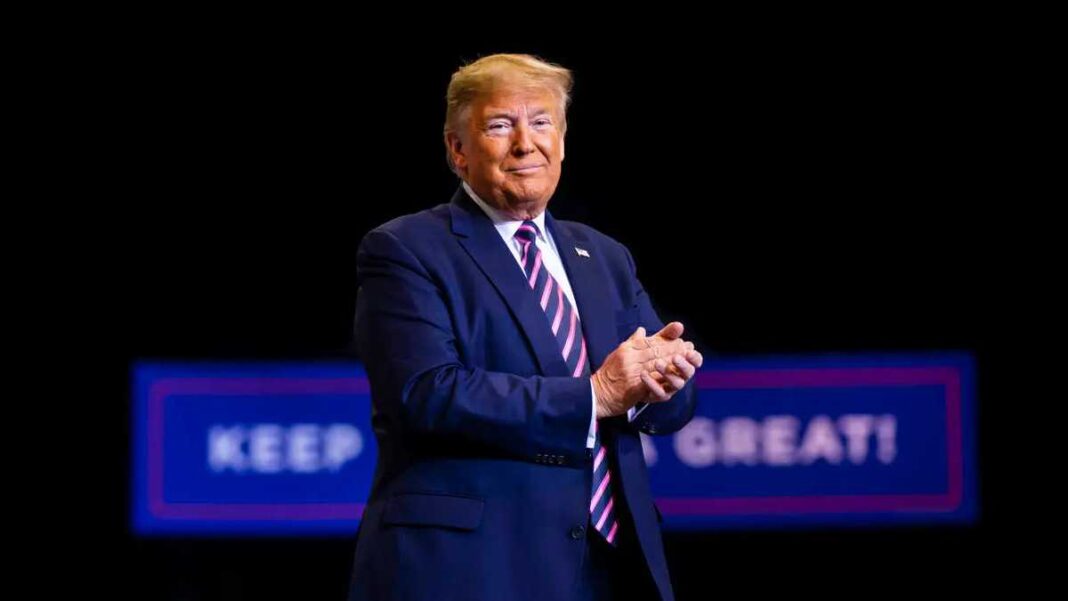
Former President Donald Trump has weighed in on the presidential ballot case following a hearing at a press conference outside his Mar-a-Lago residence in Palm Beach, Florida.
“It’s a very beautiful process,” he said, referring to the Supreme Court hearing. “I hope that democracy in this country will continue because, right now, we have a very, very tough situation with all of the radical left ideas, with the weaponization of politics. They’ve weaponized it like it’s never been weaponized before. It’s totally illegal, but they do it anyway.”
During the hearing, an argument raised by Jason Murray, the attorney for President Trump’s challengers, was that his public statements on Jan. 6, 2021, contributed to what they call an insurrection.
President Trump, however, charged that efforts to bar him from the ballot are just “more election interference by the Democrats,” and that if the Jan. 6 Capitol breach was an insurrection, it was the fault of then-House Speaker Nancy Pelosi (D-Calif.), not him.
Pointing to the tweets he posted shortly after violence broke out at the pre-approved “Stop the Steal” protest that day, he said, “If you take a look at those five or six tweets, you will see very beautiful, very heartwarming statements. ‘Go home,’ ‘the police are doing their job,’ … beautiful statements.”
He also cited his speech at the Ellipse near the White House prior to the protest, during which he urged protesters to “peacefully and patriotically” make their voices heard.
“[Mr. Murray] said I said bad statements, but it was the exact opposite. So, I think you should take a look at the statements that I made before and after and you’ll see a whole different dialogue.”
President Trump will now make his way to Nevada, where he said he expects to have “a very big night” as the only major contender participating in the state’s Republican caucus.
Justice Alito Asks About Possible Fallout of a Colorado Ban
Justice Samuel Alito asked Ms. Stevenson about the possibility that if Colorado banned Trump, then other states would “retaliate” and bar other candidates.
Ms. Stevenson replied, “I think we have to have faith in our system that people will follow their election policies and processes appropriately, that they will take realistic views of what insurrection is under the 14th amendment.”
“I don’t think that this Court should should take those threats too seriously,” she added.
Justice Alito followed up, asking, “You don’t think that’s a serious threat?”
“I think we have to proceed on the assumption that it’s not a serious threat. I think we have institutions in place to handle those types of allegations,” Ms. Stevenson responded.
Justice Alito asked, “What are those institutions?”
“Our our states, there are electoral rules, the administrators who enforce those rules, the courts that will review these decisions, and up to this court to ultimately review that decision,” Ms. Stevenson replied.
Colorado Solicitor General Makes Arguments
Colorado Solicitor General Shannon Stevenson, representing the state’s Attorney General Jena Griswold, has started her 10 minutes of allocated argument.
Ms. Stevenson argued that the state has the power to strip candidates of eligibility under the 14th Amendment.
“Nothing in the Constitution strips the states of their power to direct presidential elections in this way,” she said.
Justice Sotomayor Says ‘Officer’ Argument Only Favors Trump
Justice Sotomayor said the “officer” argument was “gerrymandered” to only benefit President Trump.
If the Supreme Court accepts that only those who have taken an oath of office that wasn’t the oath the president took, Section 3 would apply to all presidents besides George Washington and President Trump. President Joe Biden had served as a Senator, for example, and every other president had been in high level of government before taking the office of the president.
Mr. Mitchell said that was correct and “it does seem off that President Trump would ‘fall through the cracks,’ so to say,” but that he couldn’t answer as to why the framers would intend the text to work this way because it had been edited many times as the framers compromised on different points before it passed both Houses.
Justice Jackson Asks If the Ban Applies to Presidents
Justice Kentanji Brown Jackson—a liberal justice—asks if the 14th Amendment applies to the president.
She noted that the wording of the provision doesn’t include the word “President” in the list of people barred, which specifically includes other offices such as “Senator of Representative in Congress.”
“They were listing people that were barred and ‘president’ is not there,” Justice Jackson said. “I guess that just makes me worry that maybe they weren’t focused on the president.”
Justice Jackson noted that in her reading of the historical context, the framers of the amendment were more concerned with insurrectionists rising through the ranks and the South rising up again than they were with an insurrectionist running for president.
She pressed Mr. Mitchell why he had placed so much emphasis on arguing that the president is not an “office of the United States,” and not the fact that “president” is not listed.
Mr. Mitchell responded that they are arguing both, but believe the “officer” argument is much stronger and supported in several places in the Constitution, such as the Appointments Clause and the Commissions clause, where officers refer to appointed officials rather than elected officials. Members of Congress are described as holding “seat,” not ‘“offices.”
The Justices pressed Mr. Mitchell to point to areas in the Constitution that support the distinction.
Justice Gorsuch Asks Who ‘Insurrectionist Ban’ Applies To
Justice Neil Gorsuch asked the plaintiffs if the “insurrectionist ban” applies to those who are running for office or holding office.
Section 3 of the 14th Amendment states that no person “shall … hold any office … under the United States” if they have previously taken an oath to the Constitution and had engaged in insurrection.
Trump’s challengers say this wording applies to candidates, that is, those running for office.
Justices Ask Whether States Can Apply Section 3 Independently
Justice Clarence Thomas asked Mr. Mitchell to elaborate on whether Section 3 was self-executing, and Mr. Mitchell answered that the application of Section 3 was entirely up to Congress.
No secretary of state is allowed to act based on a prediction of whether Congress will remove a disability via a two-thirds vote, Mr. Mitchell added.
Justice Sonia Sotomayor pointed out that there are many cases of states using Section 3 to remove insurrectionists from state office. She faulted Mr. Mitchell for relying on the 1869 Griffin’s case, which is a district court decision that is not binding, pointing out that Chief Justice Salmon Chase, who wrote that opinion, had also previously indicated Section 3 was self-executing and disqualified Confederacy president Jefferson Davis without legislation from Congress.
Justice Amy Barrett told Mr. Mitchell that if his argument that this removal mechanism adds a new “qualification” for candidacy, then Congress could not enact legislation to allow Colorado to do what it has done anyway, because then Congress would be adding a new qualification.
Mr. Mitchell referred the U.S. Term Limits v. Thorton case, which determined that a candidate needed to be of age on inauguration day, meaning states could not enact legislation barring a candidate from running if they are not yet of age on election day if they would be on inauguration day.
Defense Delivers Opening Statement
Attorney Jonathan F. Mitchell, representing former President Donald Trump, told the justices that Section 3 did not apply to presidents, because the “officer of the United States” mentioned in the Constitution applies to appointed, not elected officials.
He argued that even if one was disqualified, the candidate could not be barred from a ballot because the law disqualifies from holding office not running for office, and Congress can remove the disability. Colorado was therefore violating the timeline “and potentially taking away the votes of tens of millions.”
80 Minutes to Argue
The Supreme Court has granted President Trump’s side 40 minutes to argue, the respondents—six Colorado voters represented by activist group Citizens for Ethics & Responsibility in Washington—30 minutes to argue, and Colorado Secretary of State Jena Griswold 10 minutes to argue.
What to Know
The Supreme Court is hearing oral arguments on whether the Colorado Supreme Court erred in ruling that former President Donald Trump is disqualified as a candidate for the presidential primaries under Section 3 of the 14th Amendment.
Legal questions abound, and experts and stakeholders have urged the high court to address the issue comprehensively so as to not result in a surprise disqualification issue for any candidate that could arise all the way up to inauguration day.
The 14th Amendment was ratified in the wake of the Civil War, granting citizenship and equal rights to all persons born or naturalized in the United States. Section 3 was added to prevent deserters who joined the Confederacy from returning to the offices they abandoned, unless a two-thirds vote from Congress removed the disqualification.
The novel legal theory that President Trump engaged in “insurrection” as written in Section 3 began circulating a day after Jan. 6, 2021, with advocates urging state election officials to bar him from any future ballots. The House of Representatives voted to impeach President Trump a second time weeks later based on “incitement to insurrection,” but he was then acquitted in the Senate.
Last summer, the movement was revived when legal challenges to President Trump were filed in dozens of jurisdictions across the nation.
On Dec. 19, Colorado became the first state to officially declare President Trump ineligible for the ballot, in an unusual decision that stayed its own order in anticipation of a Supreme Court appeal. Soon after, the Maine secretary of state followed in issuing a decision to remove President Trump from the ballot, while staying the removal in the event of an appeal.
As of early January, attorneys for President Trump noted 60-plus cases in 30-some states that they were aware of. On Jan. 5, the Supreme Court accepted President Trump’s petition to review the Colorado decision, and several other courts have dismissed similar cases to defer to the high court’s impending decision.
Attorneys for President Trump argue that not only did he not engage in or incite an insurrection, but Section 3 does not apply to presidents at all.
An administrative note indicates the Supreme Court will issue a written opinion on Feb. 8, the same day as oral arguments.