

The OECD said the United States is outperforming other advanced economies largely because of exceptionally strong investment in ICT and AI.
The U.S. economy is outperforming earlier expectations this year as surging tech sector investment and a rush of pre-tariff imports bolstered activity, helping offset the drag from cooling job growth and moderating household spending, the Organization for Economic Cooperation and Development (OECD) said on Dec. 2 as it raised its U.S. growth forecast.
In its latest Economic Outlook report issued on Tuesday, the 38-country group said it now expects the U.S. economy to grow 2 percent in 2025, up from the 1.6 percent it projected in June.
The upgrade reflects a year in which investment in information processing equipment, software, and data center construction surged at exceptional rates, providing an economic buffer even as higher tariffs, lower net immigration, and a late-year government shutdown weighed on demand.
The OECD also lifted its global forecast, now seeing the world economy expanding 3.2 percent this year—down slightly from 3.3 percent in 2024, but exceeding the 2.9 percent pace it estimated six months ago. Growth is expected to slip to 2.9 percent in 2026 as the full tariff impact works through household budgets, business outlays, and global trade.
“The global economy has been resilient this year, despite concerns about a sharper slowdown in the wake of higher trade barriers and significant policy uncertainty,” OECD Secretary-General Mathias Cormann wrote, while projecting that tariffs will gradually feed through to higher prices, weighing on consumption and private investment.
Business Investment Drives U.S. Outperformance
The OECD said the United States is outperforming other advanced economies largely because of exceptionally strong investment in information and communication technology (ICT) and artificial intelligence (AI), which has become a key engine of growth in 2025.
Private ICT equipment investment as a share of gross domestic product (GDP) has risen sharply, the report said, with U.S. spending levels now roughly 20 times those of countries such as the United Kingdom and Canada.
ICT equipment and software investment made an unusually large contribution to real GDP in the first half of the year, which grew at a 1.1 percent annualized pace through the first six months of 2025 despite “rapidly cooling job growth and numerous headwinds.”
Excluding AI-related investment—which the report said “continued to boom”—GDP would have slipped 0.1 percent over the period, highlighting the extent to which tech spending has propped up overall output.
The boom extends beyond equipment. Investment in data center construction jumped at an annualized 21 percent pace in the first half of 2025, accounting for more than 5 percent of all nonresidential construction.
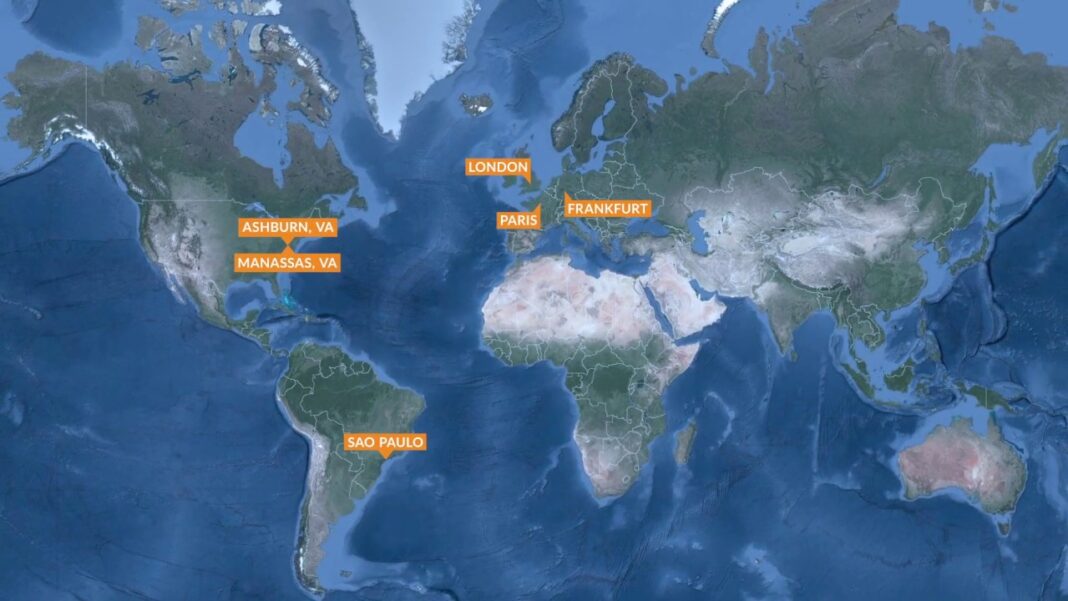
The United States—already home to 43 percent of global installed data center capacity in 2024—is widening that lead as companies accelerate the deployment of AI technologies.
“Strong demand for new AI-related investments in some countries, particularly the United States, are all providing broader support for demand, offsetting headwinds stemming from the gradual implementation of new trade policy barriers, still-elevated policy uncertainty, and declining residential investment,” the OECD said.