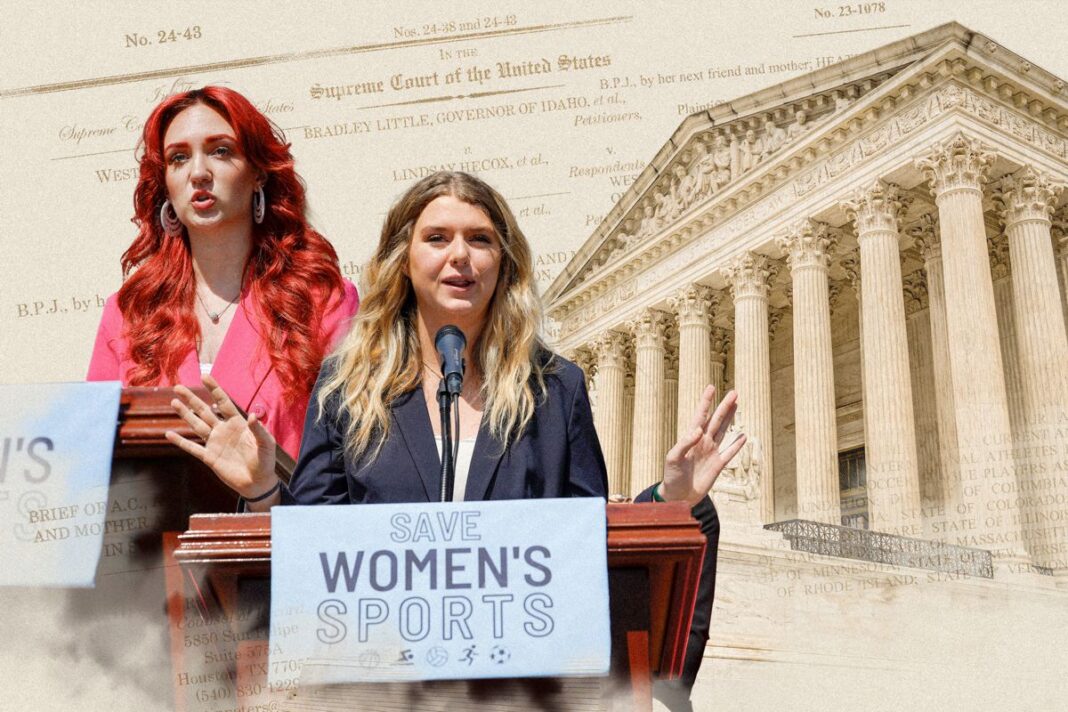


The court is set to consider the legality of two state laws that ban males who identify as transgender from participating in girls’ sports.
Selina Soule was a high school track and field champion in Connecticut, holding multiple state conference titles and school records.
But when male athletes who identified as transgender started competing against her, Soule said her prospects of winning diminished.
“It didn’t matter how much time I put in, in practice; how much extra effort I put in. There was nothing I could do to win the race,” Soule, who graduated from Glastonbury High School in 2020, told The Epoch Times.
Soule’s sentiments have been common in the ongoing national debate surrounding males competing in female sports.
The Supreme Court on Jan. 13 is set to weigh in on the issue by hearing cases challenging state laws barring boys from competing in girls’ sports.
In two cases to be heard back to back, the high court will examine allegations by male students who identify as transgender that West Virginia and Idaho illegally discriminated against them by banning their participation in girls’ sports.
The cases—Little v. Hecox and West Virginia v. B.P.J.—are expected to yield rulings on whether the state laws violate the Constitution and federal civil rights law.
Depending on how the justices decide, the lawsuits could make it easier for states across the country to maintain the sex-segregation some female athletes say is critical for sports.
‘Stakes Are High’
According to the left-leaning Movement Advancement Project, 27 states have enacted bans such as the ones being considered by the Supreme Court. Some states have encountered federal court blocks.
Those included Idaho and West Virginia, which federal appeals courts have ruled they acted illegally discriminatory based on sex and “transgender status.”
But female athletes say their interests are not being respected when males compete against them.
A recent study by the right-leaning Concerned Women for America showed that since the mid-1980s, women have been deprived of more than 1,900 gold medals by men competing in female categories.
An amicus brief from 102 female athletes told the court that “female athletes across the country, at all levels of sports, stand on the precipice of permanently losing their access to equal opportunity and safety in sports.”
“Based on their biological sex, they are at risk of being pushed aside in law and in life in a permanently damaging and irreversible way.”
Macy Petty, a former high school volleyball player, told The Epoch Times, “We’ve come to this point that men have infiltrated women’s sports to the degree where women are walking up to the court wondering if they will actually have the privilege of only playing against women.”
Petty, who participated in countless matches across the country, graduated from Northwestern High School in South Carolina in 2020. She trained in volleyball for seven years and had competed in hundreds of matches across the country by 2018.
That year, she attended an event where college recruiters were in attendance to recruit gifted female athletes and reward them with scholarships. As she walked onto the volleyball court, she was shocked to see that she was matched with a male.
“The only emotion that I knew was pure confusion,” Petty told The Epoch Times.
Countless others, including Alliance Defending Freedom President Kristen Waggoner, share Petty’s critical approach to male participation.
Although “compassion and respect needs to occur for all children,” Waggoner said during a Jan. 8 press briefing, the rights of young women must not be ignored in that process. The organization led by Waggoner, who played volleyball in high school, is helping Idaho and West Virginia defend their laws in court.
The justices are expected to focus on two legal provisions: the equal protection clause of the Constitution and Title IX of the Civil Rights Act. The first generally guarantees equal protection under the law, while the latter prohibits sex-based discrimination in educational institutions that receive federal funding.
By Stacy Robinson and Sam Dorman