

Modern medicine saves more lives than ever. So why do patients feel less cared for?
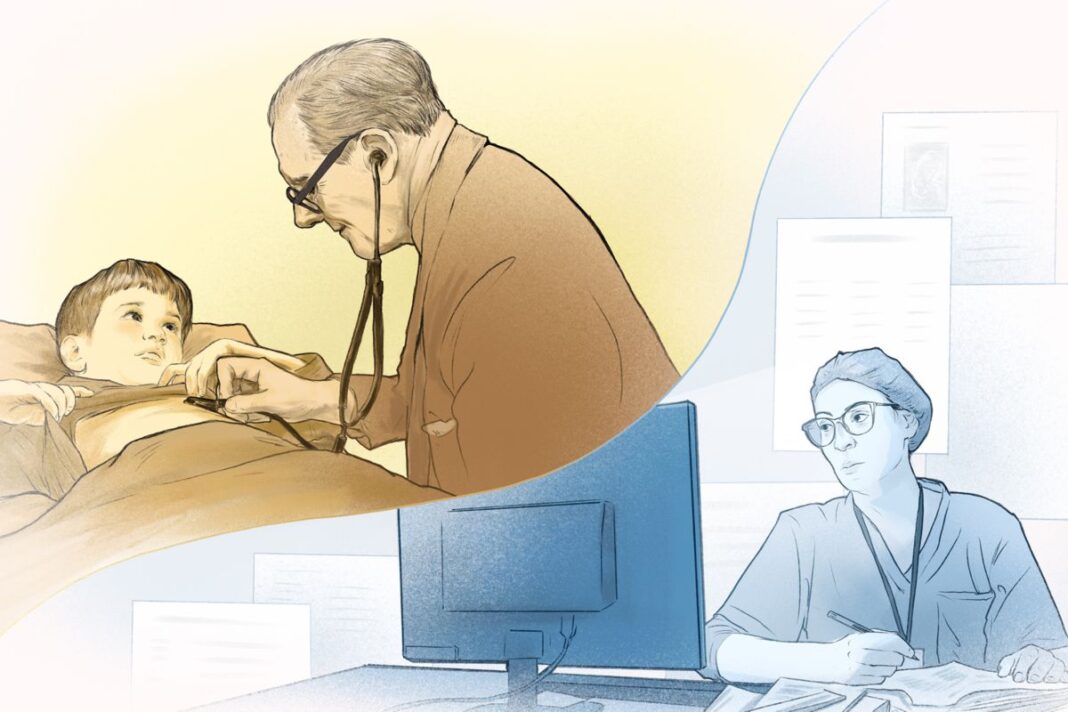
On winter evenings in Great Neck, New York, a young Frank Ittleman would watch his father step in from the cold, fedora on his head and a heavy black bag in hand. The front rooms of their small house doubled as a medical practice, lined with dark-wood cabinets with a hulking X-ray machine pressed against the wall. In the basement, X-ray films dried in a darkroom carved out of the coal chute.
Patients came by train from Brooklyn, and Dr. Felix “Big Frank” Ittleman picked them up at the station, treated them in the parlor, then drove them back. “People said talking to him was like talking to a priest,” his son, Frank Ittleman, told The Epoch Times. “Only better.”
The medicine of that era saved fewer lives, but it held a kind of attention that shaped the encounter. Doctors listened without rushing and sensed the worries behind a patient’s words—what Ittleman would later call “the complexities of the soul.” Presence was part of the diagnostic toolkit, not an afterthought.
As care shifted into larger systems, the work changed. Payment began to reward what could be coded rather than the time spent understanding a patient. Technology expanded what was possible, yet connection narrowed. Visits shortened. Familiar faces disappeared. The small cues that once guided a diagnosis grew easier to miss.
The result was progress with a missing piece. Doctors who once crossed blizzards to reach patients now struggle to reach them through an avalanche of screens, rules, and codes.
Some physicians are trying to bring those elements back together, pairing the precision of modern medicine with the attention that once anchored care, an effort to restore the one thing both patients and doctors have steadily lost: time.
How Everyday Care Was Rebuilt for Speed
By the time Ittleman entered medicine in the 1970s, the world that shaped his father was already fading.
House calls—once nearly 40 percent of visits in the 1930s—were rare. Visits that once unfolded at a patient’s pace were replaced by schedules built to meet rising demand and new clinical capabilities.
The shift mirrored deeper changes in U.S. health care. Mid-century doctors were generalists—delivering babies, setting fractures, treating infections. After World War II, expanding hospitals and new technologies—imaging, intensive care, laboratory diagnostics—made specialization both possible and necessary. As the clinical toolbox grew, independent practices shrank, and care was consolidated into larger systems. Today, roughly 77 percent of physicians work for hospitals or corporate groups.
Policy sped the shift. When Medicare and Medicaid launched in 1965, they broadened access to care but tied reimbursement to procedures and measurable services. Time—once the currency of a physician’s work—was no longer what the system paid for. It was easier to price an X-ray than a conversation.
As chronic disease rose, paperwork multiplied, and malpractice fears nudged testing upward. By the 1990s, hospital mergers and productivity targets further compressed care. Bit by bit, a system built itself between doctors and their patients. Today, clinicians spend nearly two hours on documentation for every hour of face-to-face care.
Surveys reflect the consequences. U.S. patients experience some of the shortest visits and weakest continuity among high-income nations, while physicians report some of the highest rates of burnout. Both are downstream effects of a system optimized for throughput, not presence.
One of the quiet drivers of that shift has been the erosion of primary care. Over several decades, fewer physicians entered or remained in generalist roles, even as patients lived longer with more chronic and complex illnesses. Primary care physicians, the clinicians best positioned to integrate symptoms, context, and care over time, became harder to find.
As primary care thinned, the system adapted to its absence. Patients without a primary doctor moved between urgent-care centers and emergency rooms, specialists, and hospital networks. Responsibility fragmented. Medicine grew more capable, but less anchored.
What that anchor once looked like is still vivid to those who lived inside it.
By Sheramy Tsai