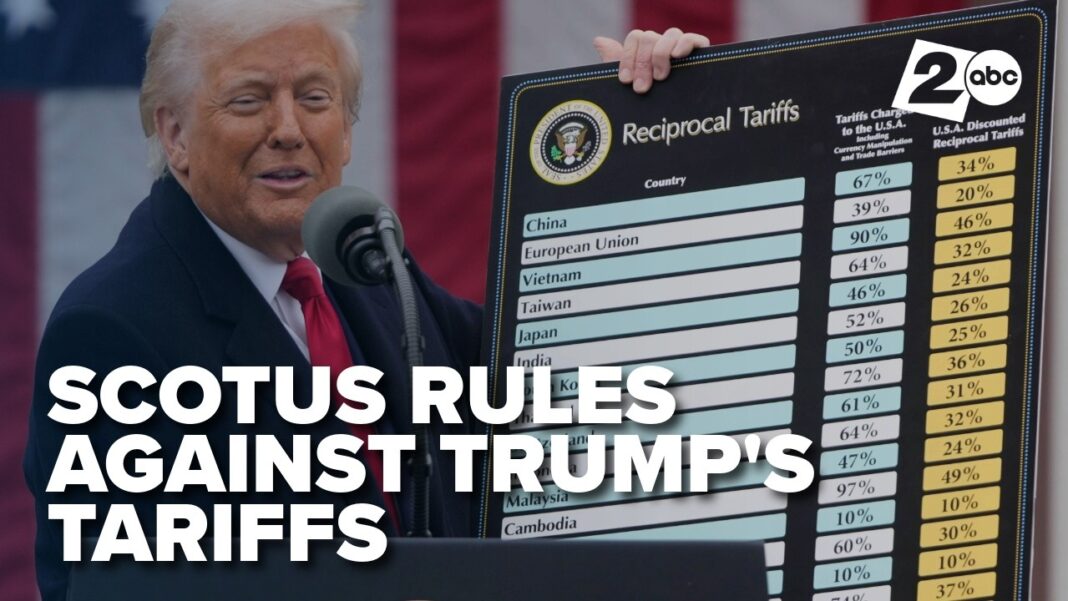


On February 20, 2026, SCOTUS struck down the Trump tariffs, writing, “The Framers did not vest any part of the taxing power in the Executive branch.” Moreover, as expected, the difficult part of the decision, how to refund $133 billion of the taxes illegally imposed, is left unanswered. Justice Kavanaugh noted the process could be difficult.
President Trump has claimed that a Supreme Court ruling that the worldwide tariffs are illegal would place the country on “the brink of economic catastrophe.” Yes, it is a blow to President Trump’s ego, but the bigger problem is that Congress has set up a slush fund to automatically pay for the illegal conduct, along with all the other illegal conduct of the Executive Branch that results in a judgment against the U.S. or a settlement with the U.S.
Any repayment resulting from a court order is paid by the agency collecting the funds, if it has the resources to do so. That process is workable for small judgments. In this instance, the Executive Branch does not have the money. So, in its cavalier manner, the bill will be sent to Congress. Congress pays the bill by appropriating funds from taxation or by imposing more debt on our children. Congress, for decades, has paid for the Executive Branch’s mistakes through the Judgment Fund.
The Judgement Fund.
The Judgment Fund, 31 U.S.C. sec. 1301, is often referred to as the “mother of all slush funds.” It is a permanent, indefinite, and unlimited congressional appropriation that is continuously available to pay money judgments entered against the United States, as well as settlements for cases that are either in litigation or likely to be. The U.S. Congress has established the fund to cover “whatever amount is necessary” to pay for qualifying judgments and settlements. It established this fund so it would not have to concern itself with the tedious paperwork of paying the nation’s bills, even big bills.
Because it is a permanent, unlimited, and indefinite appropriation, the specifics of the amounts being allocated are not debated in Congress. The Department of the Treasury pays these claims as soon as the necessary paperwork is received. Notably, in 2016, President Obama used the fund to deliver $1.7 billion in cash to Iran, the return of $400 million in Iranian assets, and $1.3 billion in interest on those funds.
Over the years, the Judgment Fund has been used to pay for thousands of claims arising from the federal government’s illegal or negligent conduct. Among them were a $1.25 billion discrimination settlement with Black farmers and a $760 million settlement with Native American farmers and ranchers who alleged lending discrimination.
The bizarre aspect of the fund is that it is not publicly accessible and lacks a comprehensive ledger. Moreover, because many records are heavily redacted under the guise of privacy, the public has no clear picture of how much money has been paid out, or to whom. Until 2018, the Judgment Fund even paid harassment settlements for members of Congress, shielding them from personal financial responsibility for their actions.
Must the Congress pay?
Federal courts can issue judgments against the government; however, they cannot compel Congress to pay those judgments. The principle of separation of powers prevents the judicial Branch from directly forcing Congress to appropriate funds. While the Executive Branch can submit judgments against it to Congress for payment under the Judgment Fund, it cannot compel Congress to appropriate more money, unless Congress honors the Judgment Fund Act and finds more money.
What are the potential consequences of leaving these judgments unpaid?
If Congress pays, it adds hundreds of billions in debt to taxpayers to cover the costs of a president’s unconstitutional actions. If Congress refuses to pay, it leaves importers with an uncollectible judgment against a country whose bond ratings have been downgraded several times this year. The most troubling aspect of the Judgment Fund is that it shields government officials from accountability while shifting all costs to taxpayers.
More troubling is that the Judgment Fund obscures the full cost of executive overreach.
Unless Congress restructures the operation of the Judgment Fund to demand transparency and accountability, taxpayers will continue to bear the financial burden of the government’s illegality and mismanagement.
William L. Kovacs, author of Devolution of Power: Rolling Back the Federal State to Preserve the Republic. It received five stars from Readers’ Favorite. His previous book, Reform the Kakistocracy, received the 2021 Independent Press Award for Political/Social Change. He served as senior vice president for the U.S. Chamber of Commerce and chief counsel to a congressional committee. He can be contacted at wlk@ReformTheKakistocracy.com