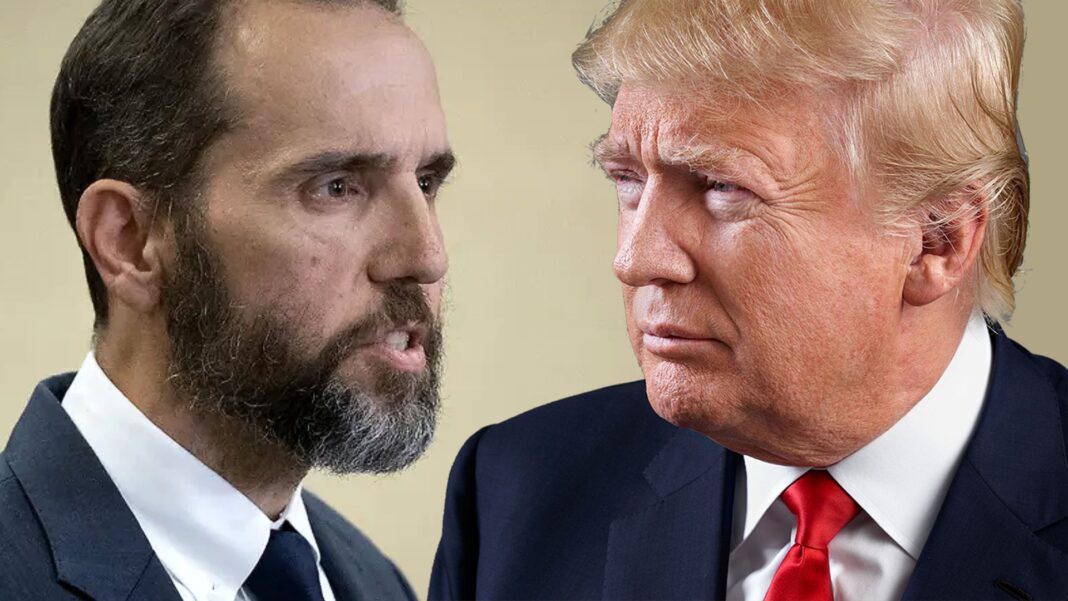


U.S. District Judge Aileen Cannon announced in December that her injunction was set to expire this month.
A federal judge on Feb. 23 said that the final report on President Donald Trump compiled by a former special counsel shall not be released.
U.S. District Judge Aileen Cannon, who is based in Florida, said in a 15-page decision that she was granting requests from Trump and his co-defendants to keep part two of the report from former special counsel Jack Smith shielded from the public.
Cannon said that Smith wrongly forged ahead with investigating Trump and others for allegedly violating federal law by gathering and retaining sensitive documents even after she ruled his appointment was unconstitutional and threw out the case.
“Rather than seek a stay of the Order, or clarification, Special Counsel Smith and his team chose to circumvent it, for months, by taking the discovery generated in this case and compiling it in a final report for transmission to then-Attorney General Garland, to Congress, and then beyond,” Cannon said.
“The Court need not countenance this brazen stratagem or effectively perpetuate the Special Counsel’s breach of this Court’s own order.”
She added later: “While it is true that former special counsels have released final reports at the conclusion of their work, it appears they have done so either after electing not to bring charges at all or after adjudications of guilt by plea or trial. The Court strains to find a situation in which a former special counsel has released a report after initiating criminal charges that did not result in a finding of guilt.”
The Department of Justice (DOJ) had appealed Cannon’s ruling, but dropped the appeal after Trump won a second term in office. The department also released part of Smith’s report just before Trump began his second term.
The other part, which has not been made public, was not to be released, according to a January 2025 order from Cannon.
Cannon announced in December 2025 that her injunction was set to expire in February this year.
Trump and co-defendants said in filings on Jan. 20 that Cannon should permanently block the release of the other part of Smith’s report. Lawyers for Trump said Smith was illegally appointed, and all acts he undertook were thus void, so the release “would constitute an irreversible violation of this Court’s constitutional rulings in the underlying criminal action and of bedrock principles of the separation of powers.”
DOJ officials backed that position.
“Put simply, Smith’s tenure was marked by illegality and impropriety, and under no circumstance should his work product be given the full weight and authority of this Department,” they said in a brief, adding later that making the second part of the report public would “lead to the public dissemination of sensitive grand jury materials, attorney-client privileged information, and other information derived from protected discovery materials, raising significant statutory, due process, and privacy concerns for President Trump and his former co-defendants.”
The DOJ and Trump did not immediately respond to requests for comment on Cannon’s ruling. Smith’s law firm did not return an inquiry by publication time.