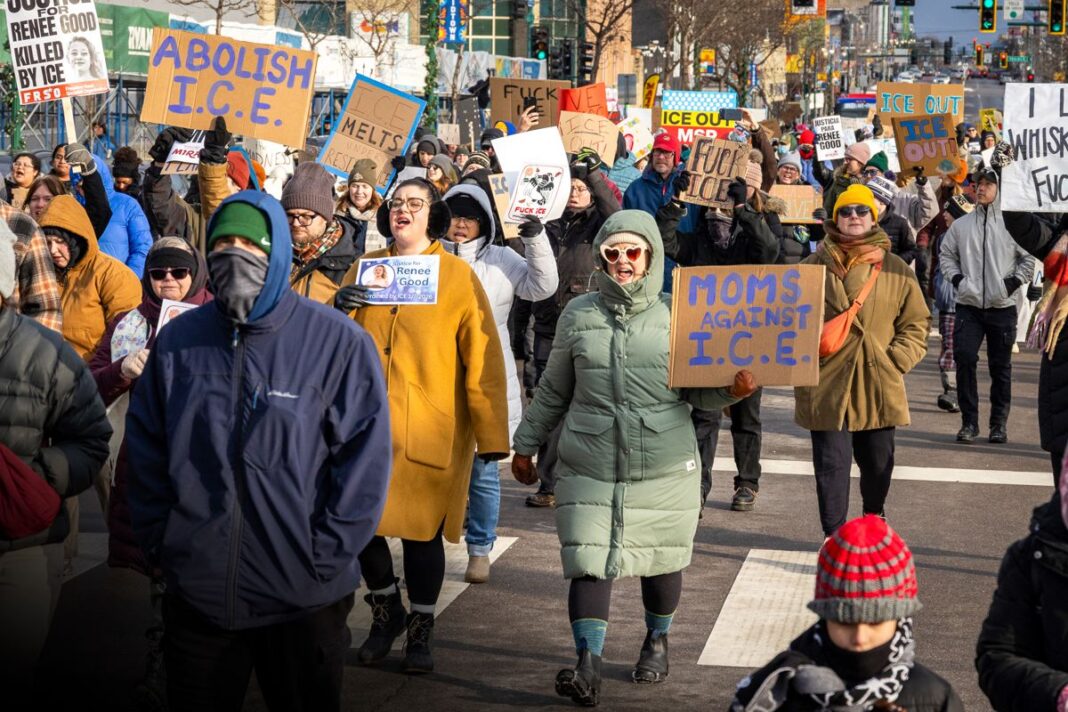


Activist networks are modernizing old insurgency tactics, such as ‘de-arresting,’ an analyst says.
A dark-colored SUV without a front license plate rolls through a neighborhood in St. Paul, Minnesota, putting civilian activists on high alert.
They know that their targets—Immigration and Customs Enforcement (ICE) agents—often drive this type of vehicle.
“They’re on the move,” an activist assigned to “mobile patrol” reports to a “dispatcher.”
The patroller requests “a plate check” and recites the SUV’s license-plate number.
After typing that number into a database of ICE-affiliated vehicles, the dispatcher responds, “No match.”
The motorist drives away, unaware that activists suspected he worked for ICE and were prepared to pounce.
That scenario, which independent reporter Cam Higby posted on X after he infiltrated an online ICE-watch group, happens regularly in Minnesota—the front line of a coordinated effort to thwart federal efforts to detain and deport illegal immigrants.
🧵🚨 MINNEAPOLIS SIGNAL INFILTRATED
— Cam Higby 🇺🇸 (@camhigby) January 24, 2026
I have infiltrated organizational signal groups all around Minneapolis with the sole intention of tracking down federal agents and impeding/assaulting/and obstructing them.
BUCKLE UP ALL WILL BE REVEALED
Each area of the city has a signal… pic.twitter.com/ATSHlCucWv
🧵🚨 MINNEAPOLIS SIGNAL INFILTRATED
— Cam Higby 🇺🇸 (@camhigby) January 24, 2026
Here is more dispatch chatter, where they tweak out when they discover a vehicle. Whistles and horns can be heard in the background.
The dispatcher asks for photos and videos of the plate for “documentation” purposes. pic.twitter.com/Yqhs9PTeE5
Unrest over ICE operations has spread to many other states, with tactics including peaceful protests, warnings to illegal immigrants who may be nearby, and violent grappling with federal agents.
Some activists have inspired, encouraged, or helped to organize walkouts by schoolchildren to protest ICE, drawing concern from parents across the nation.
This large-scale opposition is neither spontaneous nor “organic”; rather, it is a planned disruption that appears to be well-funded, former CIA operative J. Michael Waller told The Epoch Times.
“This is a very, very well-organized movement that goes beyond merely a protest movement,” said Waller, who is a senior analyst for strategy at the Center for Security Policy. He said the movement “fits the definition of an early-stage insurgency.”
FBI Director Kash Patel said investigators have made “substantial progress” in their probe of organized ICE opposition. “We’ve actually found groups and individuals responsible for funding it,” he told podcaster Benny Johnson in late January.
Such investigations have been ongoing since late last year, after President Donald Trump ordered agencies to find the sources that back “domestic terrorism and organized political violence.” He pointed to violent attacks against ICE officers in Los Angeles and Portland, Oregon, which predated the ICE surge that met strong resistance in Minnesota.
Anti-ICE activists frequently describe their groups as “grassroots” or “community-led,” and deny that they’re part of an orchestrated national effort. Some nonetheless admit that a government shakeup—or overthrow—is their goal.
Riot Inc.’
Funding for some ICE adversaries has been traced to a complex web of financiers, including foreigners and people with “documented ties to the Chinese Communist Party,” a witness told senators recently.
The witness, who testified to a Homeland Security subcommittee, was Seamus Bruner, who has worked on books alleging high-level bribery by Democratic officials. He is vice president of the Government Accountability Institute, whose independent researchers track political-influence networks. They found at least $60 million was sent to more than a dozen anti-ICE activist groups in Minnesota and across the nation, Bruner testified on Feb. 10.
The Epoch Times was unable to obtain the institute’s data for review.
Bruner said the money is funneled to ICE opponents from massive left-wing nonprofits. It flows through channels that hide the identities of donors, helping them “evade accountability” while also creating “the illusion of spontaneous public outrage,” he alleged.
This “professionalized protest-industrial complex,” in which instability serves as a political tool, is a phenomenon that Bruner called “Riot, Inc.” in his testimony.
He urged senators to expose and disrupt these networks.
“The United States cannot afford to treat this as coincidence or chaos,” he said.
Progressive organizations such as Media Matters for America have pushed back against allegations that the groups are coordinated.
“Some right-wing media figures baselessly claimed that foreign actors or governments are somehow behind the protests,” Media Matters wrote on its website last month.
The group accused critics of searching for a “bogeyman” to blame.
Outsiders Plus Locals
Minnesota state Rep. Pam Altendorf told The Epoch Times that while many local people have joined ICE-opposition groups, she believes outside agitators are coming into her state, too.
“It’s being almost staged,” she said, noting that agitators seem to purposely be “putting themselves in situations to cause these reactions, and then they use these little clips … to keep on fueling the fire and fueling the rage.”
Constant beratement, threats, and even physical attacks keep immigration agents rattled, setting them up for miscues, she said.
“They’re on the verge of being pushed to a breaking point,” she said. “And when a crisis happens, like a shooting, then everybody says, ‘See, they’re out of control.’”
In Pursuit of ‘Revolution’
In Pursuit of ‘Revolution’
Nationwide, networks are recruiting, training, and mobilizing anti-ICE activists; they also manage media relations and enlist legal aid, their websites show.
Generally, these groups express a shared goal: Stopping immigration-enforcers from making arrests, which activists routinely call “kidnappings” or “abductions.”
Several ICE-opposing organizations also openly crusade for a bigger result: political revolution against Trump.
Revolutionary Communists of America wrote in a March 2025 statement on its website that it is trying “to build a communist party that can lead the working class to power, tearing down not only Trump but also the liberals and the entire capitalist system.”
Socialist groups have espoused similar aspirations in recent months.
A youth-led activist group, Sunrise Movement, wants Trump “kicked out of power,” said Aru Shiney-Ajay, a Minnesotan who serves as its executive director.
In the meantime, Sunrise Movement is trying to make Trump’s actions “backfire” this year, Shiney-Ajay said during a Jan. 28 online meeting about ICE-opposition efforts.
Old Tactics, New Tech
Anti-ICE groups’ methods mirror those used by insurgents around the world for decades—but supercharged with new technology.
“It’s all really old tactics that are just modernized for the digital age,” Waller said. “The battle is being fought in the digital sphere. That’s where people are going to get riled up, both to join the insurgency and to become radicalized.”
Waller said he has closely followed the work of Higby and others who are mounting an online counterattack.
Although a number of tactics were unknown to outsiders until Higby reported on them, some activists have disclosed considerable information.
Upon confirming an ICE presence, activists send out electronic messages summoning protesters or “rapid responders” to come to the scene.
St. Paul City Councilmember Hwa Jeong Kim has served in that role. She allowed an Axios journalist to report on her rapid-response duties one day in late January.
“Constitutional observation is, in my mind, a type of nonviolent, peaceful protesting,” Kim told Axios.
After arriving at ICE scenes, rapid responders honk car horns and blow whistles. Those sounds warn potential immigration enforcement targets to stay away while protesters spill into the streets and use their cellphones to record officers’ actions. Activists believe that the commotion may deter agents from taking more people into custody, Kim told Axios.
“Trained legal observers” video-record ICE interactions. Some activists may then post the footage online. The footage also could become evidence in court cases.
Meanwhile, activist networks gather information on ICE agents and their vehicles; some make the information public, a practice known as “doxxing” that can lead to threats and actual attacks against the officers.
Physical Tactics Include ‘De-Arresting’
Sometimes, activists use vehicles or their own bodies to block ICE agents or even assault them.
Homeland Security has reported that increasing numbers of vehicles are being used to attack ICE and U.S. Customs and Border Protection personnel. That escalation began shortly after January 2025, when Trump launched an illegal-immigration crackdown as a cornerstone of his second presidency.
Anti-ICE forces also have targeted independent reporters, including Higby. On Jan. 12, he was with fellow reporter and influencer Nick Sortor when activists surrounded their Jeep, spray-painted it, smashed its windows, and threatened them; Sortor called 911 and drove away.
Some activists, if given the chance, may try to free a suspect that ICE has caught. That practice, known as “de-arresting” or “un-arresting” someone, dates to the 1960s. Its use became more organized under Antifa and anarchist “black bloc” movements in the 1980s.
Techniques can include opening car doors to release arrestees, grabbing the arrested person, or “pulling and pushing” an officer to break his grip, according to a “De-Arrest Primer” posted on an anarchist blog.
That primer, dated 2024, was used during a recent New York City training of anti-ICE activists, said Manhattan Institute investigative analyst Stu Smith. He posted a video and photo from the training on X.
Hidden Methods Exposed
In a newer twist to their methods, activist networks are using encrypted messaging apps such as Signal to keep communications secret.
Higby’s posts show videos and screenshots of Signal chats, revealing how activists track ICE, send out alerts, and assign disruptors to various roles. Organizers frequently delete messages and start new daily chats to avoid detection, he reported.
In addition, anti-ICE groups are using a method established in the military to standardize how they report on ICE. The mnemonic, SALUTE, stands for “Size, Action, Location, Uniform, Time (Date), Equipment.”
That procedure and others used in the Signal groups are outlined in a “best practices” guide available online; its authorship is undisclosed, but The Epoch Times found that multiple activist groups linked to versions of it.
Many ICE-watching Signal groups exist in Minnesota, each with up to 1,000 members, Higby reported in a viral Jan. 24 video that drew more than 23 million views on X and prompted the FBI to launch an investigation.
In response to Higby’s findings, retired Green Beret Eric Schwalm of Georgia wrote on X: “When your own citizens build and operate this level of parallel intelligence and rapid-response network against federal officers … you’re no longer dealing with civil disobedience.”
“The most sobering part?” he continued. “It’s domestic. Funded, trained (somewhere), and directed by people who live in the same country they’re trying to paralyze law enforcement in.”
Schwalm also wrote an article on X describing a “seismic shift” in protesters’ tactics.
“These aren’t the stationary rallies or sit-ins of past movements like Occupy Wall Street or even the 2020 Black Lives Matter marches,” he wrote.
Instead, he said, civilian activists are using “tactics that echo” those that special forces use.
And, he said, a group called States at the Core launched a hub in 2024 to support anti-ICE efforts. The organization now has spread across more than 20 states. It holds frequent training sessions that may draw more than 1,000 online attendees apiece.
The group has learned to strategically escalate its actions while staying “legal yet effective,” Schwalm wrote. “By bordering on interference,” the activists deter or delay ICE operations, he said, saying they have formed “credible, measured forces building resilient cadres.”
‘Insurgents’ or ‘Defenders’?
Critics refer to some aggressive, organized anti-ICE activists as “agitators,” “insurgents,” or “insurrectionists.”
Supporters call them “protectors,” “defenders,” or “resisters.” Some even call anti-ICE forces “abolitionists,” likening ICE immigration sweeps to patrols that scooped up fugitive slaves before the United States abolished slavery in 1865.
Regardless of how its players are labeled, the current anti-ICE movement has become significant in size, scope, and influence.
Defend the 612, named after a Minneapolis area code, states that “hundreds of thousands” have joined its mission to oust ICE from Minnesota.
But a U.S. government counter-insurgency guide cautions: “Insurgents may be deliberately deceptive of their goals, support levels, and strength.”
The guide from the Joint Chiefs of Staff states that insurgents also may lie about “abuses by counterinsurgents and mask their own,” and that “Stated insurgent policies and platforms may be deceptive as well.”
Shiney-Ajay said during her late January online meeting, “Five percent of every neighborhood in Minneapolis is currently in a Signal chat organizing for ICE patrols.”
She added that about 200,000 people joined an ICE-watch training following outrage over federal agents fatally shooting two 37-year-olds, Renee Good and Alex Pretti, in January.
Good and Pretti, both protesters and U.S. citizens, were shot and killed in two separate confrontations with federal officers attempting to arrest immigration-law offenders.
The Epoch Times was unable to independently verify published reports alleging that the pair were trained ICE-watchers.
Service Providers Targeted
Shiney-Ajay said ICE-opposition training sessions are being conducted “constantly” and that people are being taught to “target the institutions that are upholding ICE.”
These include the hotels, rental-car agencies, restaurants, and food-delivery services that ICE agents use, she said.
“Those are all things that ordinary people have control over,” Shiney-Ajay said, urging people to refuse service to agents or take action against service providers.
Addressing ICE, she said, “We’re not going to stay home in our houses when you grab our neighbors.”
Shiney-Ajay said Sunrise Movement hopes to expand its “No Sleep for ICE” campaign nationwide. That initiative calls for activists to make a ruckus outside hotels where ICE agents are believed to be staying.
In Minnesota, some hotels responded by evicting ICE agents or closing temporarily; several were vandalized.
Dilemma for Trump Administration
If the Trump administration adopts an attitude of “let’s just leave Minnesota to the Minnesotans” and bails out, “it is a retreat, and it gives the insurgents a victory,” Waller said.
But if the administration says “we’re going to enforce federal law, regardless of what the local authorities say,” that sets the stage for tensions to persist or escalate, he said.
“[Thus,] after someone is killed, the public typically responds with anger toward the government,“ Waller said, noting that some reports used terms like ”a mom“ and ”a nurse” to describe Good and Pretti after they were fatally shot in January.
“But, of course, these people are more than just moms and nurses,“ he said. ”They’re actual committed agitators, right?”
Savannah Hulsey-Pointer contributed to this report.
By Janice Hisle