

An injured aviator, decoy rescue operations, and the ‘no man left behind’ credo were all part of the daring extraction.
President Donald Trump was assured by the Pentagon and Central Intelligence Agency that the assembled array of special forces, precise intelligence, high-tech electronics, and battle-tested aircraft could extract a wounded U.S. airman being hunted deep inside Iran, but was cautioned that it would be risky and could go sideways in a hurry.
It was his trigger to pull, they said. His call.
“A risky decision,” Trump said. “We could have ended up with 100 dead, as opposed to one or two—a hard decision to make.”
But in the end, the choice was clear.
“In the United States military,” the president said, “we leave no American behind. We don’t do it.”
During an April 6 White House press conference, Trump recounted how “one of the largest, most complex, most harrowing combat searches … ever attempted” was orchestrated, serving as a narrator still buzzed by what he had watched unfold as it was happening early on April 5 in Iran.
“As commander in chief, I never forget the extraordinary risk taken by the warriors that we send into battle,” he said.
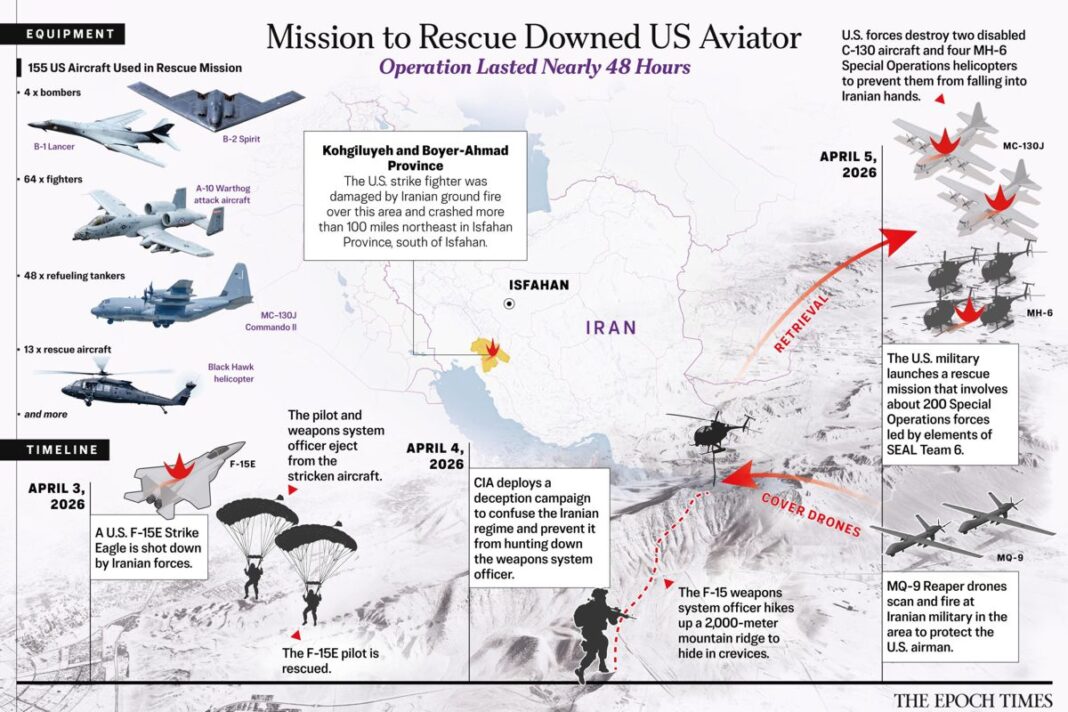
Less than 80 hours earlier, on April 3, an F-15E Strike Eagle had been damaged by ground fire over Kohgiluyeh and Boyer-Ahmad Province and crashed more than 100 miles northeast in Isfahan Province, south of the city of Isfahan, where there was a large Iranian military presence.
One man was rescued. One man was missing.
There was now only one mission.
First Rescue
After more than 13,000-plus U.S. combat sorties over Iran since Feb. 28, a “Golden BB” shot fired by what analysts believe was a visually sighted, shoulder-fired surface-to-air missile found its mark.
The F-15, from the 494th Fighter Squadron of the 48th Fighter Wing—the Statue of Liberty Wing—based in RAF Lakenheath in England, was the first U.S. fixed-wing fighter to be knocked from the sky by enemy fire since an A-10 was shot down over Baghdad in April 2003.
Later that same day—on April 3, Good Friday, two days before Easter—an A-10 would be damaged by enemy fire and crash, with the pilot safely ejecting into Kuwait.
The F-15’s pilot and systems weapons officer both safely ejected but were dispersed, one waiting a few seconds after the other in parachuting to earth as trained to do.
“They want to always go as far away from the site of the shoot-down … because [the enemy] head right to that site,” the president said, noting “even if you go out two or three seconds later,” parachuting airmen land “miles and miles away” from each other “because you’re going fast.”
The immediate response by in-theater commanders and Central Command in Tampa, Florida, was muscle memory—standard protocol for a downed aircraft in a combat zone.
“Within hours,” Trump said, “our armed forces deployed 21 military aircraft into hostile airspace, many flying at very low altitude, being shot by bullets.”
This first wave of forces rescued the pilot “from enemy territory [with] an H-60, a Jolly Green 2 helicopter,” exchanging gunfire “at very close range,” the president said.
All for One
But the weapons systems officer, who handles the craft’s radar and targeting electronics from a cockpit seat behind the pilot, remained on the ground, and the Iranians were frantically looking for him, offering the equivalent of a $66,000 reward for his capture.
Nevertheless, the CIA always knew the whereabouts of the aviator, who Trump described as a “highly respected colonel,” an unusually high-ranking officer for a combat mission; the squadron’s commanding officer is a lieutenant commander.
In addition to tracking the aviator by his own intermittent signals, the agency had also been monitoring him with a classified device—an unnamed “very sophisticated beeper-type apparatus,” as Trump described it.
The officer had been bloodied and sprained his ankle, but he managed to climb into a mountainside cleft below a 7,000-foot ridge. MQ-9 Reaper drones circled above, at one point ripping into Iranian forces less than two miles away, according to Air & Space Forces Magazine.
“He scaled cliff faces, bleeding rather profusely, treated his own wounds, and contacted American forces to transmit his location,” the president said.
The CIA also kept tabs, relaying the airman’s location to the Pentagon while engaging in fake relays and dispatches between phantom rescuers, claiming that he had been retrieved and was being ferried out of Iran in a convoy. It was an “unconventional assisted recovery,” as the agency described it, perhaps in collaboration with “civilians willing to assist.”
Meanwhile, Pentagon planners went to work. The Air Force had “gamed out” a very similar search-and-rescue scenario in 2023 in Wyoming.
Central Command assembled two MC-130Js and sighted a primitive airstrip in a rural farming area—what Iranians would later say was an “abandoned airport”—as a forward arming and refueling point where helicopters or aircraft could clandestinely wait while the airman was hauled off the mountain.
The airstrip was south of Isfahan, the hub of Iranian nuclear development, ringed by army installations, missile sites, and airbases that, at least before the war, featured F-14 Tomcats—leftovers from pre-revolution Iran but still a threat.
A commando team was readied. The force included the Army’s 160th Special Operations Aviation Regiment and the Air Force’s 427th Special Operations Squadron. Some reports say SEAL Team 6, others say Delta Force, added muscle.
“We immediately mobilized a massive operation to retrieve him from the mountain,” Trump said, noting that more than 200 special forces and 155 aircraft, including four bombers, 64 fighters, 48 refueling tankers, 13 rescue aircraft, and more, were engaged.
Rescuers didn’t concentrate around the aviator.
“We wanted to have them think he was in a different location, because they had a vast military force out there, thousands of people were looking,” the president said. “So we were scattered all over … seven different locations. They were very confused. They said, ‘Well, wait a minute. They’ve got groups here. They’ve got groups there.’”
While some initiated diversionary firefights, distracting noisemakers to confuse Iranians, the wounded officer was snatched and swiftly moved to the makeshift airstrip—likely by one of several A/MH-6 Little Bird helicopters carted in parts within the MC-130s and assembled on site by special forces.
“If you see it, you wouldn’t believe it,” Trump said. “They came off the plane. And these guys had them, the rotors were off. They rebuilt these helicopters in less than 10 minutes, and that was one of the more amazing things. These are helicopters, small and unbelievably powerful. … The genius of these people.”
One for All
But the rescue hit a snag: sand.
The heavy MC-130s were stuck in sand. Like the April 1980 failed hostage rescue attempt, which was foiled in part by swirling sand that forced some helicopters and planes to turn back, sand was imperiling this mission. Moscow has winter; Iran has sand.
“We had a contingency plan, which was unbelievable, where lighter, faster aircraft came in, and they took them out,” Trump said. “We blew up the old planes. We blew them up to smithereens, because we had equipment on the planes that, frankly, we’d like to take, but I don’t think it was worthwhile spending another four hours there taking it off.”
Much remains undisclosed, but two things are certain about the mission and about the man, the president said.
“In a breathtaking show of skill, precision, lethality, and force, America’s military descended on the area, engaged the enemy, rescued the stranded officer, destroyed all threats, and exited Iranian territory while taking no casualties of any kind,” he said.
The officer had evaded capture by Iranian forces for almost 48 hours. “That’s a long time when you’re in tough shape and when you’re bleeding,” Trump said.
But it was never about one man. It was always about the 1.34 million Americans now serving their nation in the armed forces: If you fall, we will come for you.
“We have incredibly talented people, and if the time comes, we move heaven and earth to bring them home safely,” the president said. “We thank God for every single one of them.”