

What the long timeline of U.S.–Cuba relations reveals about current dynamics, as tensions ramp up amid daily blackouts, U.S. pressure, and ongoing negotiations.
In the more than 125 years since the United States helped liberate Cuba from Spanish rule, the relationship between the two countries has shifted from close economic and military ties to ideological hostility, economic sanctions, and isolation.
As Cuba faces one of its most severe crises in decades, questions about the island’s future and the possibility of a U.S.-backed regime change have once again come to the spotlight.
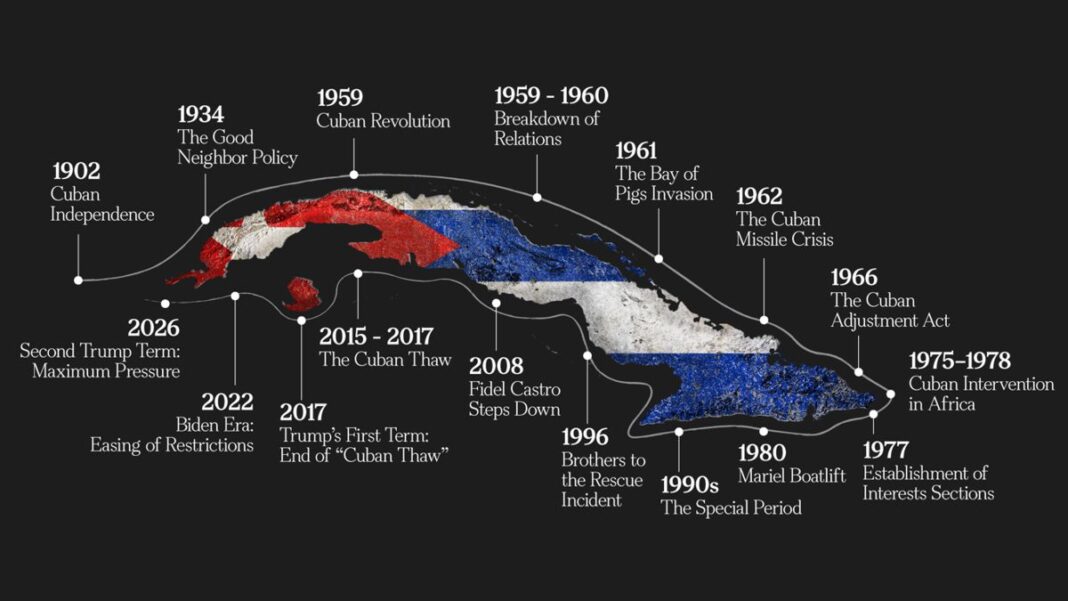
Here is a timeline of key moments that have shaped U.S.–Cuba relations since 1898.
Cuban Independence, 1902
In 1898, the United States intervened in Cuba’s war for independence against Spain, helping bring an end to more than four centuries of Spanish colonial rule on the island.
The intervention followed the explosion and sinking of the USS Maine in Havana Harbor on Feb. 15, 1898. While the cause of the explosion remains disputed, the incident intensified U.S. calls for action. The Spanish–American War began in April that year, and U.S. forces defeated Spain in less than four months. As a result, Spain relinquished sovereignty over Cuba.
After a brief U.S. military occupation, Washington granted Cuba formal independence in 1902. As a condition of ending the occupation, the U.S. government required Cuba to adopt the Platt Amendment into its constitution. The amendment granted the United States the right to intervene in Cuban affairs to defend the island’s independence and lease 45 square miles of land and water at Guantánamo Bay for its coaling and naval stations.
The Good Neighbor Policy, 1934
In May 1934, President Franklin D. Roosevelt abrogated the Platt Amendment by signing the Cuban–American Treaty of Relations, as part of his “Good Neighbor” policy toward Latin America. FDR focused on cooperation and trade instead of using military force to keep the region stable.
Even after the Platt Amendment ended, the United States kept its permanent lease on the Guantánamo Bay naval base. In 1934, the yearly lease payment rose from $2,000 in gold coins to $4,085 in U.S. dollars.
Cuban Revolution, 1959
On Jan. 1, 1959, Fidel Castro’s guerrilla movement overthrew U.S.-backed dictator Fulgencio Batista. Castro then assumed leadership of Cuba and remained in power until 2008.
The United States initially recognized the new government. Throughout 1959, Castro publicly denied being a communist.
Just four months after the revolution, the 33-year-old leader traveled to the United States for an 11-day goodwill tour. President Dwight D. Eisenhower declined to meet him, choosing instead to leave for a golfing trip in Georgia. Instead, Vice President Richard Nixon hosted Castro for a meeting lasting nearly 2 1/2 hours.
“He is either incredibly naive about Communism or under Communist discipline—my guess is the former,” Nixon concluded after his meeting with Castro.
Castro’s visit attracted a lot of media attention, with reporters repeatedly questioning him about communist infiltration within his government. Despite his broken English, he gave many interviews and public remarks denying the speculation. On NBC’s “Meet the Press,” for example, he stated he was not a communist and did not agree with communist ideology.
By Emel Akan