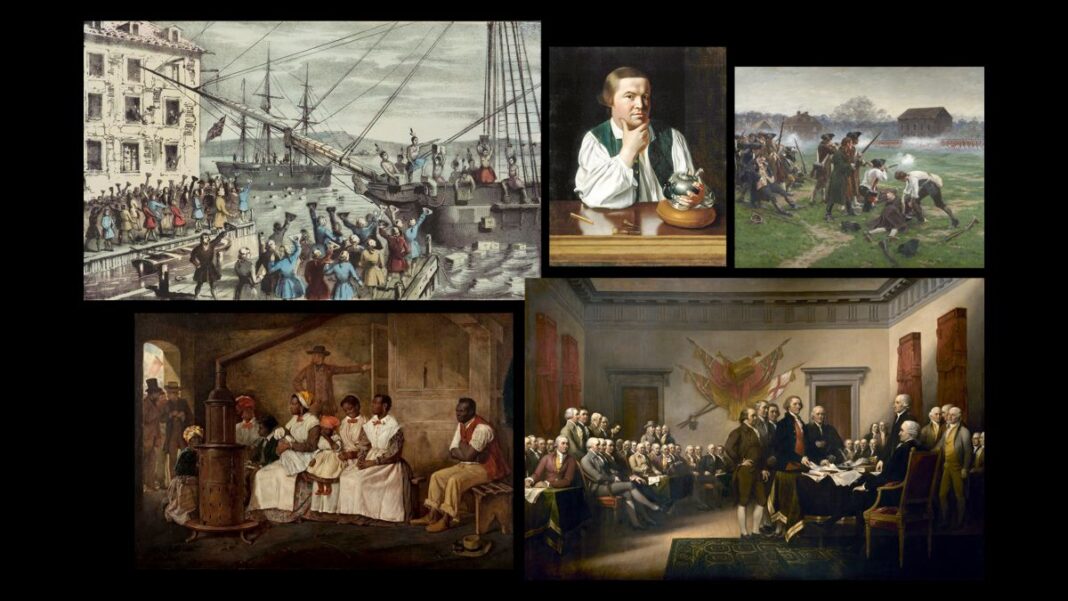


Popular beliefs collide with historians’ accounts of how the Boston Tea Party, Paul Revere’s ride, and ’the shot heard ‘round the world’ really played out.
As America celebrates its 250th birthday, it’s prime time for historians such as Jeff Bloodworth to set the record straight.
Bloodworth, a professor at Pennsylvania’s Gannon University, noted that it had become trendy among historians to “demythologize” the Founding Fathers.
“But it has gone too far,” he told The Epoch Times. “The achievements of the founders and the founding are obscured by the lists of sins.”
Now, he thinks “the pendulum is swinging back” toward a more balanced, nuanced, and accurate view of the founders—and about other aspects of American history.
Through his role with Heterodox Academy—a bipartisan group advocating for open inquiry on college campuses—Bloodworth said he sees “there’s a real pushback against this stuff.”
Any fair appraisal of the founders requires “lauding their achievements but also recognizing their omissions and their flaws and their hypocrisies,” he said.
Bloodworth and two other historians who spoke to The Epoch Times shed light on myths, misrepresentations, and misunderstandings about the nation’s foundational period; The Epoch Times also reviewed dozens of historic references for this story.
Without historical knowledge, it’s easy to “get sucked into believing things have never been worse, that there’s never been a time like this—and that just isn’t true,” Bloodworth said.
Stanley Schwartz, a professor at Cedarville University in Ohio, echoed many of Bloodworth’s observations.
When students question how early American history relates to them, he responds that issues the founders faced remain relevant. Those include “how to govern well,” he said, along with “how to relate to foreign powers.”
Many students who expected to be bored in class end up realizing that history “speaks to a person, helps you find your roots, find your place in the world,” Schwartz said.
Anna Vincenzi, a professor at Hillsdale College in Michigan, said learning about America’s history fulfills “a deeply human need … to know the truth about where we came from.” That knowledge helps people understand “the good things about the history that has brought us here, and also the origin of the problems.”
By Janice Hisle