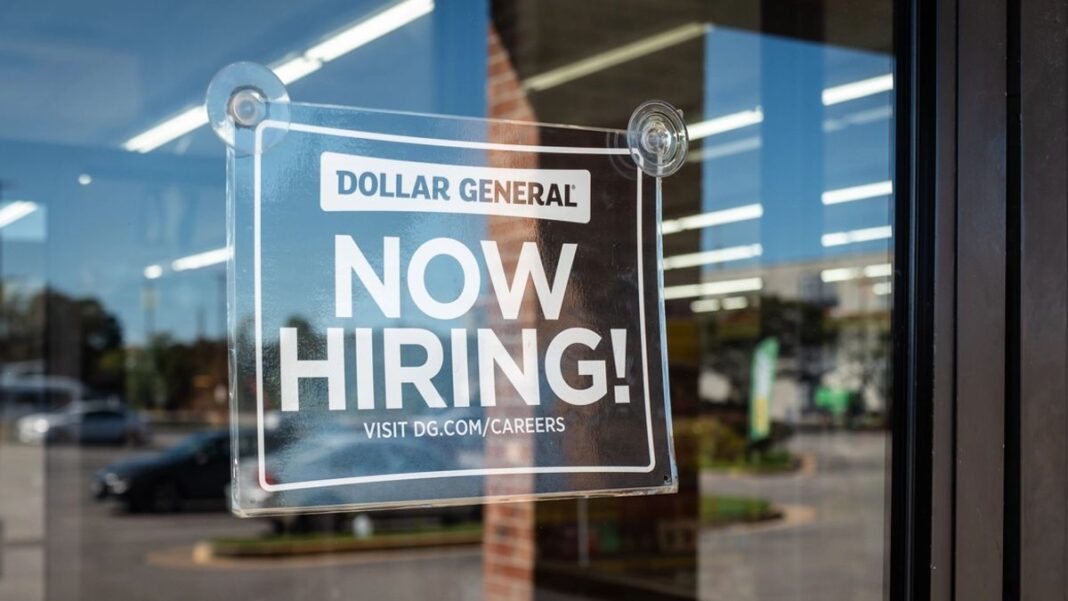


Professional and business services lead June’s employment gains.
Hiring momentum cooled sharply in June as the economy added fewer jobs than expected.
Employers added 57,000 new jobs last month, from May’s 129,000 gain, according to new data from the Bureau of Labor Statistics released on July 2.
The consensus forecast had penciled in a gain of 110,000.
The unemployment rate unexpectedly slipped to 4.2 percent, from 4.3 percent, also coming in below economists’ estimates.
This was largely driven by a dip in the labor force participation rate, which fell 0.3 percentage points to 61.5 percent.
Changes to employment dynamics—less immigration and lower workforce participation—are widely expected to keep the jobless rate subdued amid a low breakeven rate.
Following the weather-driven two-month volatility to kick off the year, employment conditions had substantially improved heading into the summer. Layoffs remained low and labor demand kicked into high gear as companies shrugged off various headwinds.
Job growth was driven by professional and business services (36,000) and social assistance (25,000). Health care payrolls also climbed by 22,000.
Leisure and hospitality shed 61,000 positions, “reflecting weaker than usual seasonal hiring,” the bureau said. This partially reversed the sector’s employment gains in recent months, fueled by the World Cup.
The private sector accounted for almost all of June’s payroll growth, with government jobs increasing by just 8,000.
Revisions were also sizable, with April and May’s nonfarm payrolls adjusted lower by a combined 74,000.
Wages were little changed in June as average hourly earnings rose 0.3 percent month-over-month and ticked up to 3.5 percent year-over-year. Both readings were in line with consensus estimates.
Upward inflationary pressures over the last few months have eroded workers’ earnings. The federal agency reported that real (inflation-adjusted) average hourly and weekly earnings slid 0.1 percent and 0.2 percent, respectively, from April to May.
But cooling price pressures amid stabilizing global energy markets could slow the trend.
Average weekly hours, meanwhile, were also flat at 34.3. The number of people employed full-time declined by 514,000 full-time, while part-time jobs were little changed.
More people took on an additional position in June, with the total number of multiple jobholders climbing by more than 120,000 to 8.554 million.
Since the monthly jobs report was released one day earlier due to the Fourth of July long weekend, it coincided with the latest weekly unemployment claims.
Initial jobless claims—the number of Americans filing applications for unemployment benefits—fell by 1,000 to 215,000 for the week ending June 27, also coming in below the market forecast. Continuing jobless claims—the number of out-of-work individuals receiving benefits—was flat at 1.814 million.
By Andrew Moran