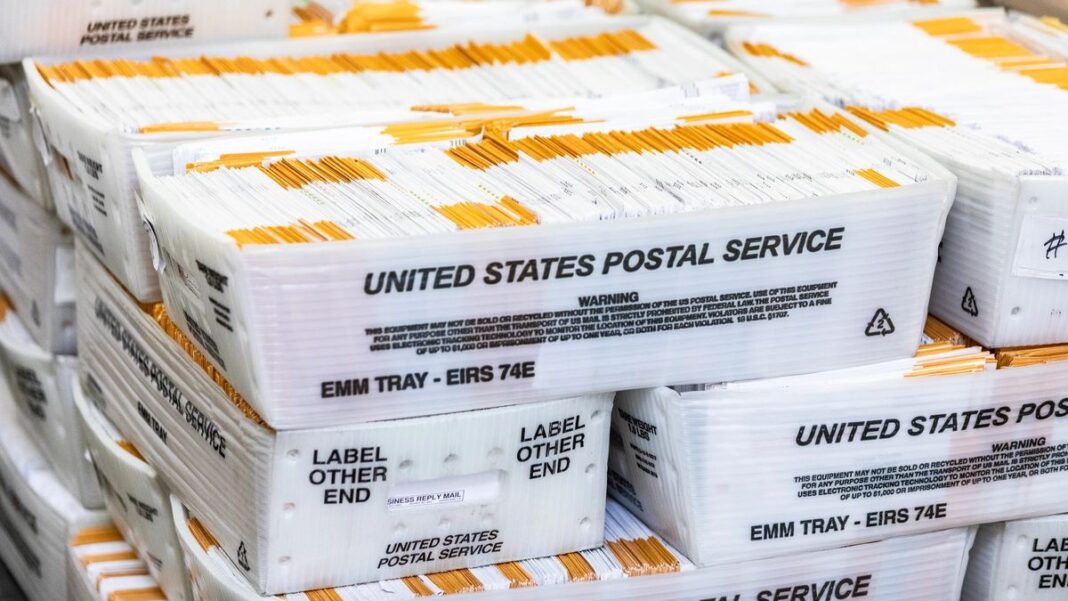


The Trump administration said the rule would improve ballot tracking and verification, but the court found it conflicted with a USPS election-mail settlement.
A federal judge on Wednesday blocked the U.S. Postal Service from implementing a Trump administration proposal to boost election integrity by enhancing ballot tracking and verification, finding it conflicted with a 2021 settlement requiring the agency to prioritize the timely delivery of election mail.
U.S. District Judge Emmet Sullivan ruled on July 1 that USPS could not move forward with the proposed rule, which would have required states using the mail for federal absentee and mail-in voting to adopt standardized ballot envelopes with trackable barcodes and provide USPS with voter participation lists to make ballot verification easier. Ballot mailings that failed to comply would have been rejected.
One day after the proposed rule was published in early June, the National Association for the Advancement of Colored People (NAACP) returned to court in a long-running lawsuit originally filed during the 2020 election, asking Sullivan to enforce a 2021 settlement that requires USPS to prioritize the monitoring and timely delivery of election mail through the 2028 election cycle.
The proposed rule stems from President Donald Trump’s March executive order directing USPS to develop new standards for handling federal ballot mail as part of a broader thrust to bolster election integrity.
The Justice Department, which represented USPS in the case, did not respond to a request for comment before publication.
Rule Boosts Election Integrity, DOJ Says
In opposing the NAACP’s motion, the Department of Justice (DOJ) argued in a court brief that the proposed rule was designed to improve—not hinder—the handling of election mail.
Attorneys representing the Trump administration wrote that requiring standardized Election Mail logos and Intelligent Mail barcodes would make ballots easier to identify throughout the postal network. They argued this would allow USPS to better monitor the movement of mail-in ballots and help implement the “extraordinary measures” USPS has traditionally used to expedite election mail before federal elections.
“Such requirements promote the ’monitoring and timely delivery of Election Mail’; they do not frustrate it,” they wrote in the brief. “And while the Postal Service has proposed requiring state and local election officials to identify the names and addresses of the persons to whom they send ballots and to provide the barcodes for the ballot envelopes, requiring this information—which officials already, by definition, have—would not compromise the lawful delivery of any mail.”
By Tom Ozimek