

Analysts say Trump’s speech reflects renewed focus on strategic competition with Beijing and could affect Xi Jinping’s standing at home.
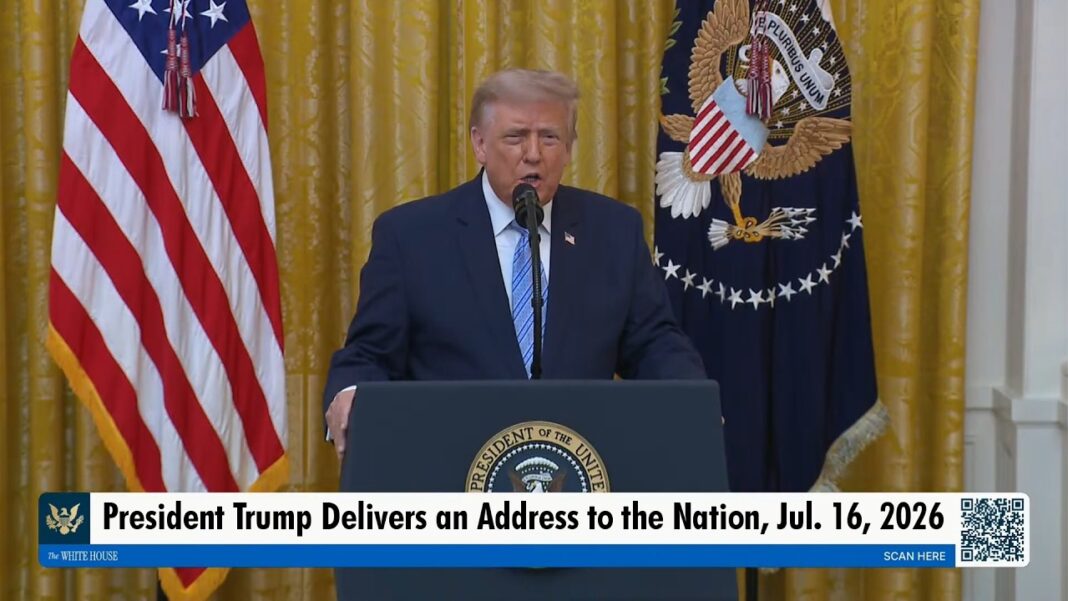
President Donald Trump on July 16 said in a primetime address that the Chinese Communist Party (CCP) has been meddling in American elections, revealing that Beijing obtained hundreds of millions of American voter records and used domestic and international networks in an effort to prevent his reelection.
He said the CCP had acquired the personal information of approximately 220 million American voters during the 2020 election cycle and suggested the data could have been used for voter registration-related activities or other unlawful purposes.
Trump also said that Beijing had conducted influence operations targeting his presidency since 2018, including efforts to weaken his electoral support, pressure him to step down, and prevent him from winning another term.
The president said U.S. intelligence agencies had concealed information about Chinese election interference. He said that dozens of reports from the CIA and the National Security Agency (NSA) concerning Beijing’s activities had not been included in daily intelligence briefings provided to the president.
Trump has directed the Office of the Director of National Intelligence and the Department of Justice to investigate the matter. He said officials found to have covered up relevant information would be removed and could face criminal charges.
These disclosures represent some of Trump’s most direct accusations against Beijing regarding American election interference and come amid renewed debate in Washington over the long-term direction of U.S.–China relations.
Several experts, including prominent Chinese dissident scholar Yuan Hongbing, said Trump’s remarks could signal a tougher phase in Washington’s approach to Beijing, while also complicating Xi Jinping’s efforts to leverage his relationship with Trump as a source of political capital inside the Chinese regime.
Strategic Competition
Yuan, a Chinese dissident and former law professor at Peking University now living in Australia, told The Epoch Times that Trump’s remarks should be viewed within the broader evolution of U.S. policy toward Beijing.
According to Yuan, Trump helped end decades of U.S. engagement with the Chinese regime during his first term, as policymakers increasingly viewed the CCP as America’s primary long-term strategic challenge.
Yuan said Trump’s public tone toward Xi had become more conciliatory after returning to office because the administration initially hoped Beijing might assist in addressing broader geopolitical issues, including the war in Ukraine and instability in the Middle East.
However, Yuan said those expectations have largely failed to materialize as China continued strengthening ties with Russia, Iran, North Korea, and other U.S. adversaries.
“His vision of making America great again is fundamentally incompatible with the CCP’s ambitions for global expansion,” Yuan said. “It is in this context that Trump delivered this speech.”