

The emergency application comes after a federal appeals court held that the president’s executive order would confuse and possibly disenfranchise voters.
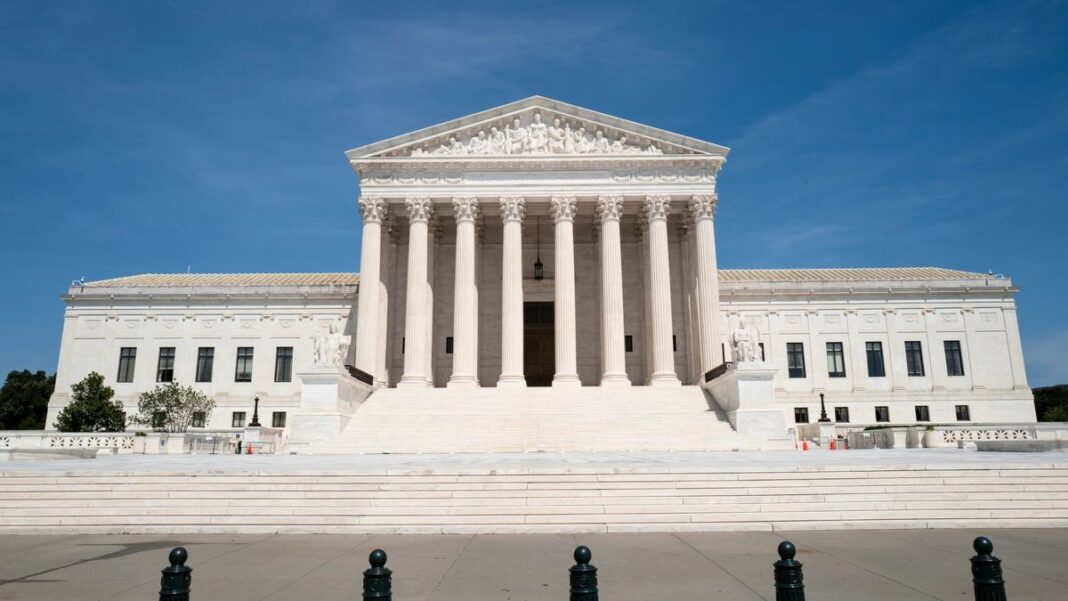
President Donald Trump asked the U.S. Supreme Court on July 27 to lift a lower court order blocking key parts of his executive order restricting voting by mail.
The Epoch Times obtained a copy of the new emergency application in Trump v. State of California, in which the federal government argues that the lower courts ruled incorrectly.
Trump’s executive order 14399, dated March 31, aimed to tighten mail-in voting rules in 23 Democratic-led states and the District of Columbia, which challenged it in court.
In June, Judge Indira Talwani of the U.S. District Court for the District of Massachusetts ruled that parts of the order were beyond the president’s power and blocked its enforcement in those jurisdictions.
The ruling applies only to the jurisdictions that sued, including California, Massachusetts, Maryland, Arizona, Maine, and New Mexico.
Specifically, the judge blocked Section 2, which directs the U.S. Department of Homeland Security (DHS) from compiling lists of voting-age U.S. citizens in each state, and Section 3, which directs the U.S. Postal Service (USPS) to develop standards for mail-in and absentee ballots to be used in federal elections.
Section 2 is an attempt “to intimidate local election officials to use the necessarily incomplete … lists as a resource, lest they face criminal prosecution,” Talwani wrote.
The judge said Section 3 could not stand because “no law enacted by Congress delegates authority to control mail-in voting to USPS.” The postal service does not have statutory authority to finalize “any binding regulations on mail-in voting.”
On July 25, the U.S. Court of Appeals for the First Circuit upheld Talwani’s order.
A majority of the First Circuit judges held that if the executive order were to take effect “for the elections taking place in September and November, it would sow confusion and threaten disenfranchisement of many eligible voters.”
The ruling dealt a blow to Trump’s election-integrity efforts ahead of the November midterm elections as Republicans try to hold on to slim majorities in both chambers of Congress.
In the new application, U.S. Solicitor General D. John Sauer said Talwani’s injunction was premature.
“[The Supreme Court] has repeatedly and recently recognized that courts cannot enjoin implementation of Executive Orders that leave open material issues that still need to be resolved by agencies, unless and until those agencies actually take concrete actions that injure the plaintiffs,” Sauer said.
The injunction irreparably harms the government because even if plans to implement the executive order “end up being entirely lawful, there is not enough time to obtain ordinary appellate relief from the injunction in order to carry them out before the November election.”
Sauer said that in the executive order, the president merely commanded his subordinates to assess applicable laws to determine what appropriate action they may take to implement the order.
“In other words, if it turns out that there is no lawful way to implement the Executive Order’s directives, the Order itself instructs the agencies not to take action. The district court was wrong to read that command out of the Order,” he said.
Sauer urged the Supreme Court to grant an immediate stay of the injunction.
Justice Ketanji Brown Jackson directed the respondents, led by California, to respond to the application by 4 p.m. on Aug. 3.
Troy Myers contributed to this report.