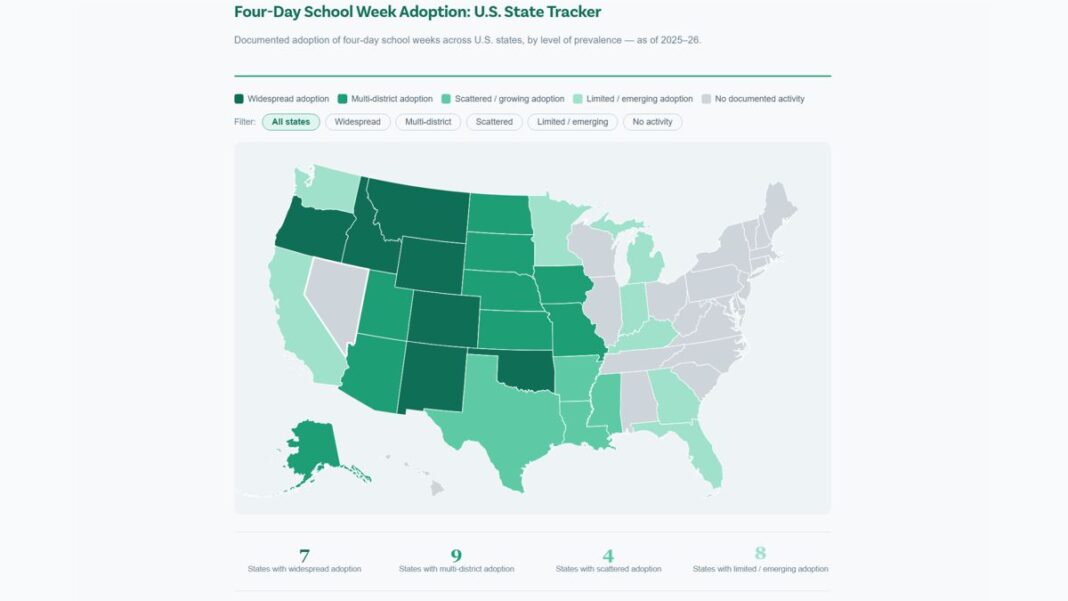


The number of schools with shorter weeks has nearly doubled since 2023, but experts say large-scale evidence of cost-savings or improved performance is lacking.
At Vinton Elementary School in Lafayette, Indiana, the transition to four longer school days with Fridays off was pretty rough at first, Principal Cindy Preston recalled.
The change was implemented in 2024 under an Indiana three-year pilot program, after the school had already committed to a new curriculum designed around traditional five-day weeks.
With several national holidays on Mondays throughout the year, some weeks ran Tuesday through Friday. The 400 students in the K-4 school settled easily into the new routine, but the first two months were challenging for lesson planning and classroom management tasks.
By the second quarter of 2024, the staff “hit their stride,” Preston said. After that, staff absences plummeted, student disciplinary incidents decreased, and the passing rate on the third-grade reading test—required to advance to fourth grade—shot up from 73 percent to 89 percent.
“There’s a noticeable difference on Mondays,” Preston told The Epoch Times. “Kids and teachers are rested. Everyone’s excited to be here.”
Lafayette, a low-income urban community located halfway between Chicago and Indianapolis, is unique in that Vinton is the only Indiana public school with a four-day week.
When the pilot ends next summer, eligibility requirements for the four-day week include a minimum teacher salary of $45,000, a fifth day of class for students who want remedial or enrichment instruction, and an “A” performance rating from the state Department of Education, which is rare for most schools.
Vinton is one of 2,100 schools across 26 states that operated on a four-day week last year. That’s up from 650 in 2020 and 850 in 2023, according to data from the Foundation for Excellence in Education (ExcelinEd) policy organization and the National Conference of State Legislatures.
While Vinton made this arrangement mainly to offer another choice in its district’s open enrollment program, where parents can select their child’s school, most institutions involved are in rural areas west of the Mississippi River. In Missouri alone, where community residents in smaller districts and the board of education in larger districts vote on the schedule change, the number is approaching 200 schools. Texas increased from 30 to 500 schools in four years.
Most are looking to save money on transportation and operational costs and have trouble recruiting bus drivers and retaining teachers, said Cara Candal, ExcelinEd vice president of policy.
So far, she said, there’s little or no evidence of significant cost savings or academic improvement in most of those districts.
“No schools or districts should be doing this,” Candal told The Epoch Times.
“It’s really about instructional time. Popularity is not about proficiency. People don’t understand the consequences.”
Candal analyzed several bodies of research on four-day school weeks so far. Schools on four-day weeks have averaged 148 days of instruction annually compared to the 180-day national norm. Cost savings from minor cuts to transportation and food service, she added, have amounted to only about 2 percent of a school’s budget, while fixed costs like teacher salaries and benefits remain unchanged.