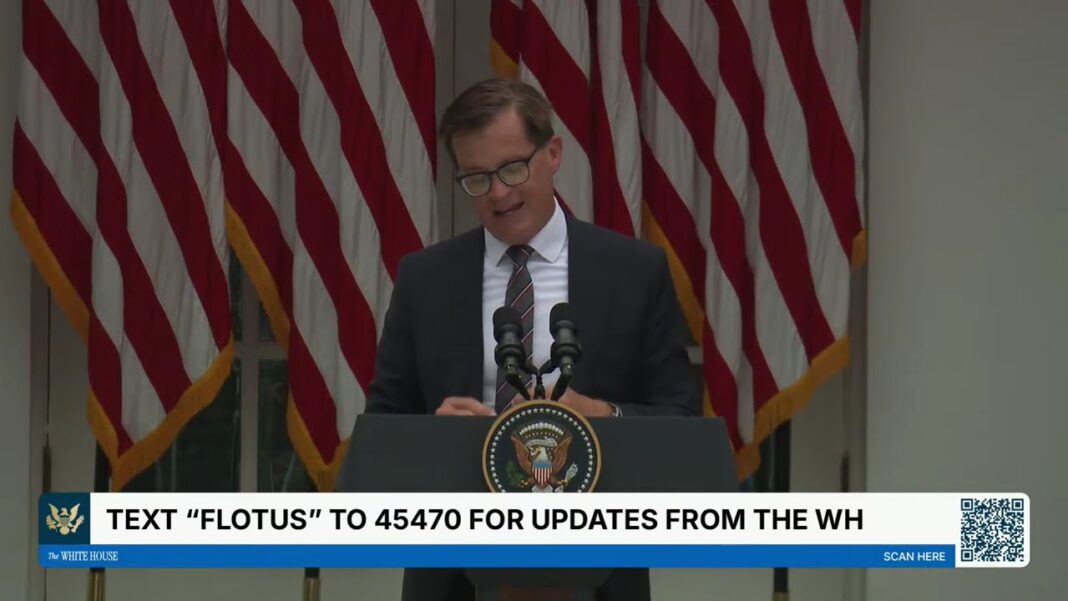
The president announced a three-day pause on additional tariffs, saying there’s a deal with Canada, which is pending finalization of the documents.
WASHINGTON—U.S. President Donald Trump announced on Aug. 18 that he would delay an additional 50 percent tariff on certain Canadian goods following last-minute talks between the two countries. The tariffs were originally set to take effect at 12:01 a.m. ET on Aug. 19.
Trump announced on Truth Social that the two countries have reached a deal.
“I have paused the 50 [percent] Tariffs against Canada, that were scheduled to kick in tomorrow morning for a three day period, based on the fact that Canada and the U.S.A., subject to the finalization of documents, have a DEAL!” he wrote.
Trump added that the Keystone XL pipeline “may be awoken from the grave” as part of the deal.
Canadian Prime Minister Mark Carney said in a statement posted to X, “Substantial progress has been made, although there is important work still to be done.”
On July 20, the White House announced the additional tariffs on certain Canadian goods, in retaliation for “unreasonable and unequal treatment” of U.S. alcohol, automotive, and dairy exports.
Trump signed three proclamations that day, setting a 50 percent tariff covering more than $20 billion in products ranging from wine to hockey sticks and cement.
This represents about 0.5 percent of goods exported to the United States, and about 0.8 percent of Canadian gross domestic product.
Trump invoked Section 338 of the Tariff Act of 1930, which allows tariffs of up to 50 percent on imports from countries that discriminate against the United States. No previous U.S. president has imposed a tariff under this authority.
Carney and U.S. officials acknowledged intense, last-minute talks before the deadline. The White House declined to comment.
Dominic LeBlanc, Canadian minister responsible for Canada–U.S. trade, and Janice Charette, Canada’s chief trade negotiator, met with U.S. Trade Representative Jamieson Greer and U.S. Commerce Secretary Howard Lutnick on Aug. 17 in Washington.
Greer told reporters on Aug. 14 that Canada would need to end its retaliatory measures to avoid additional tariffs. Canada lifted most of its retaliatory tariffs in September 2025, but it retained counter-tariffs on certain U.S. goods in response to Washington’s sectoral tariffs on automobiles, steel, and aluminum, arguing that the measures violated the terms of the U.S.–Mexico–Canada Agreement.
Canada’s supply management system, which implements limits on imports, has been a source of contention for the U.S. administration.
By Emel Akan