

Overview
With the national debt at its worst level in U.S. history, both Donald Trump and far-left Democrats like Ilhan Omar are pushing to eliminate the debt limit.
This would reduce transparency and responsibility for politicians who run up debt and make it easier for them to pass the buck to future officeholders and younger generations of Americans.
The Debt Situation
Economists typically measure each country’s national debt as a portion of its economy because this provides a good indicator of the government’s ability to service its debt. By this measure, the U.S. national debt is currently worse than it’s ever been in the history of the nation:
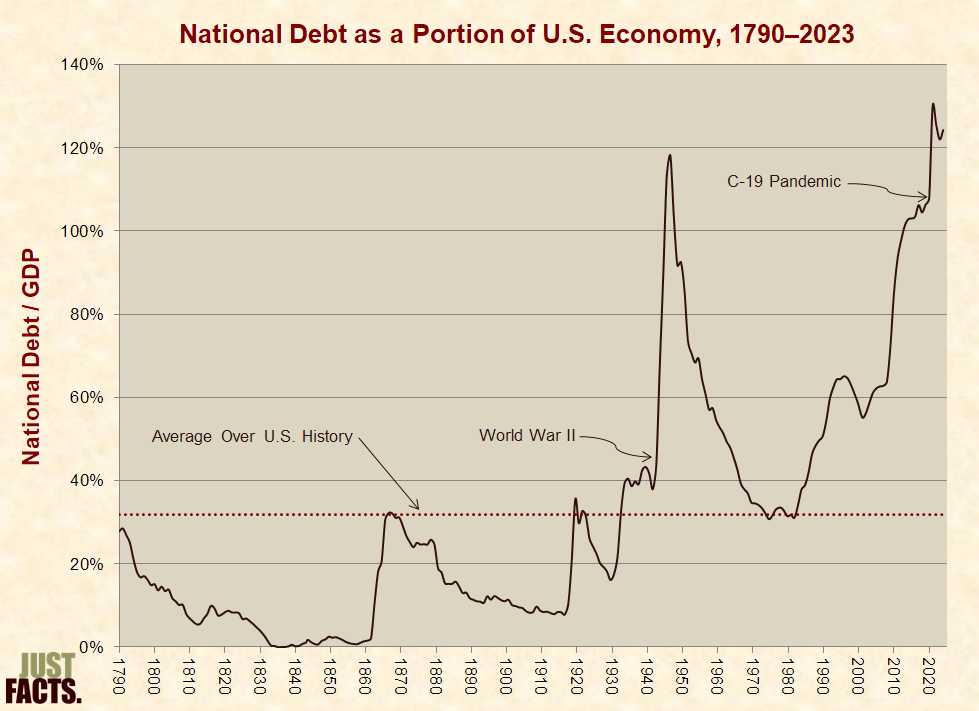
The only era in which the national debt was close to current levels was World War II, the deadliest and most widespread conflict in world history. However, the debt from World War II rapidly fell once the war ended, while he modern debt has been on a steep upward path for decades.
Driven mainly by increases in social spending, the national debt is on track to dwarf World War II levels over the next 10 years, exposing the people of the U.S. to enormous harms.
One of the most nefarious aspects of government debt is that it hurts people through economic mechanisms that aren’t always obvious to them. This is aggravated by politicians who run up debt and falsely blame others for the common effects of excessive debt.
Those effects can manifest gradually or abruptly in the form of:
- reduced “living standards” and “wages.”
- “higher inflation” that increases “the size of future budget deficits” and decreases “the purchasing power” of citizens’ savings and income.
- “losses for mutual funds, pension funds, insurance companies, banks, and other holders of federal debt.”
- increased “probability of a fiscal crisis in which investors would lose confidence in the government’s ability to manage its budget, and the government would be forced to pay much more to borrow money.”
Calls to Remove the Debt Limit
NBC News is reporting that Donald Trump stated in a phone interview with NBC that abolishing the debt limit would be the “smartest thing” Congress could do and he “would support that entirely.”
He also said, “The Democrats have said they want to get rid of it. If they want to get rid of it, I would lead the charge” because “it doesn’t mean anything, except psychologically.”
In accord with that sentiment, Trump wrote on Truth Social that the debt ceiling is “very unnecessary” and that “Congress must get rid of, or extend out to, perhaps, 2029, the ridiculous Debt Ceiling.” This stance puts him in the company of far-left influencers and Democrats, such as:
- the New York Times editorial board, which claims that the debt limit “has not served a useful purpose in living memory.”
- Representatives Ilhan Omar, Jerry Nadler, Nancy Pelosi, Pramila Jayapal, Jamie Raskin, Dan Goldman, and Rashida Tlaib, who cosponsored a bill that would castrate the debt limit by making it unenforceable without veto-proof majorities in both houses of Congress.
- Cal Berkeley professor Robert Reich, who wrote that the debt ceiling “serves absolutely no purpose” and should be abolished.
- Democrat Senator Elizabeth Warren, who posted on X, “I agree with President-elect Trump that Congress should terminate the debt limit and never again govern by hostage taking.”
Contrary to Trump and these leftists, the debt limit serves the purposes of transparency, responsibility, and preventing politicians from passing the buck.
Transparency & Responsibility
Politicians routinely enact thousands of pages of complex laws while claiming that they are saving money, cutting the deficit, and investing in America. Joe Biden’s X feed is heavily laced with such statements.
Contradicting his talk of fiscal responsibility, Biden signed a law in 2021 to raise the debt limit by $2.5 trillion, and 100% of Congressional Democrats voted for it. On top of that, Biden signed a law in 2023 to suspend the debt limit through January 1, 2025. The vast bulk of Democrats, along with a majority of Republicans, also voted for this.
Such votes provide public visibility into the actual state of federal finances and who is driving it deeper into debt. Without this, people like Hakeem Jeffries, leader of the House Democrats, can easily pull the wool over voters’ eyes with claims like this: “President Biden and House Dems have cut the deficit by $1.7 trillion” during 2021 to 2022.
In reality, Biden and the Democrats increased federal deficits by about $840 billion over that period, but understanding this requires comprehending these detailed facts:
- When Biden entered office, the Congressional Budget Office was projecting deficits would decline by $2.95 trillion in 2021 and 2022 due to the expiration of Covid-19 pandemic spending.
- Instead, deficits fell by just $2.11 trillion primarily because Democrats increased spending on wide-ranging social welfare programs and bailouts for state/local governments and private union pension funds.
- Consequently, Democrats increased the deficits by $840 billion relative to what would have happened if they kept the status quo.
- From the time that Congress enacted Biden’s first major economic proposal through 2022, the national debt grew by $3.5 trillion.
In contrast, votes to raise the debt limit are obvious. This gives voters straightforward information to hold politicians accountable.
Passing the Buck
Another important purpose of the debt limit is to hinder presidents and congresses from racking up bills and forcing future officeholders to pick up the tab.
For a prime example, one month before Republicans took control of the House in January 2023, a lame-duck Congress and President Biden passed an omnibus funding bill that spans 4,155-pages and spends about $1.7 trillion. Democrat Rosa DeLauro of Connecticut called it the greatest increase in “non-defense funding ever” and boasted that it “fulfills 98% of Democratic Member requests in the House.”
The politicians who voted for this law could have raised the debt limit in the same bill, but instead, they left that to the new Congress while saddling it with all of the spending they passed. As a result, Republicans were able to negotiate some spending reductions with Democrats in exchange for raising the debt limit.
On a much larger scale, previous congresses and presidents have enacted large mandatory programs with perpetual authority to spend money, like Medicare, Medicaid, Food Stamps, and other social programs. The share of the federal budget consumed by these programs has grown from about 30% in the early 1970s to more than 60% today.
Mandatory programs have become such an engrained part of government spending that politicians sometimes ignore these outlays when speaking about the federal budget.
The debt limit gives voters and lawmakers a measure of control over the spending that occurs under their watch, even if they don’t simultaneously control both houses of congress and the presidency.
A common talking point of people who want to scrap the debt ceiling is that “Congress has already voted to spend this money” and not spending it would be “breaking promises.” In many cases, however, the current Congress did not vote to “spend this money,” and the previous congresses that made the “promises” didn’t provide enough revenues to pay for them.
Summary
The debt limit, a provision that is rooted in the Constitution and dates back to the founding of the nation, forces congresses and presidents to go on record with clear votes to increase or not increase the national debt.
Eliminating it would make it easier for fiscally irresponsible politicians to avoid accountability, impair the ability of their successors to rein in spending, and financially cripple future generations of Americans.
James D. Agresti is the president of Just Facts, a research and educational institute dedicated to publishing facts about public policies and teaching research skills.