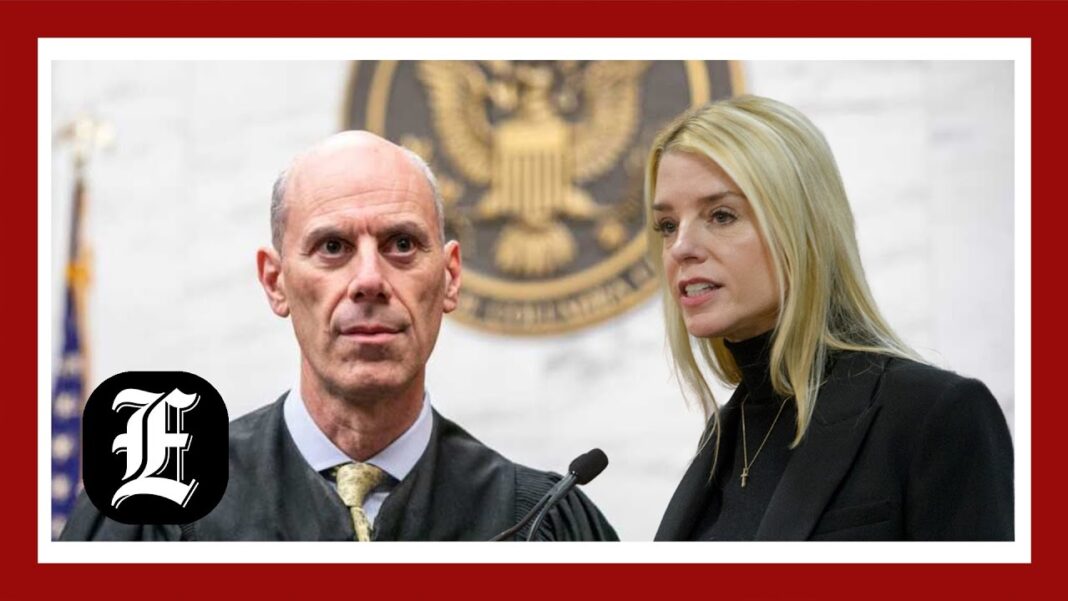


The Justice Department accused U.S. District Judge James Boasberg of pursuing a fishing expedition.
A federal appeals court has halted U.S. District Judge James Boasberg’s attempt to probe the Trump administration’s purported refusal to comply with blocks he placed on its deportations of suspected Venezuelan gang members earlier this year.
The decision on Dec. 12 is the latest development in an interbranch battle over such deportations by the administration. In a per curiam, or unsigned opinion, the U.S. Court of Appeals for the D.C. Circuit placed a temporary stay on Boasberg’s order requesting testimony about the administration’s decision-making.
“The administrative stay should not be construed in any way as a ruling on the merits of that petition or motion,” the court added.
It came the same day the Justice Department asked to block Boasberg’s order and remove him from the case.
“This radical, retaliatory, unconstitutional campaign against the Trump administration will not stand,” Attorney General Pam Bondi said on Dec. 12 in a social media post accusing Boasberg of “judicial activism.”
Today, @TheJusticeDept filed a new mandamus petition in the D.C. Circuit to stop Judge James Boasberg's lawless judicial activism and defend @POTUS's agenda.
— Attorney General Pamela Bondi (@AGPamBondi) December 12, 2025
His latest order threatens attorney-client privilege and the separation of powers underpinning our government — all…
Boasberg had issued two temporary restraining orders to prevent the administration from removing suspected gang members under the Alien Enemies Act.
While the Supreme Court has yet to say whether Trump validly invoked that law, it did vacate Boasberg’s orders on the basis that the underlying lawsuit was brought in the wrong court.
That flaw in the case should have precluded Boasberg’s inquiry into whether the orders were followed, the Justice Department told the D.C. Circuit.
Boasberg maintained in April, however, that he had probable cause to find contempt and said he could still probe whether the administration willfully disobeyed a judicial order.
The judge also said that the administration could avoid contempt by asserting custody over the removed individuals so they had an opportunity to challenge their detention.
The D.C. Circuit later said Boasberg abused his authority by attempting to coerce compliance with his original order.
However, the D.C. Circuit’s decision didn’t prevent further contempt proceedings.
U.S. Circuit Judge Gregory Katsas suggested the proceedings should end and suggested that Boasberg’s orders were ambiguous.
By Sam Dorman