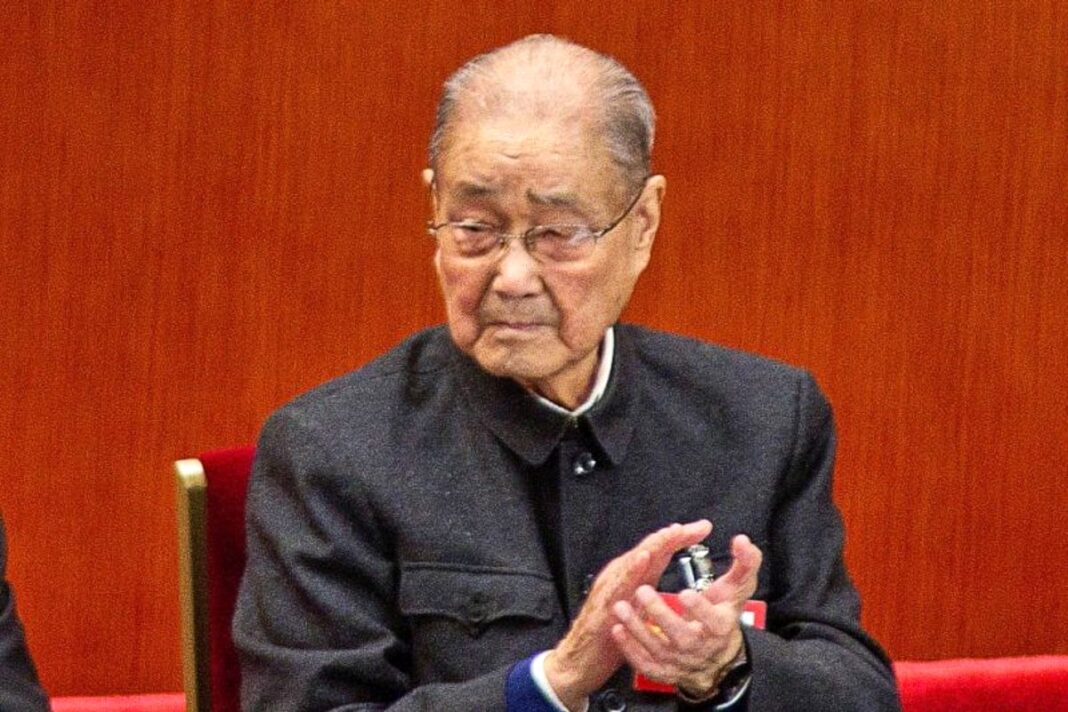


Song was the longest-living Politburo Standing Committee member.
Song Ping, the Chinese Communist Party’s (CCP’s) oldest retired official, died on March 4, according to Chinese state media. He was 109.
Song, a former state councilor and member of the powerful Politburo Standing Committee, passed away in Beijing due to unspecified illness, state media Xinhua reported.
Song retired from all his posts in October 1992, although his political influence remained intact.
In his later years, he continued to attend high-profile political events, such as the 20th National Congress in late 2022—where Xi Jinping secured an unprecedented third term as the Party’s top leader—showing that Song’s political standing within the Party and his good health remained strong even at 105.
The news of Song’s death came amid an unprecedented wave of political cleansing that swept through the upper ranks of the Party and its controlled armed forces. Dozens of senior military chiefs have been purged or sidelined, while many others have vanished without explanation.
A graduate of China’s prestigious Tsinghua University, Song was a powerful figure in Chinese politics.
Song was known as a mentor to Hu Jintao, playing a crucial role in elevating Hu to the country’s top tier of power, the Politburo. Hu became the CCP’s general secretary in 2002.
Song also had connections with Xi. According to Chinese state media People’s Daily, he had worked alongside Xi’s father, Xi Zhongxun. In 1980, when Xi’s father, then-governor of Guangdong Province, visited Iowa, Song was part of the delegation.
In late June 1989, shortly after the military massacre of pro-democracy protesters at Tiananmen Square, then 70-year-old Song was promoted to the Politburo Standing Committee, the CCP’s top decision-making body.
Holding multiple roles throughout his career, Song also served as the Party chief of Gansu Province in northwestern China following the Cultural Revolution in the 1970s.
His political career began in the 1930s, including a stint as a personal secretary to Zhou Enlai, China’s first premier after the CCP seized control of the mainland in 1949.
By Dorothy Li