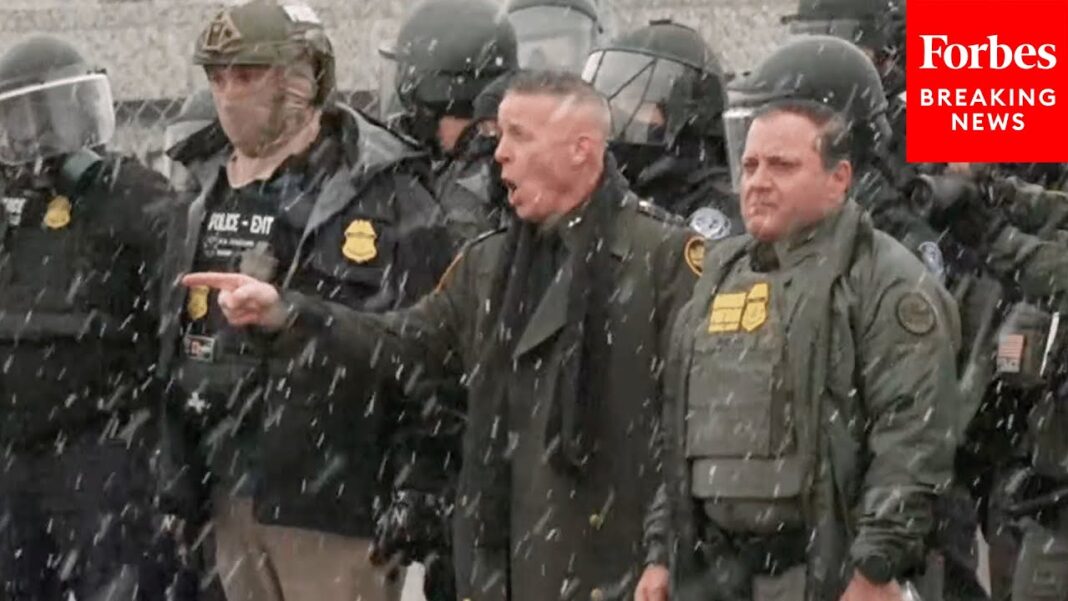


The decision came after border czar Tom Homan signaled a drawdown of agents in the city if local authorities cooperate with federal authorities.
A federal judge on Jan. 31 denied Minnesota’s emergency request to block the Trump administration’s deployment of thousands of federal agents to the Twin Cities in a large-scale immigration enforcement operation.
In her ruling Saturday morning, U.S. District Judge Katherine Menendez wrote that the “Court must view Plaintiffs’ claims through the lens of the specific legal framework they invoke, and, having done so, finds that Plaintiffs have not met their burden … the motion is denied.”
Menendez addressed in her decision that attorneys representing Minnesota and its Twin Cities focused on what they claim are costs and consequences from excessive law enforcement operations that also harm citizens. Department of Justice (DOJ) attorneys did not submit evidence directly contradicting this but rather highlighted the importance of immigration enforcement and public safety, she wrote.
Defendants also presented evidence about how federal agents have been met by resistance, threats, and violence in some cases.
“The outcome in this case depends more on the relevant law than the granular facts,” Menendez’s ruling said.
The judge delved into a high-level summary of events in Minnesota from both the plaintiff and defendants’ points of view before reaching her analysis of the case and whether Minnesota’s emergency request should be granted.
Menendez decided that Minnesota did not meet its burden of proof.
“Though Plaintiffs’ position is not without merit, for several reasons the Court finds that Plaintiffs have not shown the likelihood of success required for preliminary injunctive relief,” the judge wrote.
Menendez heard arguments earlier this week from both the DOJ and attorneys representing Minnesota, St. Paul, and Minneapolis, appearing somewhat skeptical of the district court’s authority over the separation of powers arguments the plaintiffs were advancing.
Plaintiffs had argued a temporary restraining order blocking President Donald Trump’s Operation Metro Surge was necessary to calm tensions in the streets between residents and federal agents, which reached an inflection point on Jan. 24 after a Border Patrol officer fatally shot a protester just weeks after a driver was shot and killed. Federal authorities have said the officers acted in self-defense.
By Jacob Burg and Troy Myers