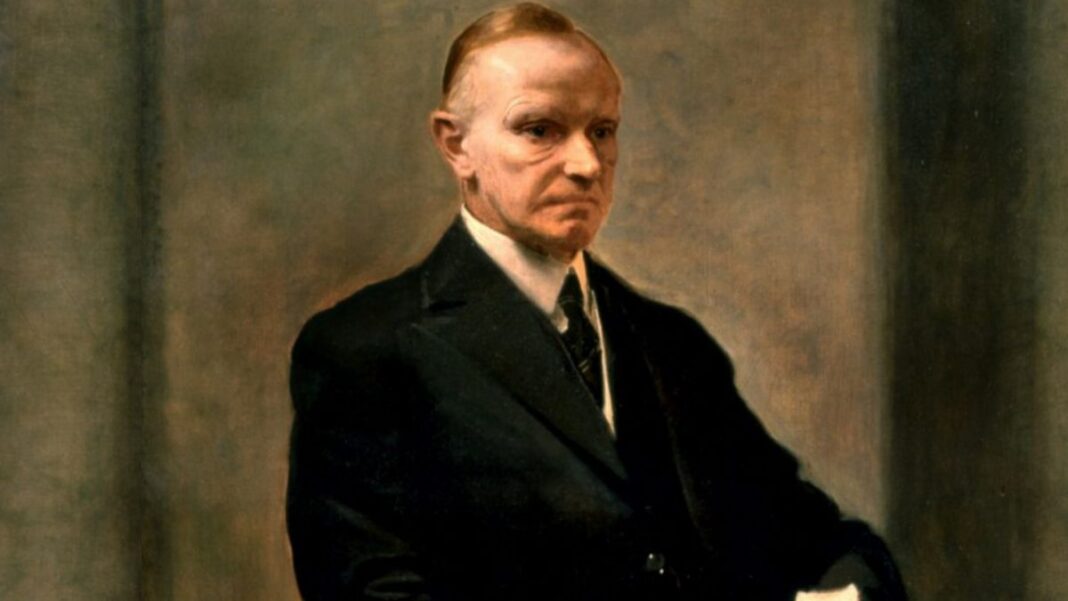


Calvin Coolidge is one of our unsung Presidents. Not one to mince words, “Silent Cal” had just as quiet an administration as he was famously known to be personally. Over time many have observed that he had simple manners and an honest character. These qualities remained a part of him all his life.
From Vermont to the White House
Vice President Calvin Coolidge was visiting his father in Plymouth, Vermont when President Warren G. Harding died. Coolidge described the event in his Autobiography:
On the night of August 2, 1923, I was awakened by my father coming up the stairs calling my name. I knew that something of the gravest nature had occurred. . . . He placed in my hands an official report and told me that President Harding had just passed away. My wife and I at once dressed. Before leaving the room I knelt down and, with the same prayer with which I have since approached the altar of the church, asked God to bless the American people and give me the power to serve them.
Coolidge was then administered the presidential oath of office by his father (a justice of the peace) around 3 A.M.
Coolidge Prosperity
Referring to Calvin Coolidge, President Harry S. Truman once said, “He didn’t do much. Maybe there wasn’t much for him to do.” Coolidge had a quiet administration. “When things are going along all right, it is a good plan to let them alone,” he would say. Coolidge mopped up the scandals of the Harding administration and chose trustworthy men to head the different departments. He expected them to work efficiently and quickly; whenever they did not, he replaced them. Coolidge sought advice and information from many people but never relied on a sole adviser.
Feeling the federal government was involved in far too much, President Coolidge made certain cuts in government spending, stopped the flow of reform legislation, reduced the national debt by two billion, and upheld a “hands-off” policy toward business. “Government [can] not relieve us from toil,” he said. He believed “wealth comes from industry and from the hard experience of human toil.” Coolidge was for strict interpretation of the Constitution and thought Jefferson “everlastingly right” in saying that “the people should manage their government, and not be managed by it.”
Keeping Cool with Coolidge
Coolidge was reelected in 1924, winning in a landslide—15,725,003 votes went to Coolidge and only 8,385,586 to the Democratic candidate. This proved that many Americans truly wanted to “Keep Cool with Coolidge” as the Republican’s campaign slogan said.
In 1924, Coolidge signed an act that allowed certificates of citizenship to be issued to American Indians. In 1926, the presidential pen created the army air corps. Coolidge reduced income taxed by 25 percent, later reducing them further. The same was done for taxes on automobiles and theater tickets.
The thirtieth President was generally liked and respected nationwide. Coolidge fared well with the press mainly because of his ability to answer their questions satisfactorily. Called “Silent Cal” he was of the opinion that “the words of the President have an enormous weight and ought not to be used indiscriminately.” Congress was not as hostile as usual, either, although Coolidge came to look upon most of its legislation as “excessively expensive.” To him the veto was a method of counteracting this spending; he used the veto a total of 50 times during his presidency. All in all, Coolidge kept the presidency simple. Wrote one biographer, “Under [Coolidge] the nation was not adventurous, but it was happy.”
“The chief satisfaction of my administration”
Coolidge did not wish to be reelected in 1928, but wanted to serve the country again as a private citizen. He would look back on his presidency and say the “well-being of my country has given me the chief satisfaction of my administration.”
A leader does not always have to do startling things to be great. One’s greatest sometimes lies in his ability not to abuse power. Calvin Coolidge was an example of this kind. He proved that the presidency could bring about prosperity by doing very little.
Bibliography:
Coolidge, Calvin. Autobiography. Plymouth, Vermont: The Calvin Coolidge Memorial Foundation, 1989.
Freidel, Frank. Our Country’s Presidents. Washington, D.C.: National Geographic Society, 1966.
Lengyel, Cornel Adam. Presidents of the U.S.A.: Profiles and Pictures. Bantam Books, 1961.
Lorant, Stefan. The Presidency. New York: The MacMillan Company, 1952.
Taylor, Tim. The Book of Presidents. New York: Arno Press, 1972.