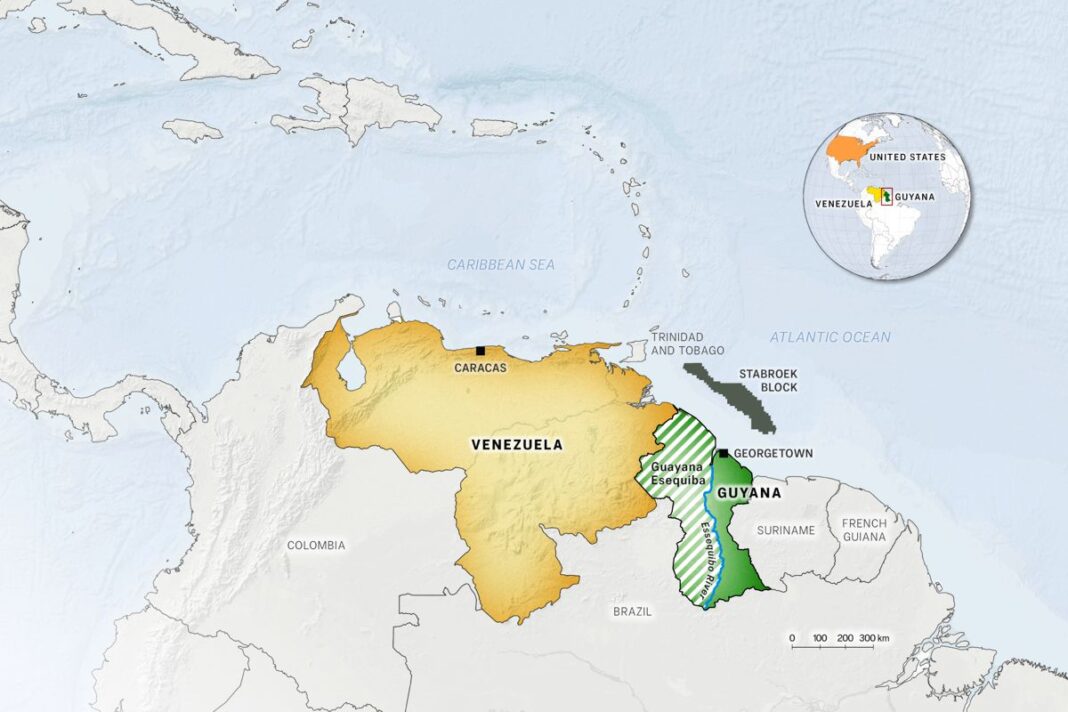


With all eyes on Venezuela, its oil-rich neighbor could be pivotal in implementing Trump’s strategy for the region.
With the U.S. capture of Venezuelan strongman Nicolás Maduro in a bold Jan. 3 military raid and a large naval force still prowling the southern Caribbean to ensure that Maduro’s successors cooperate with the Trump administration, other subtle, but key, developments in the region can be overlooked.
Among under-the-wire events is a December 2025 agreement between the United States and Venezuela’s neighbor, Guyana. That agreement could have profound implications, not only in the immediate context of unfolding events in Venezuela, but also for the long-term execution of the Trump Corollary to the Monroe Doctrine, unveiled in November 2025 by U.S. President Donald Trump.
A U.S. delegation led by senior Pentagon adviser Patrick Weaver and Acting Deputy Assistant Secretary of War Joseph Humire met with Guyanese President Irfaan Ali in the nation’s capital, Georgetown, on Dec. 9.
Ali told Guyanese media outlets that the nations had signed a statement of intent to “expand joint military cooperation,” a process that will be “evolving … in the coming months.” He stated that there “will be greater discussions on more levels of cooperation and the integration of [the two countries’] work.”
The statement of intent is not a formal mutual defense treaty, he said, calling it a “reinforcement” of long-term training and collaboration between the United States and Guyana.
But such a pact could be on the table, Ali hinted, referring to the U.S. military effort dubbed Operation Southern Spear.
“The U.S. government now is launching what they call the Southern Spear of security,” he said. “They are now coming up with a strategy for the Western Hemisphere, and the U.S. government is to invest more and pay attention more to the [Caribbean] and Western Hemisphere.”
Southern Spear has been in the spotlight off Venezuela since September. The USS Gerald Ford, the world’s largest aircraft carrier, and the USS Iwo Jima, an amphibious assault ship, are the most visible components of the campaign that destroyed drug-smuggling speedboats, imposed a selective blockade on sanctioned oil tankers, and led to the Jan. 3 U.S. military operation that captured Maduro.
Guyana has a “growing role” in implementing that strategy, State Department principal deputy spokesman Tommy Pigott said in a Jan. 6 statement.
The commitment to “deepening security cooperation with Guyana to address shared challenges” was affirmed during a Jan. 6 phone call between U.S. Secretary of State Marco Rubio and Ali, Pigott said.
By John Haughey