

While Beijing maintains a ‘perception of dominance’ in rare earths, experts say the United States is increasing its leverage.
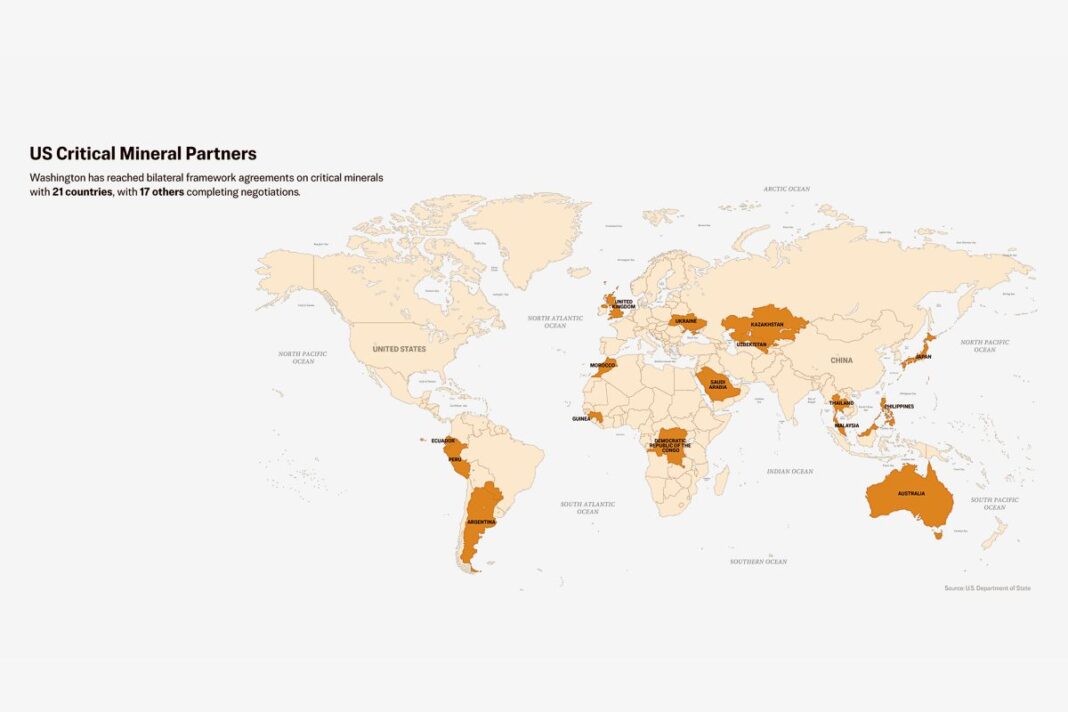
U.S. mining investment firm Cove Capital recently secured a major critical mineral project in Central Asia—a multibillion dollar deal to mine the world’s largest undeveloped tungsten deposit in Kazakhstan.
According to the company’s executive, the November 2025 deal, which involved a joint venture with a state run mining company, could serve as a blueprint for other agreements as Washington seeks to shore up critical mineral supply chains worldwide and reduce dependence on China.
The project was the result of “unprecedented” inter-agency cooperation, said Pini Althaus, managing partner of Cove Capital. That’s a key difference with the current administration, he added, even compared to President Donald Trump’s first term.
“In our project, you’ve had the president directly involved, Secretary Lutnick involved, Secretary Rubio involved. We’ve had special envoy Sergio Gor,” Althaus told The Epoch Times. “You’ve had people across the spectrum in terms of the different agencies engaged in this.”
The mining investment company received preliminary backing from two U.S. government financing agencies, totaling up to $1.6 billion. In return, Cove Capital agreed with the Department of Commerce to prioritize U.S. government and commercial needs.
Tungsten has the highest melting point of any metal. This critical mineral is essential in precision manufacturing for advanced industrial and defense use.
The Trump administration’s recent push to establish a $12 billion critical mineral stockpile and plan to set up a preferential trade zone for rare earths is likely to advance more similar deals. As of Feb. 8, the administration has struck about 20 critical mineral deals involving more than $10 billion in government-backed financing, according to the trade organization Critical Minerals Institute.
According to experts who spoke with The Epoch Times, the United States is likely to have more opportunities to secure strategic minerals as China’s price controls slip and Washington and Beijing compete more directly for mining access in other countries. Many such countries are imposing export controls and seeking to encourage in-country processing rather than shipping their raw materials to China for refining, as is the case today.
By Terri Wu