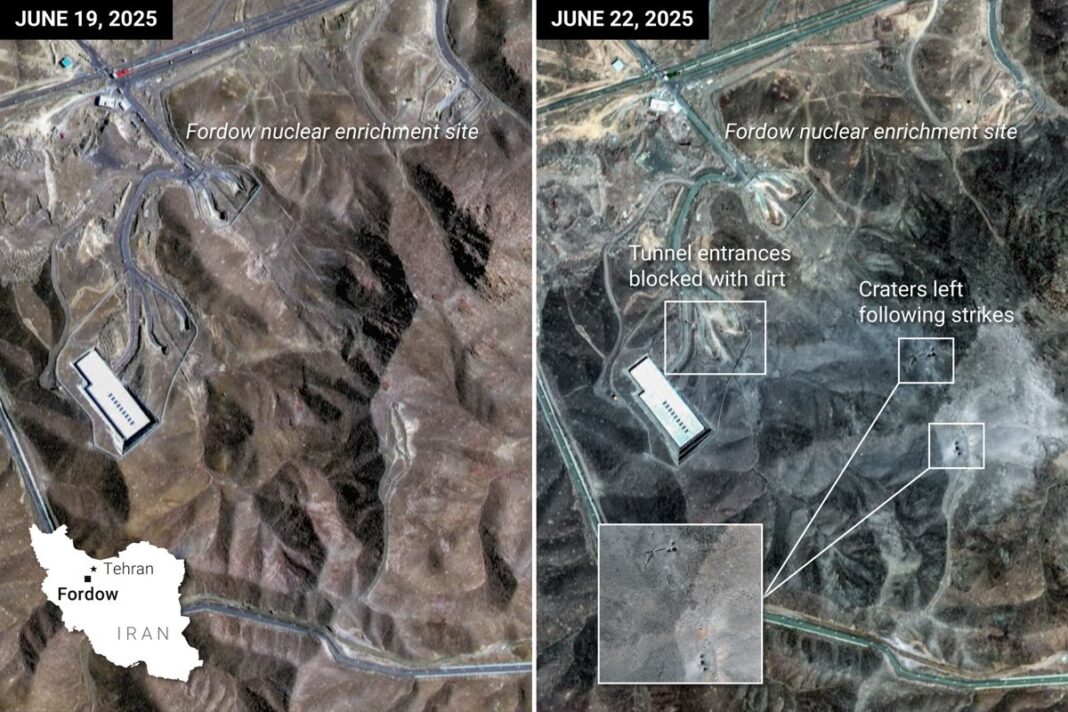


WASHINGTON—The U.S. strike on three Iranian nuclear facilities overnight from June 21 to 22 was a highly intricate plan that entailed more than 125 U.S. aircraft and warships and layers of deception, Defense Secretary Pete Hegseth said during a Pentagon press briefing.
Dubbed Operation Midnight Hammer, Hegseth said preparation for the mission took place over the course of weeks and months, “So that we could be ready when the president of the United States called.”
The U.S. strikes were made a week after Israel launched a series of surprise airstrikes across Iran, aimed at degrading the country’s nuclear programs and military capabilities.
Joining the conflict Israel initiated, U.S. military planners set Iran’s Fordow uranium enrichment facility as their primary target. With the Fordow facility situated hundreds of feet underground in a mountainous region of Iran, U.S. Air Force B-2 Spirit stealth bombers carrying 30,000-pound bunker-busting bombs, called GBU-57A/B Massive Ordnance Penetrators, offered one of the best options to destroy the facility.
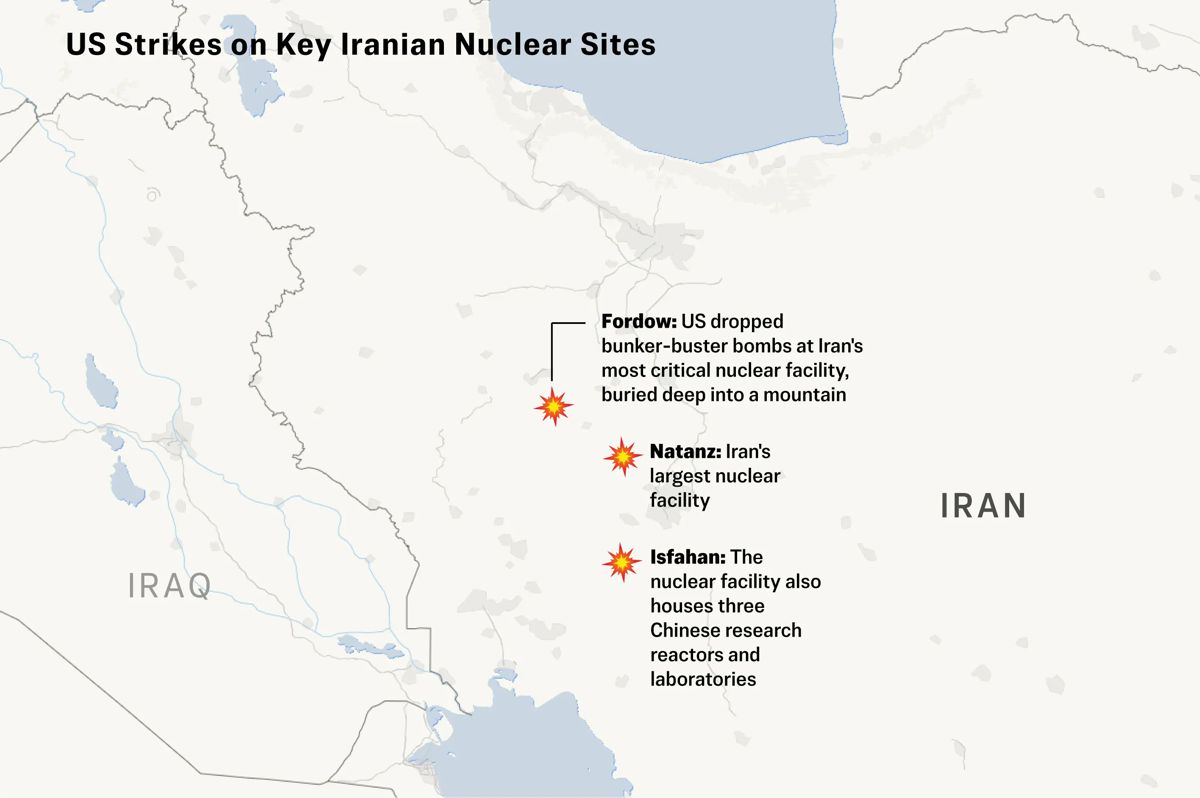
Chairman of the Joint Chiefs of Staff Gen. Dan Caine said the operation was the longest B-2 bomber mission since 2001, the second longest B-2 mission ever flown, and the first operational use of the GBU-57 bombs.
The Timeline
At the Sunday morning press briefing, Pentagon personnel presented a timeline for Operation Midnight Hammer.
- The operation began just after midnight Eastern time on June 21, as seven B-2 bombers departed Whiteman Air Force Base, Missouri, heading east on their way to Iran.
- The B-2 bombers received refueling support from dozens of aerial refueling aircraft along their journey across the Atlantic Ocean and over the Mediterranean Sea.
- The seven U.S. bombers reached the U.S. Central Command area of responsibility at around 5 p.m. Eastern time on June 22. Just before these bombers entered the Central Command area, U.S. submarines began launching Tomahawk cruise missiles at targets in Iran.
- U.S. fighter jets flew ahead of the bombers, and the air strike package entered Iranian airspace at approximately 6 p.m. Eastern time.
- As they flew ahead, U.S. fighter jets began preemptively suppressing Iranian air defense systems around the Fordow and Natanz nuclear facilities, clearing the way for the bomber crews.
- At approximately 6:40 p.m. Eastern time, the lead bomber crews reached the Fordow nuclear facility and dropped two GBU-57 bombs. Over the next 20 minutes, the rest of the bomber crews dropped their payloads over Fordow and Natanz.
- The sea-launched Tomahawk cruise missiles reached the third and final target, Iran’s Isfahan nuclear facility, and concluded the strike operation at approximately 7:05 p.m. Eastern time.
- The B-2 bomber crews exited the Iranian airspace at approximately 7:30 p.m. Eastern time.
As he delivered remarks on the strikes on Sunday morning, Hegseth said U.S. air crews were still on their return flight back to the United States.
US Drops 14 Heavy Bunker Busters
After the lead bomber dropped its two GBU-57 bombs, the remaining six B-2 bombers each released two of their own heavy bunker busters over the Fordow and Natanz facilities.
In total, these bomber crews dropped 14 bunker buster bombs.
Submarines Launch More Than 2 Dozen Tomahawks
Detailing the operation, Caine said the U.S. submarines involved in the strikes began firing “more than two dozen Tomahawk land attack cruise missiles against key surface infrastructure targets at Isfahan.”
The air and sea components of the U.S. strike package were carefully sequenced so that the Tomahawk missile impacts could coincide with the narrow time frame of the rest of the strike package.
Decoys and Deception
The U.S. strike operation entailed several elements of deception in order to misdirect Iran’s defenses.
While the bomber crews responsible for conducting the strikes flew east from Whiteman Air Force Base, Caine announced that some bombers headed west over the Pacific Ocean.
Caine said it was “a deception effort known only to an extremely small number of planners and key leaders here in Washington and in Tampa.”
The top U.S. general said U.S. forces employed other deception tactics in the course of the mission, but did not specify what those tactics were.
More Than 125 US Aircraft Used
More than 125 military aircraft participated in Operation Midnight Hammer, according to Caine.
He said this included the B-2 stealth bombers, “multiple flights of fourth and fifth generation fighters,” and “dozens and dozens of air refueling tankers.”
No Shots Fired by Iran
Emphasizing the surprise nature of the operation, Caine said the U.S. military is unaware of any Iranian forces firing on the U.S. warplanes during the mission.
“Iran’s fighters did not fly, and it appears that Iran’s surface-to-air missile systems did not see us throughout the mission,” Caine added. “We retained the element of surprise in total.”
Hegseth also said the capabilities and coordination demonstrated by the U.S. forces during the operation will be a key factor dissuading Iran from retaliating.
“We believe that’ll have a clear psychological impact on how they view the future, and we certainly hope they take the path of negotiated peace,” Hegseth said. “But I could not be more proud of how this building operated, of the precision, the sensitivity, and the professionalism of the troops involved in this effort.”
Damage Assessments Ongoing
Hegseth said Operation Midnight Hammer was launched in order to destroy or “severely degrade Iran’s nuclear program.”
The full extent of the damage inflicted on Iran’s three nuclear facilities cannot be independently confirmed at this time. Still, Caine provided an optimistic early outlook.
“I know that battle damage is of great interest,” Caine said. “Final battle damage will take some time, but initial battle damage assessments indicate that all three sites sustained extremely severe damage and destruction.”
In a statement shared by Iran’s state-run PressTV shortly after the U.S. strikes, the Atomic Energy Organization of Iran vowed it would continue its work. The Iranian nuclear agency also urged the international community to condemn the attack.
Vice President JD Vance said that he believes the U.S. airstrikes on three of Iran’s nuclear sites on Saturday have set back the regime’s nuclear program.
“I feel very confident that we have substantially delayed their development of a nuclear weapon, and that was the goal of this attack. That’s why it was a success,” Vance said Sunday on NBC’s “Meet the Press.”
“I think that we have really pushed their program back by a very long time. I think that it’s going to be many, many years before the Iranians are able to develop a nuclear weapon.”
Prior to the strikes, Israel said that Iran could be just weeks away from obtaining a nuclear weapon, while President Donald Trump had said Iran was weeks to months away from a nuclear bomb.