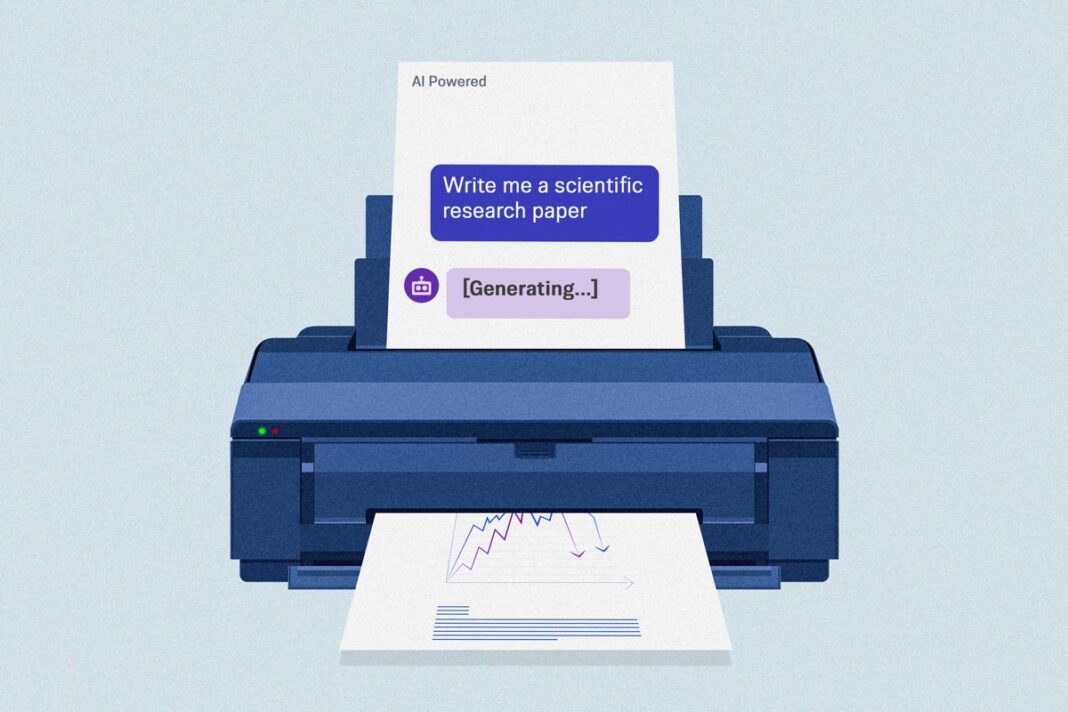

How AI Is Supercharging Scientific Fraud

5Mind. The Meme Platform

‘What we’re essentially seeing right now is the equivalent of a denial-of-service attack. Real researchers drowning in noise,’ one expert said.

Academics and cybersecurity professionals warn that a wave of fake scientific research created with artificial intelligence (AI) is quietly slipping past plagiarism checks and into the scholarly record. This phenomenon puts the future credibility of scientific research at risk by amplifying the long-running industry of “paper-mill” fraud, experts say.

Academic paper mills—fake organizations that profit from falsified studies and authorship—have plagued scholars for years and AI is now acting as a force multiplier.

Some experts believe structural changes are needed, not just better plagiarism checkers, to solve the problem.

The scope of the problem is staggering, with more than 10,000 research papers retracted globally in 2023, according to Nature Portfolio.

Manuscripts fabricated using large language models (LLMs) are proliferating across multiple academic disciplines and platforms, including Google Scholar, the University of Borås found. A recent analysis published in Nature Portfolio observed that LLM tools including ChatGPT, Gemini, and Claude can generate plausible research that passes standard plagiarism checks.

In May, Diomidis Spinellis, a computer science academic and professor at the Athens University of Economics and Business, published an independent study of AI-generated content found in the Global International Journal of Innovative Research after discovering his name had been used in a false attribution.

Spinellis noted that just five of the 53 articles examined with the fewest in-text citations showed signs of human involvement. AI detection scores confirmed “high probabilities” of AI-created content in the remaining 48.

In an analysis of AI-generated “junk” science published on Google Scholar, Swedish university researchers identified more than 100 suspected AI-generated articles.

Google did not respond to The Epoch Times’ request for comment.

The Swedish study authors said a key concern with AI-created research—human-assisted or otherwise—is that misinformation could be used for “strategic manipulation.”

“The risk of what we call ‘evidence hacking’ increases significantly when AI-generated research is spread in search engines. This can have tangible consequences as incorrect results can seep further into society and possibly also into more and more domains,” study author Björn Ekström said.

Moreover, the Swedish university team believes that even if the articles are withdrawn, AI papers create a burden for the already hard-pressed peer review system.


By Autumn Spredemann

Read Full Article on TheEpochTimes.com

Contact Your Elected Officials
The Epoch Times
The Epoch Timeshttps://www.theepochtimes.com/
Tired of biased news? The Epoch Times is truthful, factual news that other media outlets don't report. No spin. No agenda. Just honest journalism like it used to be.

Pride and Prejudice and the Modern Woman: What the Story Should Still Mean to Us Today

Why should Jane Austin's Pride and Prejudice be so influential? Because it upholds biblical precepts pertaining to purity, manhood and womanhood.

Epstein File Dump Confirms Pizzagate

Ten years ago Pizzagate was written off as a conspiracy theory. Recently the story has been exposed as viable and should be investigated further.

Gates Discussed Pandemic with Epstein in 2017!?

An email, from the newly released Epstein files, sent to Epstein with the subject “Preparing for Pandemics" allegedly came from Bill Gates.

Public Health™ Fatties For Flu Shots!

Meet Sarah Hoffman, former Alberta Minister of Health — in any sane time and place, the unlikeliest of sources for sound Public Health™ counsel.

How Will Key Countries Respond To The US’ Attempted Restoration Of Unipolarity?

The US’ new National Security and Defense Strategies outline the “Trump Doctrine,” signaling a grand strategy to restore American unipolar dominance worldwide.

Ryan Routh Sentenced to Life in Prison for Trump Assassination Attempt

A federal judge sentenced Ryan Routh to life in prison for attempting to assassinate then-candidate President Donald Trump in 2024.

DHS Reports More Than 180 Vehicle Attacks on Law Enforcement

Immigration officers have faced 182 vehicular attacks since President Donald Trump took office last year, the DHS said in a Feb. 3 statement.

Federal Judge Restricts Agents from Using Tear Gas at Protests in Portland

A federal judge ruled that federal agents must not use tear gas on protesters in Portland, Oregon, if they do not pose a threat of physical harm to agents.

Homan Announces Drawdown of 700 Federal Agents in Minnesota

Tom Homan said the Trump admin will redeploy 700 immigration agents from Minnesota, citing unprecedented county cooperation with ICE detainers.

Trump, Colombia’s Petro to Meet for White House Talks After Months of Sharp Tension

President Donald Trump will welcome Colombian President Gustavo Petro for a bilateral discussion at the White House in Washington on Feb. 3.

Trump Says UN Still Has Tremendous Potential, as Organization Struggles Financially

President Trump denied claims the UN may close its NYC headquarters for financial reasons, while praising the organization’s “tremendous potential.”

Trump Launches $12 Billion ‘Project Vault’ Critical Minerals Stockpile

President Donald Trump announced on Feb. 2 a new strategic private sector critical minerals stockpile.

US, India to Slash Tariffs Under New Trade Deal, Trump Says

The US and India have reached a trade agreement and will begin lowering tariffs on each other’s goods immediately, Trump announced
spot_img

Related Articles