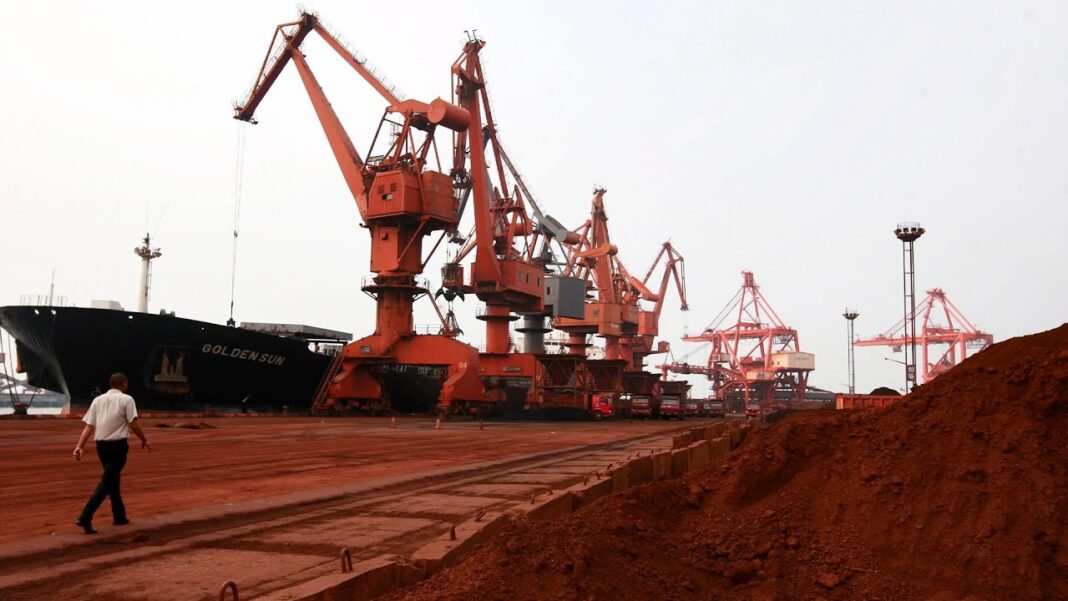


Keith Norman, from California-based battery manufacturer Lyten, said reliance on China becomes a ‘challenge’ during periods of heightened geopolitical risk.
The Pentagon needs to relocate the manufacturing of all critical components to the United States. That’s what Secretary of War Pete Hegseth said in a Sept. 30 speech in Quantico, Virginia.
“The moment requires restoring and refocusing our defense industrial base, our shipbuilding industry, and onshoring all critical components,” said Hegseth.
Rebuilding what Hegseth calls the “arsenal of freedom” comes hand-in-hand with ensuring the United States’ industrial base is no longer reliant on China, other hostile actors, and vulnerable supply chains.
‘Deterrence Fails When Delivery Slips’
“Deterrence fails when delivery slips,” Steve Aberle, CEO of Rohirrim, a Washington-based company that makes procurement software for the aerospace and defense industry, told The Epoch Times. “What we intend to do is make delivery the default for America and its allies.”
“War starts when gaps appear, so we close those gaps via acquisition before they matter, so no adversary should wake up to an advantage,” Aberle said.
The present situation has come as a direct result of the rise of Chinese manufacturing, which saw its global share grow from 9 percent to 23 percent between 2004 and 2023. Meanwhile, fewer and fewer products are made in the United States.
A case in point would be Magnequench, a company founded by General Motors (GM) in 1986 to manufacture neodymium-iron-boron magnets used in precision-guided munitions, mainly for the Pentagon.
In 1995, GM sold Magnequench for $56 million to a consortium backed by Chinese investors, who later closed down two magnet manufacturing plants in Indiana.
As a result, “America now cannot build a single guided missile without permission from Beijing,” Michael Dunne wrote in a June 2025 report in The Dunne Insights Newsletter. “America’s defense industrial base had been hollowed out for $56 million: the cost of a single F-35 fighter jet.”
On Feb. 24, 2021, President Joe Biden signed Executive Order 14017, which ordered the Department of Defense and other branches of government to review critical supply chains.
Biden said at the time, “The United States needs resilient, diverse, and secure supply chains to ensure our economic prosperity and national security.”
The Manufacturing Capability Expansion & Investment Prioritization (MCEIP) program, which seeks to address “vulnerabilities” in the supply chain of the U.S. industrial base, was launched, and in April 2023, it awarded contracts to “strengthen supply chains for hypersonic and strategic systems.”
In February 2024, the U.S. Department of Defense handed out seven contracts worth $192.5 million to restore manufacturing of certain critical chemicals within the United States.
As a result, hundreds of new jobs are being created in Colorado, Louisiana, Ohio, Oregon, and California.
For example, METSS Corporation—based in Westerville, Ohio—was given a $14 million contract to produce various chemicals, including potassium sulfate, which is used as a muzzle flash suppressant in artillery and firearms.
“Our objective is simple: transform the entire acquisition system to operate on a wartime footing,” Hegseth said in a speech on Nov. 7, “To rapidly accelerate the fielding of capabilities and focus on results, our objective is to build, rebuild the arsenal of freedom.”