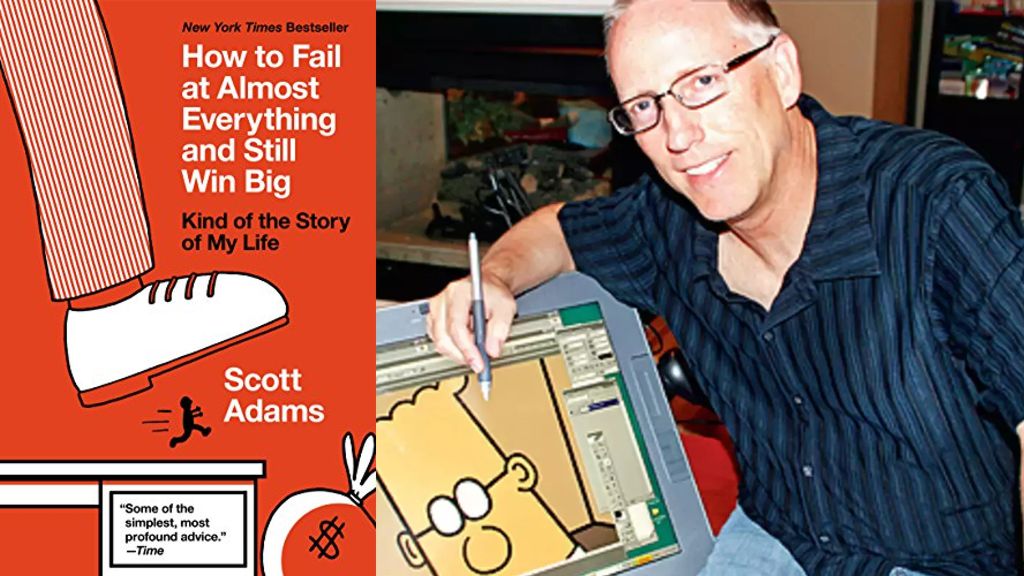


Blasting clichéd career advice, the contrarian pundit and creator of Dilbert recounts the humorous ups and downs of his career, revealing the outsized role of luck in our lives and how best to play the system.
Scott Adams has likely failed at more things than anyone you’ve ever met or anyone you’ve even heard of. So how did he go from hapless office worker and serial failure to the creator of Dilbert, one of the world’s most famous syndicated comic strips, in just a few years? In How to Fail at Almost Everything and Still Win Big, Adams shares the game plan he’s followed since he was a teen: invite failure in, embrace it, then pick its pocket.
No career guide can offer advice that works for everyone. As Adams explains, your best bet is to study the ways of others who made it big and try to glean some tricks and strategies that make sense for you. Adams pulls back the covers on his own unusual life and shares how he turned one failure after another—including his corporate career, his inventions, his investments, and his two restaurants—into something good and lasting. There’s a lot to learn from his personal story, and a lot of entertainment along the way. Adams discovered some unlikely truths that helped to propel him forward. For instance:
• Goals are for losers. Systems are for winners.
• “Passion” is bull. What you need is personal energy.
• A combination of mediocre skills can make you surprisingly valuable.
• You can manage your odds in a way that makes you look lucky to others.
Adams hopes you can laugh at his failures while discovering some unique and helpful ideas on your own path to personal victory. As he writes: “This is a story of one person’s unlikely success within the context of scores of embarrassing failures. Was my eventual success primarily a result of talent, luck, hard work, or an accidental just-right balance of each? All I know for sure is that I pursued a conscious strategy of managing my opportunities in a way that would make it easier for luck to find me.”
Editorial Reviews
About the Author
Scott Adams is the creator of Dilbert, one of the most popular and widely distributed comic strips of the past quarter century. He has been a full-time cartoonist since 1995, after 16 years as a technology worker for companies like Crocker National Bank and Pacific Bell. His many bestsellers include The Dilbert Principle and Dogbert’s Top Secret Management Handbook. He lives outside of San Francisco.
From Booklist
The creator of the Dilbert comic strip is also the author of several nonfiction books that apply Dilbert’s philosophy to the workplace. Here he takes an autobiographical approach, using his own life to illustrate his thesis that failure isn’t necessarily a bad thing. Adams’ own list of failures is—given his spectacular success as a cartoonist—surprisingly lengthy: a couple of unsuccessful restaurants as well as computer games, inventions, and online businesses that all tanked. Adams isn’t bummed by any of his flops because—and this is the key element of his philosophy—you learn by trying, not by succeeding. And every failure in life helps point us in the direction of ultimate success. (Adams says he would never have become a cartoonist if it weren’t for a combination of personal failures and the successes of some of his friends, who were willing to take personal risks.) Readers familiar with the author’s previous nonfiction will note the same easygoing, conversational style here, an approach that works perfectly for blending humor with serious advice. –David Pitt
Excerpt. © Reprinted by permission. All rights reserved.
Excerpt:
This is not an advice book. If you’re ever taken advice from a cartoonist, there’s a good chance it didn’t end well. For starters, it’s hard to know when a cartoonist is being serious and when he or she is constructing an elaborate practical joke. I’ve crafted pranks that spanned years, sometimes when no one was in on the joke but me.
On top of that, I’m getting paid to write this book, and we all know that money distorts truth like a hippo in a thong. And let’s not forget I’m a stranger to most of you. It’s never a good idea to trust strangers.
I’m also not an expert at anything, including my own job. I draw like an inebriated howler monkey and my writing style falls somewhere between baffling and sophomoric. It’s an ongoing mystery to me why I keep getting paid.
Most advice-like books take the view that the author is an omnipotent source of knowledge and the reader is an empty vessel of dysfunction. I approach this book with a more realistic humility. For starters, anyone who reads this sort of book is likely to be brighter than the average citizen, and, in far too many cases, brighter than me.
Review
“Adams has a funny, refreshingly considered set of ideas about how to find success—and what that success will look like when one gets there.”
—Kirkus Reviews
“Scott Adams has drawn nearly 9,000 Dilbert cartoons since the strip began, in 1989, and his cynical take on management ideas, the effectiveness of bosses, and cubicle life has affected the worldview of millions. But he built his successful career mainly through trial and error—a whole lot of error, to be exact.
—Harvard Business Review