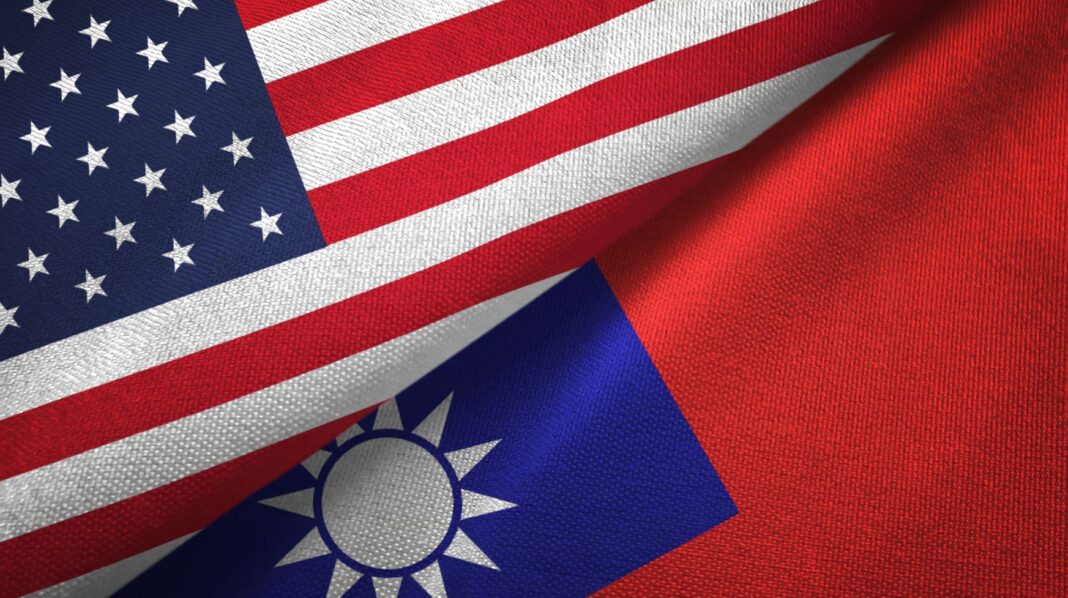


Yu says Washington’s post-2017 security shift reframed Taiwan’s defense as a matter of American self-interest.
The U.S. strategic focus on countering the Chinese Communist Party (CCP) began during President Donald Trump’s first term and has since hardened into a bipartisan consensus—making Taiwan’s security a core U.S. national interest, according to Miles Yu, a senior fellow and director of the China Center at the Hudson Institute and a former adviser to then–Secretary of State Mike Pompeo.
Yu said Washington formally reoriented its national defense strategy toward China under Trump, marking the most significant shift in U.S. grand strategy since World War II.
Speaking at a forum in Taipei, Taiwan, on Dec. 15, Yu said, “Protecting Taiwan is an act of altruism—and also a necessity rooted in self-interest.”
A Historic Strategic Pivot
Yu said U.S. national security strategy has undergone only two major transformations over the past 80 years.
The first came in 1947, when Washington reshaped its entire national apparatus—industry, education, science, defense, and intelligence—to confront the global expansion of the communist Soviet Union. That shift produced the National Security Act of 1947 and defined U.S. strategy throughout the Cold War.
The second transformation, he said, began in about 2015 when Trump entered the presidential race and accelerated after his election in 2016. In 2017, the Trump administration released a new National Security Strategy that identified the CCP as the primary U.S. strategic threat.
That document marked a decisive pivot away from Russia and the Middle East entanglements and toward the Indo-Pacific, according to Yu.
“Russia’s economy is less than one-tenth the size of China’s, the CCP’s military buildup has far outpaced Russia’s, and the United States has assessed that NATO allies have the economic capacity—and should be required—to increase defense spending to counter the Russian threat,” he said.
Trump’s Second-Term Approach
Looking at Trump’s second term, Yu said Washington’s posture toward Beijing has hardened further.
“There is now a consensus [across the aisle] in U.S. politics that the CCP is the number one threat,” he said.
Yu described Trump’s current national security team as highly centralized and loyal, with fewer internal dissenters than during his first term. He said Trump has lost faith in trade agreements with Beijing after previous deals failed to materialize.
“Trump will no longer believe in negotiating trade agreements with the CCP,” he said. “[What he believes in] now is tariffs.”
Yu said the core objective of Trump’s trade policy is to force genuine market access and reciprocity. Countries closely tied to China’s export chain—such as Canada and Mexico—have faced higher U.S. tariffs after Chinese goods were routed through them to circumvent trade barriers during the Biden administration.
Similar concerns have driven U.S. tariffs on Vietnam, Cambodia, and Malaysia, he said.