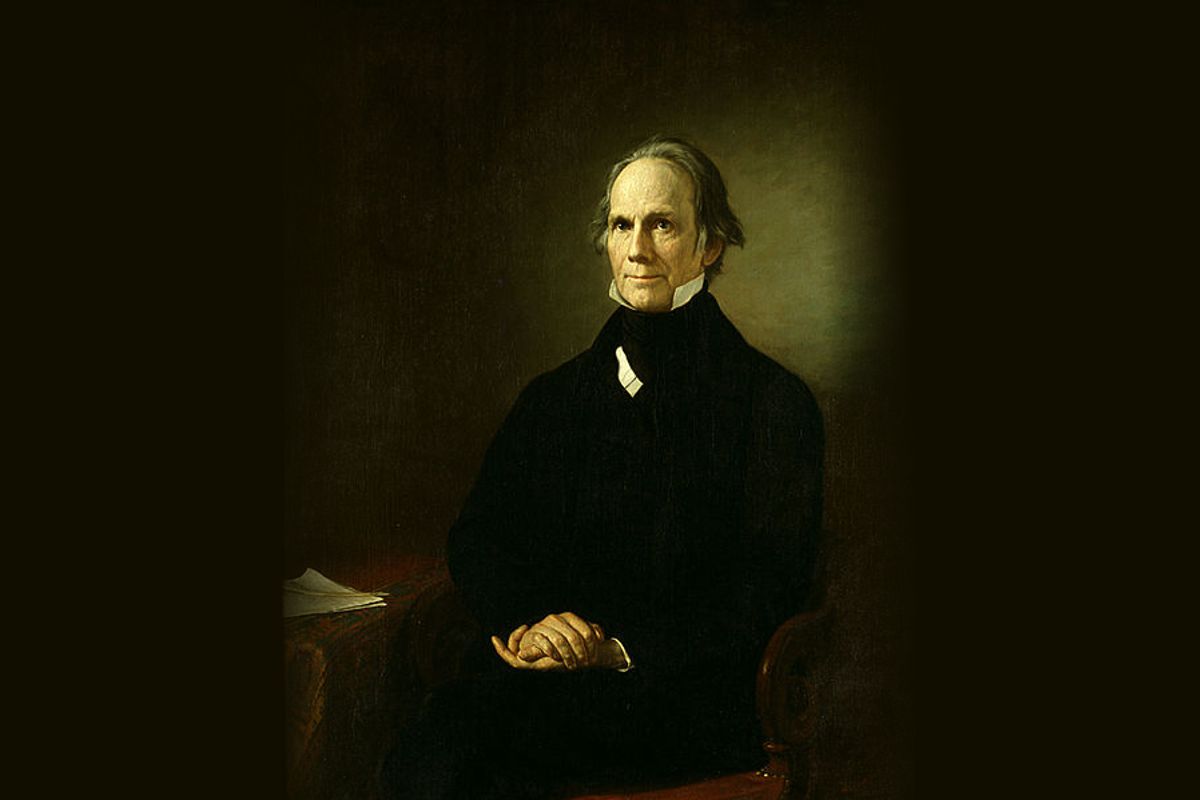


Speaker of the House, Senator, and Secretary of State – Henry Clay had accomplished much in his political career despite never ascending to the presidency, although that was not from lack of trying. He suffered three defeats for that office in 1824, 1832, 1844. Despite these shortcomings, his story is not only one of failure. He became a vocal critic of President Andrew Jackson with the latter charging that Clay had brokered a “corrupt bargain” to declare John Quincy Adams the victor of the 1824 election after no winner was declared in the electoral college and the vote went to the house. Speaker Clay endorsed Adams who, after winning, appointed Clay his secretary of state.
Where does Clay’s relevancy show itself in the current political landscape? That would be title bestowed upon him for his willingness to find understanding: The Great Compromiser. The country was divided over expansion of slavery when, in 1819, Missouri applied for statehood. As a potential slave state, this could outnumber the free states. In 1820, a compromise was created to allow Maine to become a free state along with Missouri’s admittance thus maintaining the balance. This issue of slavery’s expansion in the western territory was also addressed with a dividing line at the 36°30′ parallel, allowing for slavery below it, but not above. Despite not creating the compromise, Clay played a major role in its passing through the House.
1832 saw a crisis that nearly broke the union apart when South Carolina threated to secede over the 1828 Tariff of Abominations. This was a tax on imported goods that raised prices and created anxiety among Southerners that their cotton exports would be hurt when foreign tariffs were imposed on them. The Nullification Crisis saw South Carolina argue the tariff was unenforceable – subsequently nullified – in their state, threatening secession if the federal government tried to collect it. Again, it was Clay who helped President Andrew Jackson, his political rival, and South Carolina, find a compromise. In the House, Clay proposed a new tariff that passed in 1833 after South Carolina had declared Jackson’s latest 1832 tariff nullified. For context, Clay was Jackson’s opponent in the 1832 election. The two hated each other with Clay successfully getting the Senate to censure Jackson over his dismantling of the Bank of the United States while Jackson never forgot Clay’s supposed role in the Corrupt Bargain.
Clay’s last efforts at compromise came in 1850 when he attempted to push an omnibus through Congress to settle tensions arising from new territories ceded by Mexico following the Mexican-American War. Although it was Senator Stephen Douglas of Illinois that worked to get each of Clay’s resolutions passed individually: California entering the Union as a free state, outlawing the slave trade in Washington D.C., a new fugitive slave law, settling a border dispute between Texas and New Mexico, and popular sovereignty, or a vote by the residents, to determine the status of slavery in the Utah and New Mexico territories. The resolutions were the product of an aging Clay, who would pass just two years later at 75.
Whether you call it compromise, bipartisanship, or some other name, the practice of simply “getting along” in national politics is seemingly less common in the Trump era. To be sure, we still find bipartisan efforts in Congress, but there is one action – a leap of faith – the Democrats absolutely will not make – conceding to work alongside President Donald Trump rather than against him.
Ironically, their success as a party could depend upon it. Compromising their hardline “Never Trump” politics could very well soften their image as a party and see a return to reason. The bipartisan needs to overcome blind partisanship. Blind partisanship is what we have seen from Democrats since Trump’s return in 2025. In May, 13-year-old cancer survivor DJ Daniel received a standing ovation in Congress as he became an honorary secret service member. USA Today noted more than a few Democrats remaining seated. Although that gesture was a callous and classless one, it was also a golden opportunity missed. Standing for a young man who in 2018 was given months to live would be an easy way to give the American people some ounce of hope this party was not completely deranged. It would not have even been a concession to Trump but a display of decency.
Democrats at all levels were aghast when Trump decided a crackdown on crime was needed, not just in Washington D.C., but across the country. Chicago Mayor Brandon Johnson called the president’s plan to send the national guard to his city “uncoordinated, uncalled for, and unsound.” Plans for a deployment in Los Angeles were met in a similar manner by Mayor Karen Bass in June. “I’m very disappointed that he chose to do this, because it’s just not necessary,” she said. Something is necessary for a city that ranks in the 27th percentile for safety. Widespread oppositions to Trump’s immigration policies need little explanation. Anti-ICE protests, comparisons between ICE and the Gestapo, deadly attacks on ICE facilities, along with calls for complete non-compliance with ICE agents indicate the Democrats have no intention of shedding their Biden era infatuation with open borders.
Social Psychologist Milton Rokeach in his 1973 work The Nature of Human Values groups values into the instrumental and the terminal. Instrumental values are the means by which we achieve the ends – our terminal values. By establishing terminal values with our opposition, we find common ground to work from, hashing out the specifics where we disagree – the instrumental. If Democrats plan to have a coherent message, finding their terminal values with Trump is the only viable course. My Editor-At-Large at the Western Journal, Josh Manning, refers to Democrats behavior as “toddlerian” or toddler-like. Toddlers do not understand compromise, nor do they find the desired common ground with their opposition. There is no terminal value, only an arms crossed, heels-in-dirt, emphatic “my way.”
Has it dawned on Democrats to say they too want safe cities and closed borders for the sake of those timeless words from the preamble, “justice and domestic tranquility”? What of the old party leadership? A concession to Trump is not a total abandonment of what the Democratic Party stands for, or more appropriately stood for. Several of the president’s policies were in vogue under Presidents Bill Clinton and Barack Obama.
In an article from the New York Times dated March 3, 1993, the outlet announced, “Determined to continue casting himself as an enemy of big government, President Clinton announced today that his Administration would conduct a six-month investigation of ways to eliminate waste and abuse in government.” It added comments by Clinton that would make the ears of Democrat party brass in 2025 bleed. “Our goal is to make the entire Federal Government both less expensive and more efficient, and to change the culture of our national bureaucracy away from complacency and entitlement toward initiative and empowerment.” Clinton would cut 400,000 federal workers. Fast-forward to 2025 and we only see vehement opposition to Trump’s cuts under the Department of Government Efficiency, and that is putting it lightly. In a misguided effort to denounce DOGE, Telsa owners had their cars vandalized with criminals trying to bomb dealerships, all to somehow harm billionaire Elon Musk for his work leading the department.
On the immigration front, Obama had 3 million deportations for his 8 years in office. When looking at the numbers from the first Trump term compared to either Obama term, Trump’s are lower. 1.2 million people were removed during Trump’s first term, Obama’s terms saw 1.57 million and 1.49 million for his first and second term respectively.
2026 is not the 19th century political landscape for which Henry Clay operated in. The value of historical parallels only goes so far. Clay’s time proved to be an explosively divisive one, despite his death in 1852 not allowing him to witness the Civil War. Former President Thomas Jefferson said the Missouri Compromise was “like a fire-bell in the night, awakened and filled me with terror. I considered it at once as the knell of the Union.” Regarding Clay’s efforts to end the Nullification Crisis, that moment, in retrospect, displayed the radical ends southerners we willing to go in opposing perceived abuses by the federal government as South Carolina would be the first state to seceded in December 1860 following the election of Abraham Lincoln. The Compromise of 1850 had a similar place in the timeline of the sectional crisis, when north and south were at odds over slavery. Clay was by no means the savior of the Union with that information considered, but the legacy of the man should not be discarded.
Despite being a politician at his core in every conniving, scheming way his critics would brand him, Clay found his terminal values as a compromiser: the preservation of the Union, a preference for peace over a bloody civil war, and bipartisanship in the name of the Constitution which he swore an oath to uphold.
The Democratic Party of 2026 does not have mirror the life of Henry Clay, but take a kernel of knowledge from his career: find common ground, find a set of terminal values with the president or other bitter political rivals, make concessions in the name of bipartisanship. Acting like petulant children in reaction to every executive action flies in the face of reason and maturity. In doing so, the party’s identity has devolved in a lowbrow anti-Trump politics, lacking nuance and sophistication needed to formulate a digestible message to voters.