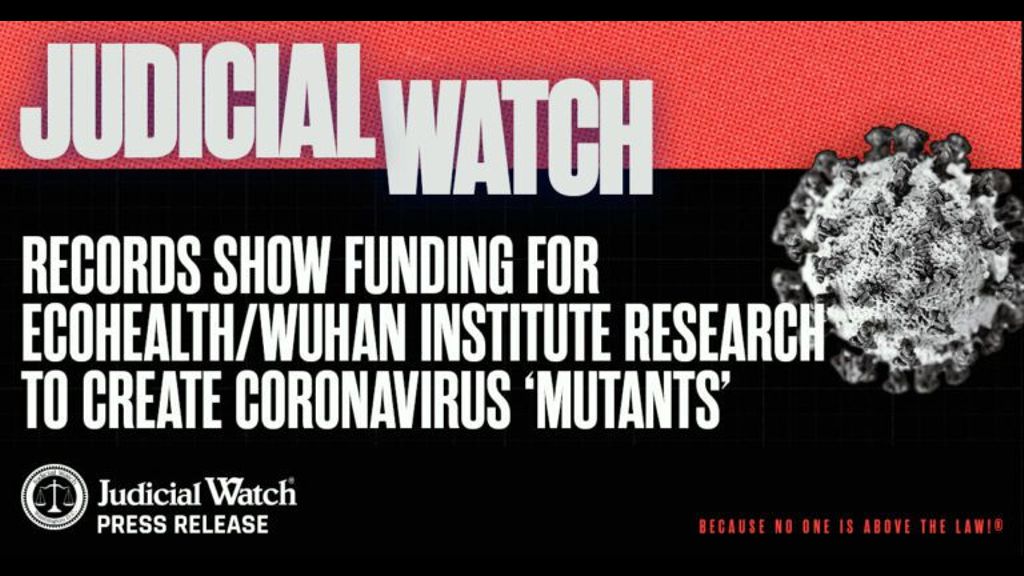


(Washington, DC) – Judicial Watch announced today it received 552 pages of records from the U.S. Department of Health and Human Services (HHS) which include the initial grant application and annual reports to the National Institutes of Health (NIH) from EcoHealth Alliance, describing the aim of its work with the Wuhan Institute of Virology in China to create mutant viruses “to better predict the capacity of our CoVs [coronaviruses] to infect people.”
Eco Health planned to sequence the spike protein from coronaviruses obtained from bats for the purpose of “creating mutants to identify how significantly each would need to evolve to use ACE2,” which is explained as “the receptor to gain entry to human cells.”
Judicial Watch obtained the records through a Freedom of Information Act (FOIA) request it filed in December 2021 for:
All reports submitted by EcoHealth Alliance to NIH or its sub-agencies related to NIH Grant No. 1R01A|110964 titled “Understanding the Risk of Bat Coronavirus Emergence” during the term of the grant.
In the initial “Application for Federal Assistance” submitted on June 5, 2013, by EcoHealth Alliance, a section is titled “Specific Aims,” which notes the intention to create mutant bat viruses and “predict the capacity of our CoVs [coronaviruses] to infect people:”
To understand the risk of zoonotic CoV [coronavirus] emergence, we propose to examine 1) the transmission dynamics of bat-CoVs across the human-wildlife interface; and 2) how this process is affected by CoV evolutionary potential, and how it might force CoV evolution. We will assess the nature and frequency of contact among animals and people in two critical human-animal interfaces: live animal markets in China and people who are highly exposed to bats in rural China.
“Specific Aim 3” discusses “Testing predictions of CoV inter-species transmission:”
We will test our models of host range (i.e. emergence potential) experimentally using reverse genetics, pseudovirus and receptor binding assays, and virus infection experiments in cell culture and humanized mice. With bat-CoVs that we’ve isolated or sequenced, and using live virus or pseudovirus infection in cells of different origin or expressing different receptor molecules, we will assess potential for each isolated virus and those with receptor binding site sequence to spill over. We will do this by sequencing the spike (or other receptor binding/fusion) protein genes from all our bat-CoVs, creating mutants to identify how significantly each would need to evolve to use ACE2, CD26/DPP4 (MERS-CoV receptor) or other potential CoV receptors.
In the continuing discussion of the aims of the research, the report states:
In vitro [outside the body] cell lines & Humanized mouse model: We have developed primary cell lines and transformed cell lines from 9 bat species using kidney, spleen, heart, brain and intestine. We have used these for virus isolation, infection assays and receptor molecule gene cloning. We also have a large number of cell lines from humans and animals that we will use for virus infectivity assays. We have obtained a letter of support from Dr Ralph Baric, who is keen to collaborate with us initially to infect his humanized mouse model with our bat SL-CoV [SARS-Like Coronavirus] that uses ACE2, and subsequently to use other CoVs that we identify …
***
The results will provide information whether bat-CoVs could use known bat and human ACE2, DPP4 or other known CoV receptors to enter cells, and allow us to determine critical receptor binding sites, viral host range, and to better predict the capacity of our CoVs to infect people. [Emphasis in original]
EcoHealth Alliance’s $3.3 million grant to fund a project titled “Understanding the Risk of Coronavirus Emergence” was initially to run from October 1, 2013, to September 30, 2018. The first “Project/Performance Site Location” is the Wuhan Institute of Virology. Three other Chinese sites follow: East China Normal University in Shanghai, Yunnan Institute of Endemic Disease Control and Prevention in Dali, and the Center for Disease Control and Prevention of Guangdong in Guangzhou.
On May 27, 2014, the NIH awarded EcoHealth Alliance $3,086,735 over five years for “Understanding the Risk of Bat Coronavirus Emergence.”
An EcoHealth Alliance grant application, received by the NIH on June 5, 2013, includes a list of “Senior/Key Personnel” including Shi Zhengli and Zhang Yun-Zhi of the Wuhan Institute of Virology (WIV); Peter Daszak, CEO of EcoHealth Alliance; and other Chinese scientists, including Ke Changwen of the Chinese “CDC and Prevention of Guangdong Province.”
A section of the EcoHealth Alliance application titled “EcoHealth Alliance Budget Justification” describes some of the work to be conducted by EcoHealth scientists in China:
A research scientist will be hired at 12 months time per year to provide direct assistance and oversight of field activities in China; maintain equipment and logistics; and coordinate animal and human sample shipment to the labs in China and in the US.
***
Once we secure IRBs [Institutional Review Boards] for human sampling in Y1 [Year 1], we will hire three medical officers from China provincial CDCs [Centers for Disease Control] as consultants to work in Guangxi, Hunan, and Fujian during Y2-Y5. These medical officers will be responsible for IRB approved human sampling as well as maintaining cold chain for storage and shipping samples.
***
Dr. Zhengli Shi, Senior Virologist. [Redacted] per year in Y1 -Y5. Dr. Shi will oversee the coronavirus screening for all samples collected in China. She will work with the PI [Principal Investigator], Co-Investigators, and Senior/Key Personnel to analyze data and write manuscripts. She will also coordinate data and material sharing with the co-investigators.
In a budget calculation for the year 2014-15, the Wuhan Institute of Virology as a sub-awardee of the grant was allocated to receive $128,718 in direct costs and $10,297 in indirect costs from NIH. The salaries of Shi Zhengli and a Wuhan Institute of Virology colleague Ge Xingyl are redacted from the budget. Over the five years of the grant, the Wuhan lab was to receive $749,976.
A section of the grant award titled “Wuhan Institute of Virology Budget Justification, Subaward” discusses “Other Direct Costs:”
RNA Extractions
We will be running RNA extractions for 1,000 bats per year (three sample per bat: oral, anal, and blood) in each year … Extracted RNA per animal will be pooled.
***
DNA Sequencing
In each year of the project, DNA sequencing will be performed on 3,200 samples at a cost of $2.91 per reaction….
Laboratory Supplies
We request support for in vitro infection experiments using pseudoviruses carrying the spike proteins (wild type or mutants) or live viruses in cell lines of different origins, binding affinity assays between the spike proteins (wild types or mutants) and different cellular receptor molecules, and humanized mouse experiments.
The Year 2 annual report for the bat coronavirus project, budget period June 1, 2016, to May 31, 2017, under “Specific Aim 3,” states:
Testing predictions of CoV inter-species transmission. The following experiments will be undertaken in Year 2:
- Humanized mice with human ACE2 receptors will be infected with WIV1 and the two rescued chimeric SARS-like coronaviruses to determine the tissue tropism and pathogenicity of bat SL-CoV.
- Isolation of novel bat coronaviruses. Live virus or pseudovirus will be used to infect cells of different origin or expressing different receptor molecules. Spillover potential for each isolated virus will be assessed.
- An infectious clone of full-length MERS-CoV [Middle East Respiratory Syndrome coronavirus] will be constructed using reverse genetic method. Using the S [spike] sequence of different MERS-related viruses identified from Chinese bats, the chimeric viruses with S gene of bat MERS-related coronaviruses and backbone of the infectious clone of MERS-CoV will be constructed to study the receptor usage and infectivity of bat MERS-related coronaviruses.
Among the “Additional Year 2 items for Specific Aim 3” are:
- The infectious clone of WIV1 was successfully constructed using reverse genetic methods;
- Two chimeric bat SARS-like coronavirus strains were constructed by replacing the S [spike] gene in the backbone of WIV1;
- Permission to import mice with human ACE2 to China was obtained, so as to conduct the experimental infections proposed in our R01 specific aims.
The annual report submitted for Year 3 of the grant project, budget period June 1, 2017, to May 31, 2018, under the heading “Specific Aim 3: Testing predictions of CoV inter-species transmission,” notes:
In Year 3, we successfully isolated Rs4874 from the single [bat] fecal sample. Using the reverse genetic system we previously developed, we constructed two chimeric viruses with the WIV1 backbone replaced with the S [spike] gene of Rs7327 and Rs4231, respectively. Vero E6 cells were respectively infected with Rs4874, WIV1-Rs4231S and WIV1-Rs7327S, and efficient virus replication was detected by immunofluorescence assay in all infections. To assess the usage of human ACE2 by the three novel SL-CoVs, we conducted virus infectivity studies using HeLa cells with or without the expression of human ACE2. All viruses replicated efficiently in the human ACE2-expressing cells.
In the Year 4 annual report, budge period June 1, 2018, to May 31, 2019, submitted to NIH by EcoHealth on September 16, 2020, in answer to the question “How Have the Results Been Disseminated to Communities of Interest,” the report details that Peter Daszak and WIV lab director Shi Zhengli briefed their findings to, among others, the Defense Advanced Research Projects Agency (DARPA), the National Natural Science Foundation of China, the Chinese Center for Disease Control and Prevention, and the Chinese Academy of Sciences.
Among the accomplishments listed in the Year 4 report is: “In vivo [experimentation done in a whole organism] infection of SARSr-CoVs with variants of S [spike] protein in human ACE2 (hACE2) expressing mice.”
The report also includes information about the construction of viruses of “varying pathogenicity” and testing them on humanized mice:
Using the reverse genetic methods we previously developed, infectious clones with the WIV1 [bat SARS-like coronavirus] backbone and the spike protein of SHC014, W IV16 and Rs4231, respectively, were constructed and recombinant viruses were successfully rescued. In Year 4, we performed preliminary in vivo infection of SARSr-CoVs on transgenic mice that express hACE2. Mice were infected with 105 pfu of full-length recombinant virus of W IV1 (rWIV1) and the three chimeric viruses with different spikes. Pathogenesis of the 4 SARSr-CoVs was then determined in a 2-week course. Mice challenged with rWIV1-SHC014S have experienced about 20% body weight loss by the 6th day post infection, while rWIV1 and rWIV-4231 S produced less body weight loss. In the mice infected with rWIV1 -WIV16S, no body weight loss was observed (Fig. 35a). 2 and 4 days post infection, the viral load in lung tissues of mice challenged with rWIV1-SHC014S, rWIV1-WIV16S and rWIV1-Rs4231 S reached more than 106 genome copies/g and were significantly higher than that in rWIV1-infected mice (Fig. 35b). These results demonstrate varying pathogenicity of SARSr-CoVs with different spike proteins in humanized mice.
In a revised award dated July 13, 2020, the NIH granted additional funds, including $77,750 to the University of North Carolina-Chapel Hill, $76,301 to the Wuhan Institute of Virology, and $75,600 to the Institute of Pathogen Biology of China.
The 2020 renewal application to extend funding for the Wuhan bat research projects states that EcoHealth would not be working with “select agents” (severe threats), such as SARS-CoV, but rather with a SARSr-CoV molecular clone designated WIV1 which, while a “BSL3” (biosafety level 3) pathogen, was not considered a select agent.
The select agent research was to be conducted at Ralph Baric’s lab at the University of North Carolina-Chapel Hill.
A section titled “P3CO Research” notes:
Importantly, we are not proposing to genetically manipulate SARS-CoV over the course of this proposal. [Emphasis in original] However, we are proposing to genetically manipulate the full length bat SARSr-CoV WIV1 strain molecular clone during the course of this proposal, which is not a select agent, has not been shown to cause human infections, and has not been shown to be transmissible between humans.
The same 2020 renewal application states: “This project is a multi-institutional collaboration led by EcoHealth Alliance, New York (Daszak, PI), which will subcontract funds to three institutions: the Wuhan Institute of Virology (Dr. Shi), the University of North Carolina at Chapel Hill (Dr. Baric), and the Institute of Pathogen Biology (Dr. Ren).”
“A review of these and other documents strongly suggest that U.S. funding in China and elsewhere for mutant virus, gain-of-function research may have been responsible for the emergence of the COVID pandemic in Wuhan,” said Judicial Watch President Tom Fitton. “This gain-of-function scandal should be the subject of criminal investigations.”
Through FOIA, Judicial Watch has uncovered a substantial amount of information about COVID-19 issues:
- HHS records included emails of then-Director of the National Institutes of Health (NIH) Francis Collins showing a British physicians’ group recommended the use of Ivermectin to prevent and treat COVID-19.
- Heavily redacted HHS records showed that just two days prior to FDA approval of the Pfizer-BioNTech COVID-19 vaccine a discussion was held between U.S. and UK health regulators regarding the COVID shot and “anaphylaxis,” with the regulators emphasizing their “mutual confidentiality agreement.”
- Judicial Watch obtained HHS records regarding data Moderna submitted to the FDA on its mRNA COVID-19 vaccine, which indicated a “statistically significant” number of rats were born with skeletal deformations after their mothers were injected with the vaccine. The documents also revealed Moderna elected not to conduct a number of standard pharmacological studies on the laboratory test animals.
- Heavily redacted records from the FDA regarding the COVID-19 booster vaccine detailed pressure on COVID booster use and approval.
- HHS records detailed internal discussions about myocarditis and the COVID vaccine. Other documents detail adverse “events for which a contributory effect of the vaccine could not be excluded.”
- Judicial Watch uncovered HHS records detailing the extensive media plans for a Biden administration propaganda campaign to push the COVID-19 vaccine.
- HHS records revealed previously redacted locations of COVID-19 vaccine testing facilities in Shanghai, China. The FDA had claimed the name and location of the testing facilities were protected by the confidential commercial information exemption of the FOIA.
- NIH records showed an FBI “inquiry” into the NIH’s controversial bat coronavirus grant tied to the Wuhan Institute of Virology. The records also show National Institute of Allergy and Infectious Diseases (NIAID) officials were concerned about “gain-of-function” research in China’s Wuhan Institute of Virology in 2016. The Fauci agency was also concerned about EcoHealth Alliance’s lack of compliance with reporting rules and use of gain-of-function research in the NIH-funded research involving bat coronaviruses in Wuhan, China.
- Texas Public Information Act (PIA) records showed the former director of the Galveston National Laboratory at the University of Texas Medical Branch (UTMB), Dr. James W. Le Duc, warned Chinese researchers at the Wuhan Institute of Virology of potential investigations into the COVID issue by Congress.
- HHS records regarding biodistribution studies and related data for the COVID-19 vaccines showed how a key component of the vaccines developed by Pfizer/BioNTech, lipid nanoparticles (LNPs), were found outside the injection site, mainly the liver, adrenal glands, spleen and ovaries of test animals, eight to 48 hours after injection.
- Records obtained from HHS through a FOIA lawsuit related to hydroxychloroquine and COVID-19 revealed that a grant to EcoHealth Alliance was cancelled because of press reports that a portion of the grant was given to the Wuhan Institute of Virology.
- HHS records revealed that from 2014 to 2019, $826,277 was given to the Wuhan Institute of Virology for bat coronavirus research by the NIAID.
- NIAID records showed that it gave nine China-related grants to EcoHealth Alliance to research coronavirus emergence in bats and was the NIH’s top issuer of grants to the Wuhan lab itself. The records also included an email from the vice director of the Wuhan Lab asking an NIH official for help finding disinfectants for decontamination of airtight suits and indoor surfaces.
- HHS records included an “urgent for Dr. Fauci ” email chain, citing ties between the Wuhan lab and the taxpayer-funded EcoHealth Alliance. The government emails also reported that the foundation of U.S. billionaire Bill Gates worked closely with the Chinese government to pave the way for Chinese-produced medications to be sold outside China and help “raise China’s voice of governance by placing representatives from China on important international counsels as high level commitment from China.”
- HHS records included a grant application for research involving the coronavirus that appears to describe “gain-of-function” research involving RNA extractions from bats, experiments on viruses, attempts to develop a chimeric virus and efforts to genetically manipulate the full-length bat SARSr-CoV WIV1 strain molecular clone.
- HHS records showed the State Department and NIAID knew immediately in January 2020 that China was withholding COVID data, which was hindering risk assessment and response by public health officials.
- HHS records show that NIH officials tailored confidentiality forms to China’s terms and that the World Health Organization (WHO) conducted an unreleased, “strictly confidential” COVID-19 epidemiological analysis in January 2020.
- Fauci emails include his approval of a press release supportive of China’s response to the 2019 novel coronavirus.
###