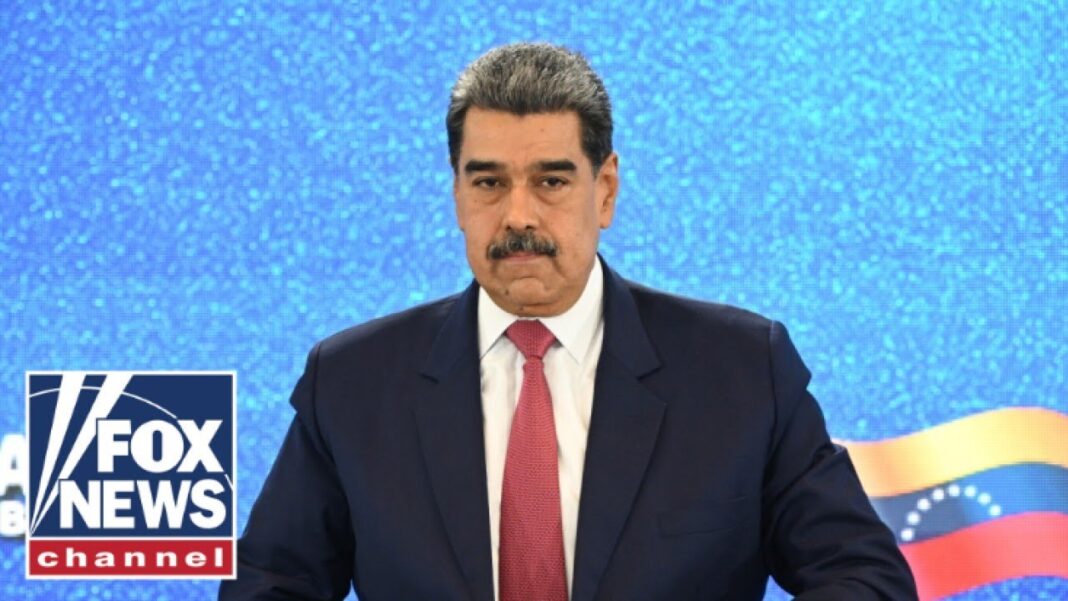


The captured Venezuelan leader is set to be arraigned at noon on Monday in a Manhattan federal court before Judge Alvin Hellerstein.
Deposed Venezuelan leader Nicolás Maduro is scheduled to appear in federal court on Monday on narco-terrorism conspiracy charges, just more than two days after his extraction from his country by U.S. military forces.
He’s set to be arraigned at noon in a Manhattan federal court before Judge Alvin Hellerstein.
An early morning operation in and around Caracas carried out at around 2 a.m. local time on Jan. 3 resulted in the capture of both Maduro and his wife, Cilia Flores.
On Jan. 3, Attorney General Pam Bondi announced that Maduro, alongside Flores, had been indicted in federal court shortly after their capture and extraction from Venezuela.
“Nicolas Maduro has been charged with Narco-Terrorism Conspiracy, Cocaine Importation Conspiracy, Possession of Machineguns and Destructive Devices, and Conspiracy to Possess Machineguns and Destructive Devices against the United States,” Bondi wrote on X.
“They will soon face the full wrath of American justice on American soil in American courts.”
The indictment that serves as the basis for the Monday court appearance lists Maduro as a defendant, alongside his wife and other Venezuelan officials.
All four of the charges against Maduro come with a maximum penalty of life in prison. His wife and son stand charged with all but the narco-terrorism conspiracy charge, also facing the potential of life in prison.
The indictment refers to Maduro as a Venezuelan citizen who was previously the president but remained in power despite losing the 2024 presidential election.
The Biden administration had determined that the socialist leader lost the election but had manipulated the results through widespread fraud to overcome steep opposition.
Neama Rahmani, president of West Coast Trial Lawyers and a former Department of Justice prosecutor who has prosecuted drug and human trafficking cases, told The Epoch Times that the Trump administration was likely also seeking to avoid “sovereign immunity.”
“Heads of state typically can’t be prosecuted,” Rahmani said.
Several pages of the indictment track the ways in which the defendants and others in the Maduro regime allegedly “facilitated the empowerment and growth of violent narco-terrorist groups, fueling their organizations with cocaine profits” over the years.
“These narco-terrorist organizations not only worked directly with and sent profits to high-ranking Venezuelan officials, but also reaped the benefits of the increased value of that cocaine at each transshipment point along the way to the United States, where demand and thus the price of cocaine is highest,” U.S. Attorney John Clayton, who filed the indictment, wrote.
Organizations mentioned included Venezuela’s Tren de Aragua, Mexico’s Sinaloa cartel, Colombia’s Marxist-Leninist guerrilla group Fuerzas Armadas Revolucionarias de Colombia (FARC), and Marxist-Leninist guerrilla group Ejército de Liberación Nacional, which operates along the Colombia–Venezuelan border.
According to the indictment, Maduro and other defendants sold diplomatic passports to individuals known to be drug traffickers, and accepted bribes as high as $100,000 per flight to ensure safe passage of trafficking flights.
The indictment also alleges that Maduro’s son met with two FARC representatives in Medellin, Colombia, in or around 2020, when they “discussed arrangements to move large quantities of cocaine and weapons through Colombia and into the United States over the course of the next six years, until in or about 2026,” according to the indictment.
T.J. Muscaro and Ryan Morgan contributed to this report.
By Joseph Lord