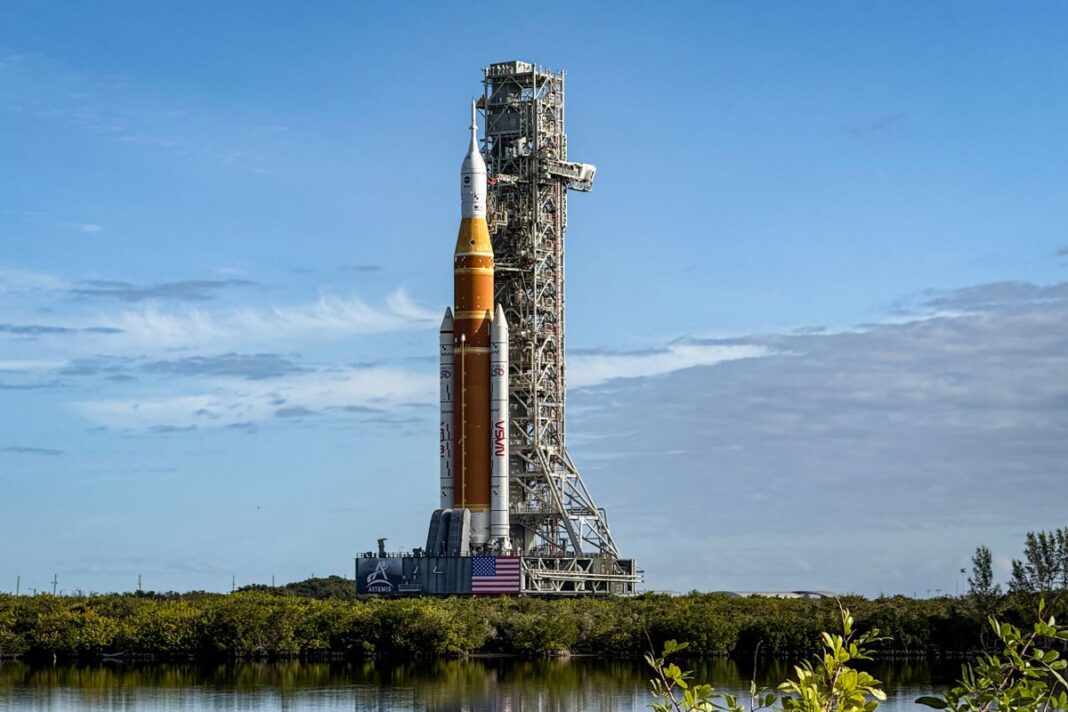


10 days, 4 astronauts, 700,000 gallons of fuel: Everything to know about the Artemis II mission.
CAPE CANAVERAL, Fla.—For the first time in more than 50 years, NASA has mounted a rocket on the launch pad at Kennedy Space Center in preparation for a manned flight around the moon.
The super heavy lift rocket is called the Space Launch System. Fueled by more than 700,000 gallons of liquid oxygen and hydrogen and two solid rocket boosters reminiscent of the space shuttle era, the orange and white behemoth could, as soon as Feb. 6, carry the Artemis II crew—NASA astronauts Reid Wiseman, Victor Glover, Christina Koch, and Canadian Space Agency astronaut Jeremy Hansen—on their 10-day voyage around the moon and farther from Earth than any astronauts have gone before.
Hundreds of men and women who had a hand in assembling the rocket braved the winter cold on Jan. 17 to watch the ship roll out of the vehicle assembly building and move to the launch complex. The Artemis II crew, mission leaders, and NASA Administrator Jared Isaacman were also on hand to commemorate the milestone.
But there is still a lot to be done before liftoff, and the exact launch date is still to be determined.
Here is what to know about the Artemis II mission, as well as what preparations and parameters still stand in the way of launch.
What Is Artemis II?
Artemis II is the second mission of NASA’s Artemis campaign. Named after the ancient Greek goddess of the moon and Apollo’s twin sister, the program’s purpose is not only to return manned missions to the moon, but also to establish a sustainable, permanent human presence on the lunar surface and in lunar orbit before 2030.
Lead flight director Jeff Radigan emphasized that the mission is first and foremost a test flight. Wiseman, Glover, Koch, and Hansen will be the first to fly aboard the Space Launch System and NASA’s Orion spacecraft, which includes the crew capsule and a service module provided by the European Space Agency.
NASA’s priorities for the test flight include successfully demonstrating that the spacecraft and ground teams can sustain the crew members for the entirety of the mission and return them safely to Earth, successfully demonstrating the operations and procedures that are essential for future crewed moon missions, and demonstrating emergency systems and operations.
These demonstrations will include proving the readiness of critical functions, including life support systems, radiation shielding, and maneuverability for docking on future missions, as well as solidifying everyday procedures onboard. That includes how to optimally stow flight suits and fulfill physical exercise requirements in the cramped quarters of the crew capsule.
The crew will also test a new laser communication array, participate in ship-to-ship communication with the International Space Station, and conduct human science experiments. Those experiments will not only broaden understanding of how deep space affects the body, but also improve NASA’s ability to customize treatments for each astronaut.
“This is a test flight, and there’s things that are going to be unexpected,” Radigan stressed at a news conference on Jan. 16. ”You know, I think we’ve prepared for those as much as we can, and we’re very much looking forward to flying this mission successfully with the crew and learning what we need to on Artemis II moving forward and paving the road for future Artemis missions.”
By T.J. Muscaro