


Far beyond medical treatment, advocates for full augmentation intend to overcome the human condition itself.
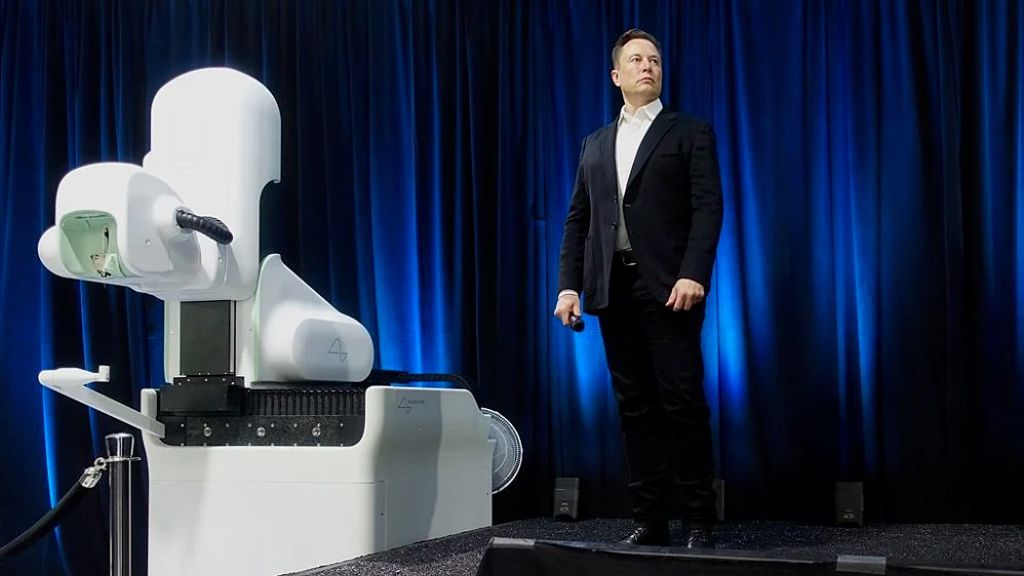
Last year, Elon Musk predicted his Neuralink brain implant could eventually allow people to bypass human language. With a handful of AI-powered chips jabbed into their brains, Neuralink users could converse with their thoughts alone. Poetry and liturgy would become a sentimental pastime, like roasting marshmallows over a campfire.
“In principle, you would be able to communicate very quickly, and with far more precision, ideas,” Musk mumbled to Joe Rogan. “And language would — I’m not sure what would happen to language … [But] really, in the first few versions all we’re going to be trying to do is solve brain injuries.”
Many scoffed at the time, just as they did when Musk hyped the idea of a self-driving Tesla. Today, a quick glance around the 405 freeway in Los Angeles provides evidence that a billionaire’s dreams can quickly become the public’s reality — even if a few models have to burst into flames to get there.
On July 14, the transhumanist goal of neuro-telepathy came a step closer to realization, thanks to a major breakthrough by a team at the University of California, San Francisco. Neuroscientists surgically implanted a subdural electrode array on the surface of a stroke victim’s brain. For 81 weeks, they fed his sensorimotor cortex signals into an artificial intelligence system. Using the algorithms’ predictive power as a sort of auto-complete feature, the team was able to translate the subject’s attempts at speech into text with extraordinary accuracy.
Although presently limited to a 50-word vocabulary, the silent patient is able to string together full sentences, which are displayed onscreen in real time. A few evocative examples include: “Here is my computer,” “My family is very comfortable,” “They have faith,” and “Faith is good.”
This experiment was supported by Project Steno, a long-term program funded and supported by Facebook. One of the project’s broader goals was to create a non-invasive helmet that could translate the average user’s thoughts into digital information. Although Facebook Reality Labs decided to put this mass-market brain-cap on hold for now, the engineers are celebrating the UCSF neuroprosthetic implant as a new “milestone” in brain-computer interface.
The experiment’s leader, neuroscientist Edward Chang, extended his gratitude to the social media company. “We’ve learned so much about how speech is processed in the brain [over the past decade], but it’s only in the last five years that advances in machine learning have allowed us to get to this key milestone,” he said. “Facebook’s machine learning advice and funding really accelerated our progress.”
Chang’s results were published in the New England Journal of Medicine. The scientists and engineers over at Neuralink are either seething with envy or dying to announce their next breakthrough in the race to create a cyborg elite.
From Healing To Enhancement
Whether or not Chang’s invasive procedure can be reproduced consistently, the momentum behind it is irrefutable. According to the prevailing mythos in Silicon Valley and various academic programs, technology can ultimately heal what ails us. Brain implants will cure stroke damage, paralysis, traumatic injuries, and even soothe emotional maladies such as depression. Far beyond medical treatment, though, advocates for full augmentation intend to overcome the human condition itself.
Of all the transhumanists in high places, Elon Musk is perhaps the most famous. Last April, he stunned the unsuspecting world with a video of a macaque monkey playing MindPong using two Neuralink chips drilled into his brain. While Neuralink’s next planned step will be treating degenerative brain disease in humans, Musk has said many times his ultimate goal is cognitive enhancement and human-AI symbiosis.
By Joe Allen
Joe Allen is a fellow primate who wonders why we ever came down from the trees. For years, he worked as a rigger on various concert tours. Between gigs, he studied religion and science at UTK and Boston University. Find him at www.joebot.xyz or @EvoPsychosis.
Joe Allen on Substack