


The future of population growth or decline is a complex issue influenced by various factors. While some countries continue to experience rapid population growth, others are already seeing a population decline. Many experts predict that the world population will continue to grow in the near future but begin to reverse in the not-too-distant future.
It usually requires a fertility rate of 2.1 to maintain a given population. However, many countries today are well below this rate. What does the future hold for various societies, given this reality?
One can calculate future population growth based on various variables – such as death rates, infant mortality rates, median age, and fertility rates for a said country. Here is a fairly good population simulator that allows for these and other variables for a said population.
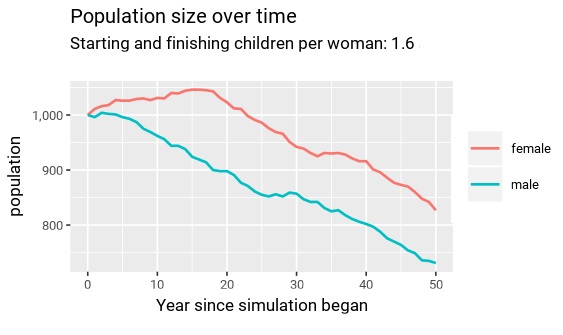
Below is a chart of a simulation of a country with a fertility rate of 1.6 – countries in this range include the US, Sweden, Brazil, Australia, Germany, and the UK, for example. In this scenario, the population will decline by 10 to 20% over the next 50 years.
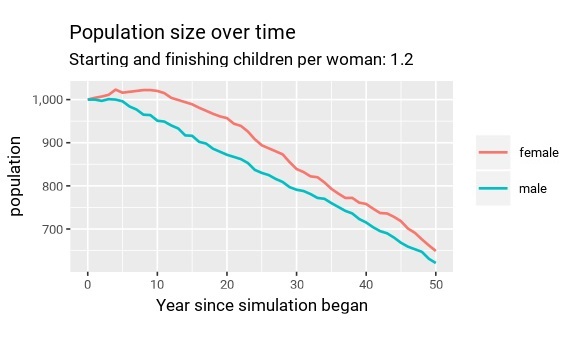
Below is a chart of a simulation of a country with a fertility rate of 1.2 – countries in this range include China, Japan, Italy, Brazil, Spain, Puerto Rico, and South Korea, for example. In this scenario, the population will decline by 20 to 30% over the next 50 years.
Several issues that are not calculated in these population statistics are the effects of immigration or other negative depopulation effects, such as severe pandemics, war, natural disasters, or other unforeseen cultural effects.
To illustrate the effects of this depopulation effect, Peter Zeihan predicts that China, with an estimated population of 1.3 billion, will only have 650 million people by 2050. Peter estimates that the Chinese system will collapse this decade. Think about what that will do to global geopolitics. See this analysis in the video below.
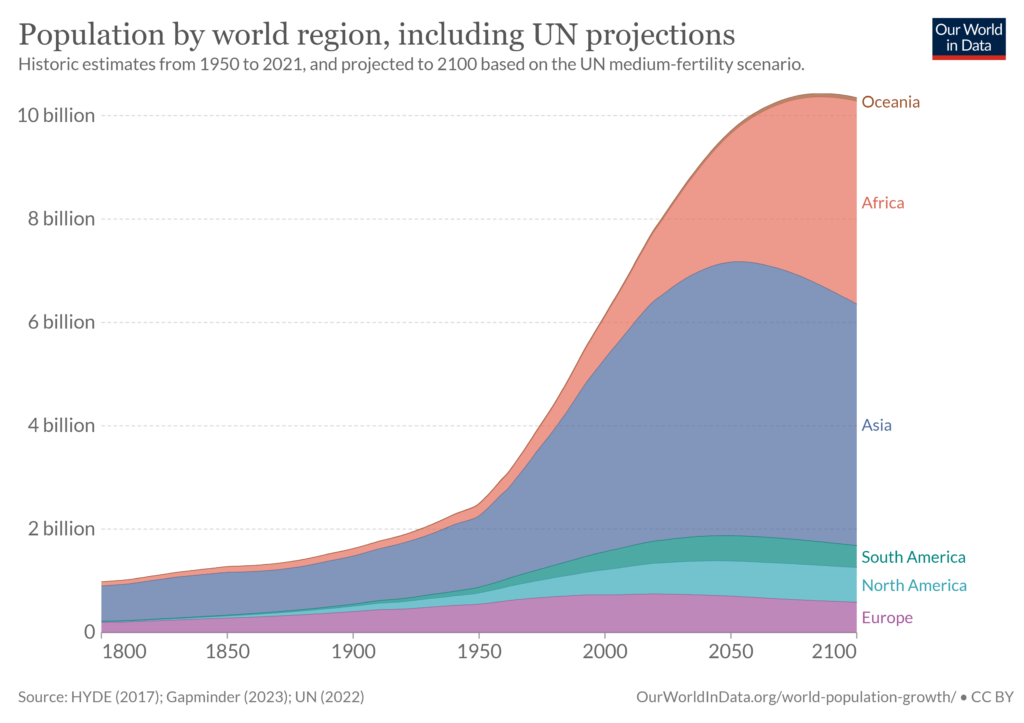
The world population increased from 1 billion in 1800 to around 8 billion today. Most of this growth in population has been post WWII – nearly 75%. So for a generation or two, the world has not known anything else but historically massive growth in populations. See this in the chart below and learn more here.
What happens when this population growth reverses? Imagine if 30% of the houses in your neighborhood become empty, and there is no need to build any new ones. A population decline can have significant consequences for a country, both in the short and long term. The following are just a few.
- Shrinking workforce: A population decline can lead to a smaller workforce, reducing economic productivity and growth.
- Demographic imbalances: A population decline can result in demographic imbalances, such as an aging population and a shortage of young people. It can lead to increased pressure on social services such as healthcare and pensions, as fewer workers support the elderly.
- Reduction in political power and influence: As the country becomes less significant on the global stage due to a declining population, it may also see a decline in political power and influence.
- Brain drain: A population decline can lead to a brain drain, where skilled workers leave the country searching for better opportunities elsewhere.
- Decreased tax revenues: Fewer taxpayers can result in reduced tax revenues, negatively impacting the government’s ability to fund public services and infrastructure.
- Reduced demand for goods and services: A population decline can lead to reduced demand for goods and services, which can negatively impact businesses and the economy as a whole.
- Social and cultural impacts: A declining population can lead to social and cultural effects, such as losing diversity and tradition, as communities become more insular.
To illustrate what much of this means for many countries with low fertility rates, we have all heard of the ongoing retirement protests in France. It’s not just France. See in the video below an interesting analysis of the beginnings of the demographic issues facing many Western countries.
Another issue for many countries will be immigration. The population shortfall can be made up with immigration at the risk of the legacy population losing their culture and political power. In short, these demographic changes may well lead to conflict – even potential wars.
Demographics is destiny – just ask many disappearing indigenous populations.
Most likely, this coming depopulation war will be a problem for the next generation. However, those over 60 years of age today are already feeling the beginning effects of this coming reality as policymakers are scrambling to resolve the financial and cultural effects that are driving these new demographics. Issues to consider when looking at demographic changes.
- Immigration and the inevitable cultural changes and conflict it brings.
- Reshaping pension plans (e.g., extending retirement age requirements) to account for the shrinkage of younger workers that could bring on economic hard times.
- Extreme feminism, woke culture, and materialism have affected many Western countries. These ideas will need a serious rethink, or Darwin will cull the behavior.
- Loss of political power from shrinking populations could cause geopolitical changes and conflict in the world.
So what are world leaders to do? China’s one-child-policy back in the 1980s has had devastating consequences. China, in a very few short years, will face demographic changes that will threaten its very existence – this will be true with other countries in similar predicaments. Consider some of the following ideas that some leaders and societies may resort to below.
- Some societies may begin to pass laws to coerce childless couples and women to procreate. This may extend to even taxing (and/or providing incentives) contraception and abortions – or outlawing them outright.
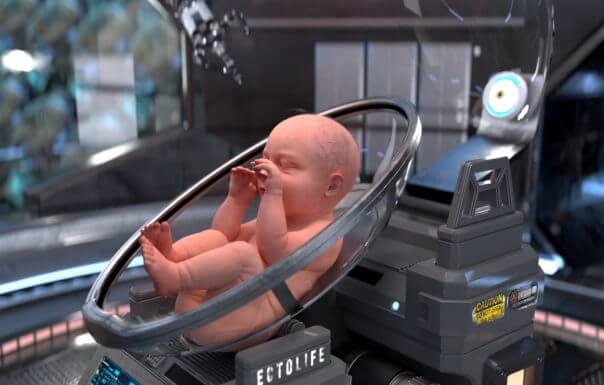
- As Frankstienish as it may seem, some misguided leaders may turn to laboratory wombs – see here and a video here.
- Perhaps even more draconian, more tyrannical leaders may consider forced pregnancies in some manner for those young childbearing women who have refused.
- Perhaps you have other scenarios to share, as frightening as they may be.
But can any of these tinkering ideas with mother nature save the affected societies? As part of the Sunday Thoughts series, is there any Biblical guidance concerning this subject? Consider the following admonishments.
- Genesis 9:7: “And you, be ye fruitful and multiply; bring forth abundantly in the earth, and multiply therein.” Our current Western culture seems to avoid this point and leave it to future generations to resolve.
- Proverbs 14:12: “There is a way which seemeth right unto a man, but the end thereof are the ways of death.” Manipulation of populations has unintended consequences that can have devastating effects on the future, as history has shown.
- Hosea 4:6: “My people are destroyed for lack of knowledge. Because thou hast rejected knowledge …” There seems to be no limit to elite leaders that think they can manage society for a believed utopia.
Regardless of your belief systems, most have no idea what these massive depopulation demographics will do to the future stability of the world. The coming depopulation wars will come and will heavily affect the next generation – and even the current generation. In the comment section below, give us your take on these coming depopulation wars.
See more Sunday Thoughts posts.
By Tom Williams