

Supreme Court Case ‘Threatens Chaos’ to Immigration System

5Mind. The Meme Platform
The Epoch Times Header

The justices will consider if tattoos thought to be associated with MS-13 are grounds for a consular officer to refuse a visa to a U.S. citizen’s husband.

A complex upcoming Supreme Court case could weaken a key tool the government uses in immigration law enforcement and throw the system into chaos, legal sources say.

The case at hand deals with the doctrine of “consular nonreviewability,” which is the legal principle that a consular official’s decision to refuse a visa to a foreigner is not subject to judicial review.

Cracking down on the doctrine would harm the immigration system and cripple its ability to conduct business, supporters of the nonreviewability principle say. Opponents, such as those who favor expanded immigration, say relaxing it respects constitutional rights and the institution of marriage.

The doctrine is a judge-made exception to the Administrative Procedure Act (APA), a federal statute enacted in 1946 that governs administrative law procedures for federal executive departments and independent agencies. The late U.S. Sen. Pat McCarran (D-Nev.) said the APA was “a bill of rights for the hundreds of thousands of Americans whose affairs are controlled or regulated in one way or another by agencies of the federal government.”

Decisions about who gets to enter the United States are vested in the legislative and the executive branches, not the judicial branch.

The U.S. Constitution gives Congress exclusive authority to create policies about the admissibility of individuals to the United States. At the same time, the legislative branch delegates the power to implement those policies to the executive branch.

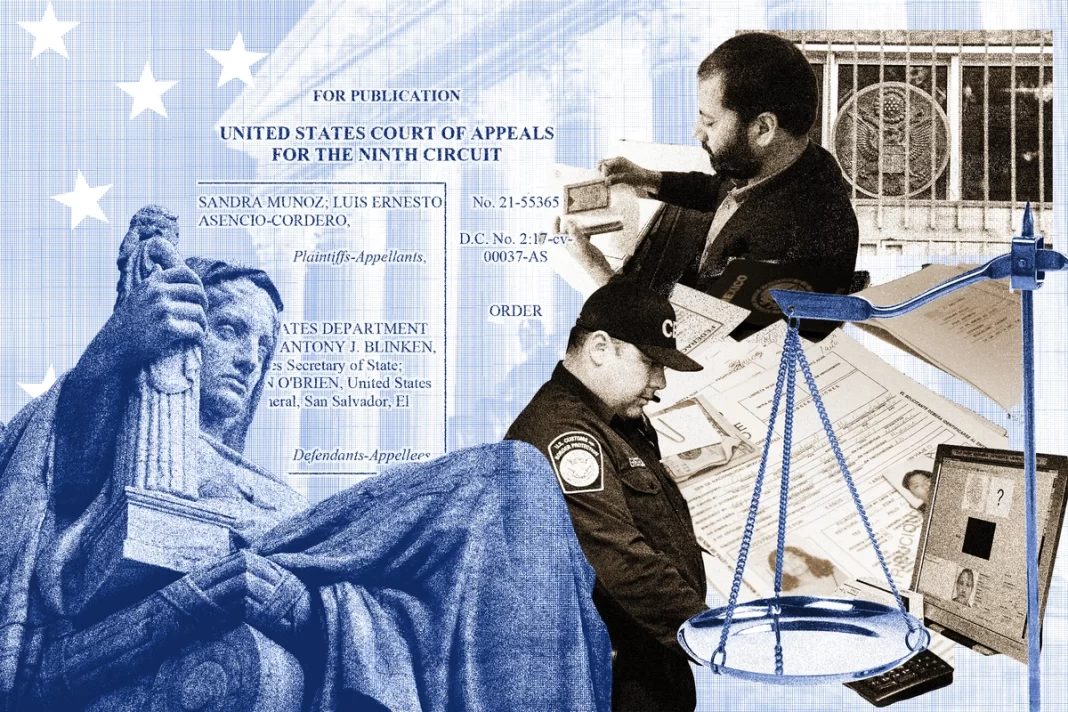
On April 23, the Supreme Court will hear Department of State v. Munoz, which concerns spousal sponsorship.

Facts of the Case

Foreign citizens have minimal rights in the immigration process, so the Supreme Court is expected to focus on whether U.S. citizens have a constitutionally protected interest in visa petitions sponsoring their spouses.

The case is about Luis Asencio-Cordero, a Salvadoran citizen with no criminal record whose U.S. immigration visa was denied because a consular officer thought his tattoos indicated gang membership. His wife, U.S. citizen Sandra Munoz, challenged the consular decision in court, arguing that her rights as a citizen were violated.

The case goes back to 2005 when Mr. Asencio-Cordero first arrived in the United States. Ms. Munoz married him in 2010 and they had a child together who is a U.S. citizen. The husband was in the country illegally.


By Matthew Vadum

Read Full Article on TheEpochTimes.com

Contact Your Elected Officials
The Epoch Times
The Epoch Timeshttps://www.theepochtimes.com/
Tired of biased news? The Epoch Times is truthful, factual news that other media outlets don't report. No spin. No agenda. Just honest journalism like it used to be.

Rob Reiner’s Death Proves Trump Right, Again

“I believe Donald Trump will be the last president...

The Sacred Responsibility

From the beginning of time the female of every kind holds the sacred responsibility of continuing existence itself.

Vaxx Producers Would Go Bankrupt Without Legal Immunity, Concedes Former CDC Director

Rochelle Walensky justified in a Boston Globe "Fireside Chat" vaccine makers’ special legal protections that leave Americans no recourse for injuries paid.

What’s Really Behind the US’ Ambitious Tech Plans for Armenia?

Two US think tank experts argued in a WaPo article that deeper American engagement with Armenia could help more effectively contain Russia.

Unheralded and autonomous

NIL money has turned recruiting into a financial arms race, where loyalty fades and players follow whoever writes the biggest check.

One Big Beautiful Bill: From Taxes to Tuition, How Key Provisions Will Roll Out

President Donald Trump’s One Big Beautiful Bill has set in motion one of the most far-reaching overhauls of U.S. tax and social policy in years.

FBI Had Concerns About Probable Cause for 2022 Mar-a-Lago Raid, Patel Says

FBI Director Kash Patel said agents warned DOJ of probable cause issues weeks before the 2022 Mar-a-Lago raid to recover classified documents.

Trump Says He’s Considering an Executive Order to Reclassify Marijuana

President Trump is considering an executive order to reclassify marijuana out of Schedule I, reserved for drugs deemed to have no medical value.

FDA Not Adding ‘Black Box’ Warning to COVID-19 Vaccines: Commissioner

The FDA is not adding “black box” warnings to COVID-19 vaccines, even though an agency center recommended it, FDA commissioner Dr. Marty Makary said on Dec. 15

Trump Defends Susie Wiles After Vanity Fair Article

President Trump defended his Chief of Staff Susie Wiles, who Vanity Fair reported as saying the president has an “alcoholic personality” in an interview.

Trump Says He Is Pardoning Former Colorado County Clerk Tina Peters

Trump is pardoning Tina Peters, a former Colorado county clerk convicted of election machine tampering in the aftermath of the disputed 2020 election.

Trade Chief Jamieson Greer Indicates Progress on US–India Trade Deal

U.S. Trade Representative Jamieson Greer hinted that the United States and India are making progress on a deal.

Trump Touts Lower Prices, Bigger Paychecks in 1st Stop of National Tour

President Trump told an energetic crowd at a Dec. 9 rally that his administration’s policies are lowering the cost of living nationwide.
spot_img

Related Articles