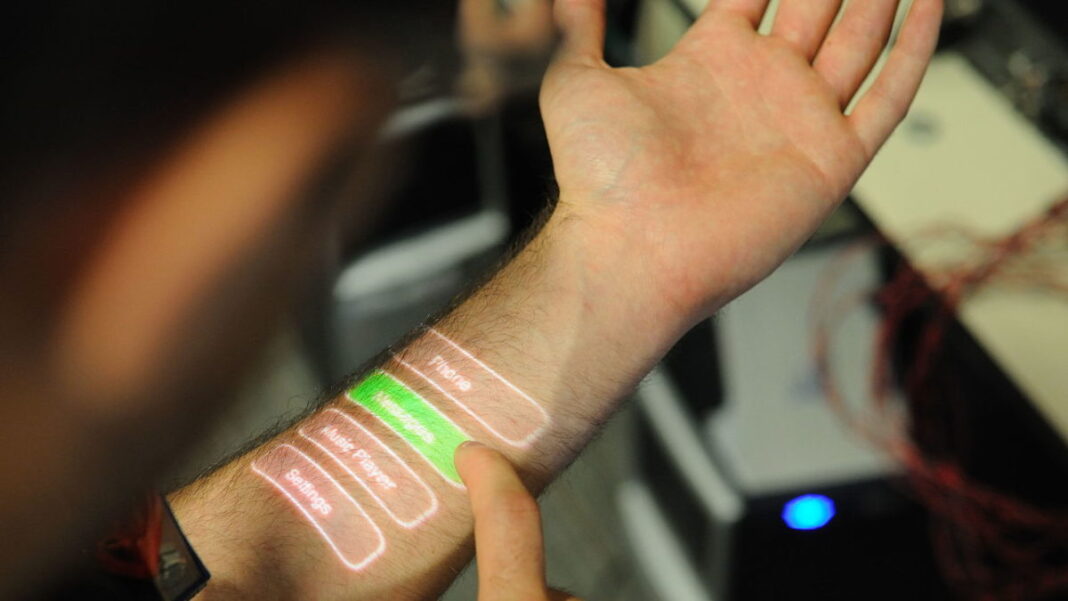



If military strategists, corporate elites, and government officials are taking the prospect of implanting humans with biotech seriously, so should we.
Last week, the world glimpsed a future in which vaccine passports are implanted under the skin. A viral video from South China Morning Post profiled a Swedish start-up hub, Epicenter, that injects its employees with microchips.
“Right now it is very convenient to have a COVID passport always accessible on your implant,” its chief disruption officer, Hannes Sjöblad, told the interviewer. Oddly enough, he repeatedly spoke of chipping “arms” when we clearly see a woman opening doors with her hand.
Two years earlier, Sjöblad told ITV, “I want us humans to open up and improve our sensory universe, our cognitive functions. … I want to merge humans with technology and I think it will be awesome.”
Naturally, some Christians see the Mark of the Beast. In a sane world, the idea of having your hand chipped to access public goods or private property—to receive a mark in order to “buy, sell, or trade”—should alarm anyone, regardless of religious persuasion. The same goes for using an implanted brain-computer interface to access the digital realm, as Elon Musk plans to do with Neuralink.
Yet for a growing fringe, this invasive tech isn’t just desirable. It’s already normal. Presently, some 5,000 Swedes use implanted radio frequency identification (RFID) chips to open doors, pay cashless, present medical records, access concert venues, and ride public transportation. According to Ars Technica, as of 2018 an estimated 50,000-100,000 people worldwide have microchip implants, primarily in their hands.
A 2019 analysis in Nature reported about 160,000 people have deep brain stimulation devices implanted in their heads. Currently, this is only done out of necessity to treat disorders like epilepsy and Parkinson’s disease, or even addiction and depression. Of these devices, only 34 are true brain-computer interfaces. However, with current advances in technology, enormous injections of capital, and the U.S. Food and Drug Administration’s (FDA’s) recent approval, that number will rapidly climb.
Hurtling Toward a Hybrid Humanity
Enthusiasts say they aim to propel these technologies from healing to enhancement. In 2018—the same year Biohax gained international attention for chipping thousands of Swedish hands—MIT Technology Review boosted it with the fawning headline: “This company embeds microchips in its employees, and they love it.”
Since the first human-grade RFID implant was patented in 1997, followed by FDA approval in 2004, subdermal microchips have become just another device in a growing cyborg toolkit. Drawing on that cache, the Internet of Bodies paradigm has gained enormous traction among the medical establishment. At the extreme end, the concept of natural-born humanity is to be abolished.
For more than six decades, the U.S. Defense Advanced Research Projects Agency (DARPA) has funded Human 2.0 projects, with particular interest in brain-computer interfaces. Citing these and many other human-machine hybrids, the World Economic Forum’s chairman Klaus Schwab recently spelled out his vision of civilizational transformation. His widely read books—“The Fourth Industrial Revolution” (2016) and “The Great Reset” (2020)—both describe inexorable progress toward total technocracy.
The same idea emerges in a 2019 government analysis by Policy Horizons Canada, entitled “Exploring Biodigital Convergence.” According to the authors, “Digital technology can be embedded in organisms [and today] biotechnology may be at the cusp of a period of rapid expansion—possibly analogous to digital computing circa 1985.” Its success will hinge on sweeping surveillance.
The document goes on to describe tracking chips, wearable bio-sensors, internal organ sensors, Web-connected neurotech, swallowable digital pills—merging body and brain with the digital beehive.
Last spring, the UK’s Ministry of Defense published the jarring study, “Human Augmentation: The Dawn of a New Paradigm.” The authors promise this “will become increasingly relevant, partly because it can directly enhance human capability and behavior, and partly because it is the binding agent between people and machines.” Surveying today’s cyborgs, they write, “Once inserted, these ‘chips’ can…replace many of our keys and passwords, allowing us to unlock doors, start vehicles, and even log onto computers and smartphones.”
All the above authors fret over ethics in a perfunctory fashion, but most accept the “inevitable” fusion of man with machine. If military strategists, corporate elites, and government officials are taking this prospect seriously, so should we.
The New Normal Is Total Digitalization
For people with any sense at all, the notion of having a microchip jabbed into your hand (or your head) triggers animal revulsion. Disturbing as it may be, a more immediate concern is the widespread use of non-invasive biometric systems.
Wherever the New Normal takes hold, access to society is granted or denied on the basis of arbitrary “health and safety” concerns. Today, it’s masks or vaccine status. Tomorrow, it could be ideology. Authorities don’t have to chip you if they can simply scan your smartphone and tell you to get lost, or lock you in your dwelling pod whenever “the numbers” rise.
To cite one common example among many, the biometric company Clear rode the Patriot Act to prominence. Today, Clear is contracting to provide biometric and QR code-based vaxxports to fully jabbed citizens on the go.
It won’t stop there. Not without a fight. As Clear’s CEO Caryn Seidman-Becker told CNBC last year, “Just like screening was forever changed post-9/11, in a post-Covid environment you’re going to see screening and public safety significantly shift. But this time it’s beyond airports. It’s sports stadiums, it’s retail, it’s office buildings, it’s restaurants.”
Taking a more cerebral angle, tech mogul Bryan Johnson founded Kernel to develop non-invasive brain-scanning helmets to enhance your health and happiness. The devices can also gather users’ neurological data. Last summer, Johnson told Bloomberg Businessweek that by 2030 he’d like to put his BCI helmets in every American household.
These people want to completely transform our mental and physical spaces. It isn’t even a secret. They want some form of transhumanism, whether they use the term or not. It’s past time to smash their devices.
America Cannot Let This Happen
One by one across the globe, canaries are falling dead in the digital coal mine. We see implanted vaxxports in Sweden, lockdowns for the unvaccinated in Austria and Germany, and yes, quarantine camps in Australia.
The Untact program in South Korea is specifically designed to replace human interaction with social robots and the Metaverse. At the pandemic’s outset, American writers at The Atlantic and CNN urged U.S. leaders to adopt Chinese authoritarianism. Their wish is beginning to come true.
By Joe Allen
Read Full Article on TheFederalist.com