

The talks unfolded as Washington pushes for deescalation and the U.N. peacekeeping force in southern Lebanon prepares to end its mission.
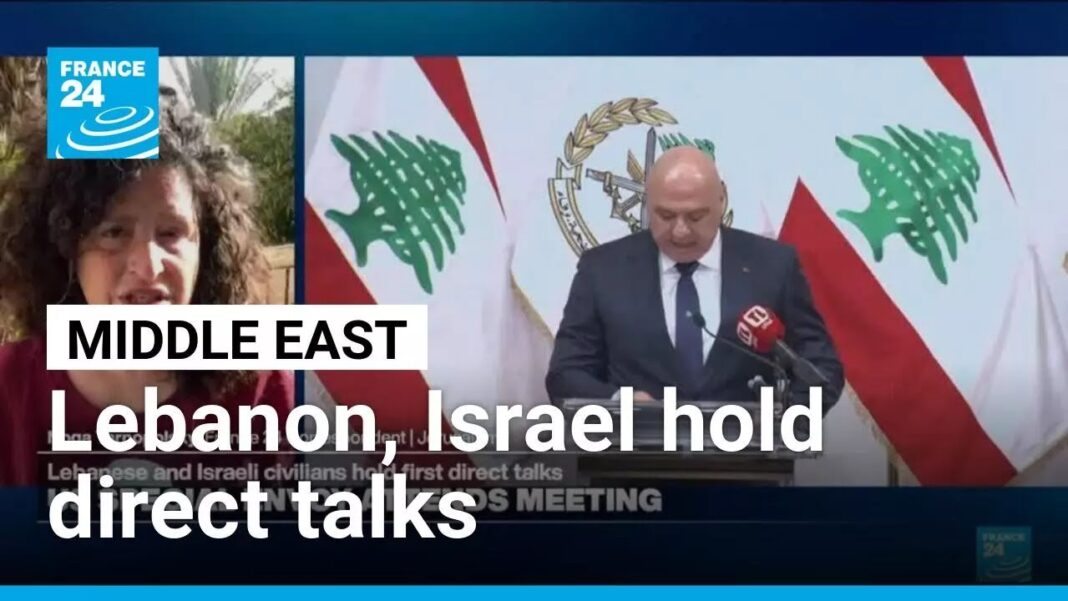
Lebanese President Joseph Aoun said on Dec. 5 that this week’s phase of Lebanon–Israel negotiations in southern Lebanon focused on ending Israeli military action in Lebanese territory, after the Israeli prime minister’s office said it seeks economic cooperation.
In his speech to the visiting U.N. Security Council delegation, Aoun said officials from Lebanon, Israel, and the United States met in Naquora, southern Lebanon, on Dec. 3, and the negotiations were primarily aimed at ending what he called “the hostile actions carried out by Israel on Lebanese territory,” recovering prisoners, scheduling the withdrawal of Israeli forces, and resolving disputed points along the Blue Line. The Blue Line is the U.N.-mapped boundary that serves as the frontier between Lebanon and Israel.
He said that the success of the talks depended mainly on Israel’s position, which would determine “whether the negotiations produce practical outcomes or fail.”
Ahead of the Dec. 3 meeting, Israeli Prime Minister Benjamin Netanyahu described it as a step toward establishing a basis for relations and economic cooperation with Lebanon.
Lebanese Prime Minister Nawaf Salam said on Dec. 3 that normalization of relations with Israel remains distant, but hoped the meetings would help “defuse tensions,” saying further Israeli strikes in recent weeks sent an escalatory signal.
Under the 2024 U.S.–French-brokered cease-fire, Israel was to pull its forces out of southern Lebanon, while the Lebanese army was tasked with removing Hezbollah fortifications near the border.
Tensions have persisted, with Israel retaining positions inside Lebanon and carrying out airstrikes it says are aimed at stopping Hezbollah from rearming and preparing new attacks.
The Israel Defense Forces (IDF) said it targeted several Hezbollah weapons storage sites in southern Lebanon on Dec. 4, describing them as “located in the heart of the civilian population” and accusing Hezbollah of using civilians as human shields.
The IDF said the sites violated agreements with Lebanon and that it would continue to operate to remove any threat to Israel.