

The as yet unresolved Ukraine peace initiative notwithstanding, America’s 47th president has secured key victories for his legacy. And pragmatism was at the heart of each.
Since his inauguration in January, Donald Trump has endured ongoing criticism from factions of his MAGA base – due in large part to the ongoing conflicts in Gaza and Ukraine. He prevailed in the election by promising – along with other commitments — to end several protracted foreign conflicts.
On a somewhat counterintuitive note, Trump’s most strident critic, recently, has been Rep. Marjorie Taylor Greene (R-GA) – a former Trump devotee and committed MAGA supporter.
The Georgia Republican has recently indicated her intent to resign her seat following a scathing social media attack by Trump for criticism of his refusal to release all documents held by the Justice Department relating to its investigation of Epstein.
Such is the political context which precipitated Trump’s more aggressive efforts at resolving the Gazan, Ukrainian and Epstein controversies. Clearly, his domestic and foreign policy agendas are inextricably related.
The US president recently brokered a solution to the Gaza conflict that has resulted in a temporary “peace” (i.e. cease fire) – one which, unfortunately, is unlikely to satisfy either the Palestinians or the Netanyahu government. It is, however, acceptable to the Arab states in the Middle East, Russia, China, and the United Nations.
Trump’s provisional settlement is one that the Biden administration did not even contemplate. Biden, as was the case with other presidents before him, was committed to uncritically maintaining the status quo of the 1993 Oslo Accords – irrespective of the absence of any realistic possibility for their success.
The 47th president has achieved such dramatic political results by just being himself – a quintessential American pragmatist.
Trump’s domestic agenda is contrary to modern liberalism’s elitist approach and is rather authoritarian – yet, as you will see, his unexpected endorsement last week of the “democratic Socialist” mayor-elect of New York City, Zohran Mamdani, reveals Trump’s pragmatic – flexible — politics.
Ukraine
Trump’s efforts to resolve the three-year conflict in Ukraine have, until recently, proved elusive. Ukrainian leader Vladimir Zelensky’s intransigence, and the determination of London and Brussels to support their ailing proxy – “for as long as it takes” – has continued to prolong the conflict.
It now appears, however, that the US president may be on the brink of resolving the conflict – which has needlessly wrought destruction and death for the past three years.
Trump’s latest attempt to end the conflict is based on a 28-point peace initiative published last week. Again, this resolution was never even contemplated by Biden – committed as he was to supporting the faltering Zelensky regime so as to conduct a proxy war with Russia.
Trump is determined to end the Ukraine conflict, but not because he is an isolationist and wants to defuse growing discontent within the Republican Party. Moreover, it is not because he has any real understanding of the complex historical relationship between Ukraine and Russia or an appreciation of how the US-led eastward expansion of NATO since the early 1990s provoked the ‘Russian Bear” into conflict in the first place.
The answer is to be found in Trump’s essential pragmatism and his instinctive belief that politics – both foreign and domestic – can be reduced to what he terms “the art of the deal.”
Trump’s determination to end the Ukraine conflict has been opposed by influential figures within his own party – his administration contains many anti-Russia hawks and enthusiastic supporters of Ukraine. Keith Kellogg, Trump’s special envoy to Ukraine, who announced his resignation this week, fell into this category. So, too, until recently, did Trump’s secretary of state, Marco Rubio.
Consequently, Trump insisted that the negotiations relating to his 28-point peace plan be conducted by Steve Witkoff, Trump’s special envoy to Russia, rather than Kellogg or Rubio. Witkoff is neither a diplomat nor an ideologue – he is, like Trump, a wealthy property developer and a pragmatist.
This also explains why Ukraine’s backers continue to criticize Witkoff — seeking to preclude his participation in ongoing settlement negotiations.
At this point, however, Trump is likely to succeed in resolving the Ukraine conflict. By any measure, circumstances now compel a settlement: Russia’s comprehensive military success in Ukraine (roughly one-fifth of the country is currently under Russian control); the lack of manpower needed to prosecute the conflict; the increasing political instability and unpopularity of the Zelensky regime (evidenced by resignations, the jailing of political opponents, and endless corruption scandals); the fact that Trump has made it clear to Zelensky that if a settlement is not reached, America will stop intelligence sharing and the supply of weapons to Ukraine; intensifying opposition to the conflict within those European nations that continue to fund it.
Trump gave Zelensky a week to accept his plan, but agreement will not be reached within this timeframe. Given that the plan obligates Ukraine to cede large tracts of territory, reduce its military capability and give up any hope of joining NATO, further discussions between the US and Kiev – which began this week – will clearly be necessary if a settlement is to be achieved.
And it appears that the UK, France, and Germany are now willing, for the first time, to seriously contemplate a settlement of some kind – although the ideologically-driven alternative settlement plan suggested by them this week will be rejected by Trump.
Interestingly, mainstream Western media organizations have recently modified their uniformly adulatory view of Zelensky. No longer is he portrayed as a saint-like figure and successful statesman. In fact, some media coverage of Zelensky now mirrors Trump’s pragmatic assessment of him – as a failed leader who could have prevented the conflict, rejected a favorable early settlement offer under pressure from the West, and is now obliged to accept very harsh peace terms.
New York’s new mayor
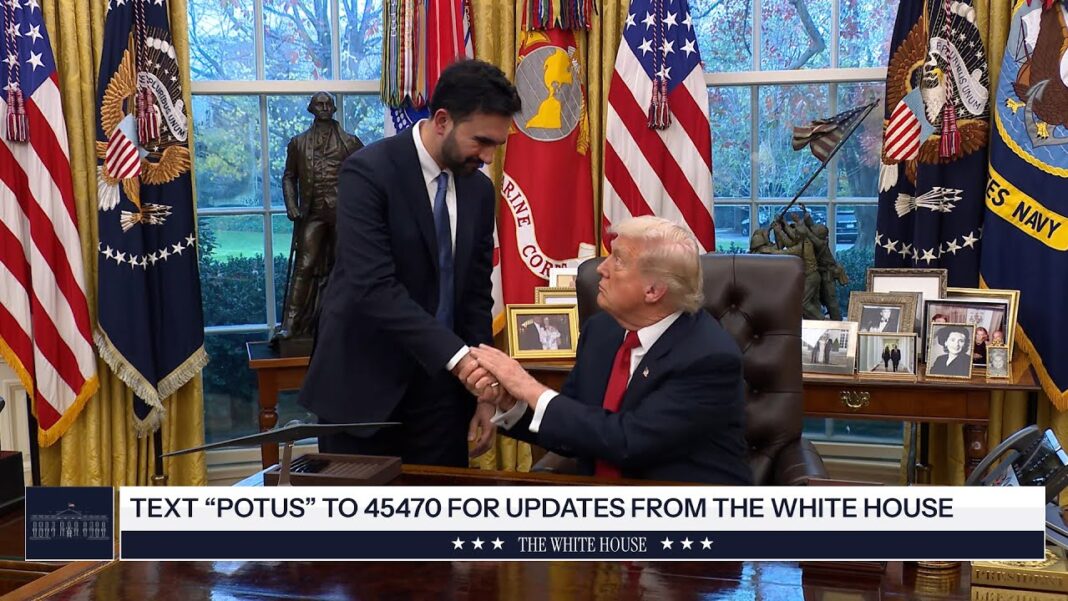
If anyone doubts Trump’s pragmatism, his meeting at the White House last week with newly-elected New York City mayor, Zohran Mamdani, should dispel any illusions in that regard.
During Mamdani’s campaign, Trump condemned him as a “100% communist lunatic” and “total nut job” and endorsed his opponent, former Democrat Governor Andrew Cuomo. Trump also threatened to cut off federal funds to New York if Mamdani was elected mayor.
Thus, when Trump invited Mamdani to the White House for a meeting last week, mainstream media expected ideological pyrotechnics.
But Trump welcomed Mamdani warmly and congratulated him on his victory, telling journalists: “I expect to be helping him, not hindering him.” Trump, in fact, foreshadowed entering into a political partnership with Mamdani that “would make New York city great again.” Trump also stunned journalists by saying, “some of his ideas are really the same ideas that I have.”
Mamdani, being something of a pragmatist himself, and no doubt wishing to secure much needed federal funding for New York, graciously accepted Trump’s glowing endorsement.
Trump, in fact, will find it much easier to work with the left-wing populist Mamdani than the current Democratic Party leadership. After all, the Democrat elites genuinely despise and fear Mamdani.
Trump endorsed Mamdani because the New York mayor is a winner – and Trump wants to achieve electoral success in New York in next year’s mid-term elections. In the last presidential election, Trump polled very well in some working-class districts of New York – attracting the votes of ordinary New Yorkers who refused to vote for the elitist Democratic Party.
This brings me back to the Republican Congresswoman from Georgia and Trump’s internal MAGA critics – all of whom are committed ideologues, unable (or unwilling) to comprehend Trump’s political pragmatism.
This is why Trump has been able to so easily disarm Greene and her attacks on him. Trump branded her a “traitor” and sarcastically referred to her as “wacky.” He then, in a 180-degree pivot, agreed to release all the Epstein documents – realizing that, no matter what they disclose, he will always be able to maintain that the Epstein saga is a “Democrat hoax” and simply ignore the consequences.
By announcing his 28-point peace plan and agreeing to release the Epstein documents in full, Trump has cleverly warded off any political threat that Greene, his Ukrainian detractors and others pose to him.
Thus, in little more than a week, Trump initiated serious settlement discussions designed to finally resolve the conflict in Ukraine, ended the political career of his most vociferous internal MAGA critic, and brokered a political rapprochement with the socialist mayor of New York – remarkable achievements that confirm Donald Trump — as America’s pragmatist, extraordinaire.