

Democrats and Republicans are eyeing pivotal Senate races as polling, retirements, and primaries shape the 2026 electoral battlefield.
As 2025 draws to a close, the country is already turning its attention to next year’s midterm elections.
Republicans are facing favorable odds in the Senate, where they currently hold a 53–47 advantage.
In the 2026 midterms, 33 Senate seats are up for election—20 currently held by Republicans and 13 held by Democrats. Prediction site Polymarket gives Republicans a 66 percent chance at holding the upper chamber.
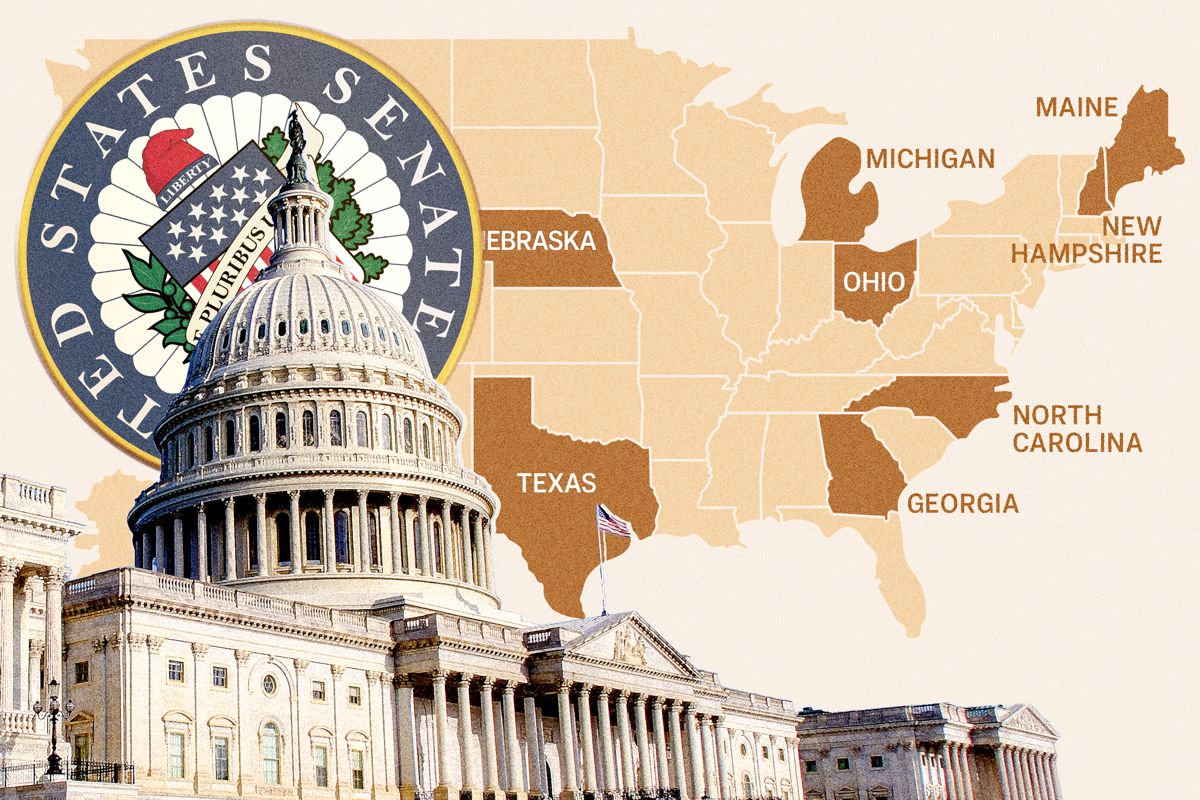
To do so, they’ll need to fend off challenges from Democrats and make gains in a series of key races, including in Georgia, North Carolina, Maine, and Texas.
Meanwhile, Democrats are the current favorites to reclaim the House from Republicans, who hold the chamber 220 to 213, with two vacancies. Prediction sites such as Polymarket are giving Democrats a 78 percent chance of winning and RealClearPolitics (RCP) shows Democrats leading in House polls by about 3.7 percentage points.
Here are the top eight Senate races to watch, leading up to the Nov. 3, 2026, general election.
1. Texas
Both the Democratic and Republican primaries in the Lone Star State are intense contests.
On the GOP side, Texas Attorney General Ken Paxton is running to replace incumbent Sen. John Cornyn (R-Texas).
Paxton entered the race earlier this year, carrying baggage from controversies, including a 2023 impeachment trial in which he was ultimately acquitted by the Texas Senate.
The race has been labeled by Paxton as a contest between his populist, America First politics and the establishment politics, which he claims are represented by Cornyn.
Cornyn has described the race as a question of character, referencing Paxton’s impeachment, allegations of adultery, and other legal challenges faced by his challenger.
Most observers and prediction markets have pegged these two candidates as the frontrunners.
However, Rep. Wesley Hunt (R-Texas) has also thrown his hat into the ring, setting up a three-way primary that is likely to result in a runoff.
The National Republican Senatorial Committee, the main campaigning and fundraising arm of the Senate GOP, is supporting Cornyn, who is slightly favored in current RCP polling.
Trump has not yet made an endorsement in the race.
Given the broader political environment, Democrats hope for a long-shot win and currently leading the pack of potential nominees is Texas state Rep. James Talarico.
Talarico rose to prominence during the redistricting battle this summer as Texas Republicans voted to add five Republican districts to the state’s congressional map.
His main rival for the nomination is Rep. Jasmine Crockett (D-Texas), whose Oct. 8 entry into the race prompted Rep. Colin Allred (D-Texas) to end his bid.
The primary race will be held on March 3, and any runoff races are scheduled for May 26.
2. Georgia
For years, Republicans have sought to reclaim at least one of the Peach State’s two Senate seats, which were won by Sens. Raphael Warnock (D-Ga.) and Jon Ossoff (D-Ga.) in early January 2021 runoff elections.
This year, Ossoff has no Democratic rivals to fend off in the primary; while Republicans show a crowded field in their bid to reverse their losing streak in the state’s Senate races.
The top declared challengers in the Republican primary include Rep. Mike Collins (R-Ga.), Rep. Buddy Carter (R-Ga.), and former football coach Derek Dooley.
Each has emphasized loyalty to Trump as they vie for an endorsement from the White House, though the president has so far stayed out of the race.
Outgoing Georgia Gov. Brian Kemp has endorsed Dooley.
The RCP average shows Collins currently leading the GOP field by almost 10 percent.
However, Ossoff leads in hypothetical match-ups with any of the three Republicans in the general election.
Georgia’s primary is set for May 19, 2026, and the primary runoff date is June 16, 2026.
3. Maine
Further up the Eastern Seaboard, a long-serving Republican could be facing her toughest political challenge yet.
First elected in 1996, Sen. Susan Collins (R-Maine) has bucked trends in New England, where all other federal office seats are held by Democrats.
Collins’s seat is a top target for Democrats. She was reelected in 2020 with 51 percent of the vote, fending off Democratic challenger Sara Gideon who won 42.4 percent.
Two major Democratic contenders seeking the nomination in the Pine Tree State are military veteran and political newcomer Graham Platner and Maine Gov. Janet Mills.
At the start of the election cycle, Platner’s populist and progressive brand of politics garnered attention from left-leaning Democratic voters nationwide, earning him the endorsement of Sen. Bernie Sanders (I-Vt.).
However, his candidacy has faced difficulties following multiple scandals.
Mills’ candidacy has the backing of Senate Minority Leader Chuck Schumer (D-N.Y.).
Platner has a wide lead over Mills in the RCP average, which also shows that he would defeat Collins. Polling shows Collins winning a hypothetical matchup with Mills.
Maine’s primary is scheduled for June 9, 2026.
4. Michigan
In Michigan, Republicans hope to capitalize on incumbent Sen. Gary Peters’ (D-Mich.) retirement to win a key pickup in a state that has become synonymous with battleground politics in recent years.
Former Rep. Mike Rogers (R-Mich.) is the presumptive GOP nominee this year. Rogers was the Republicans’ nominee in the state’s 2024 Senate election, which he lost to Sen. Elissa Slotkin (D-Mich.) by just 0.3 percent.
Trump has endorsed Rogers in the race.
However, in a race that still favors Democrats, the Democratic field is more competitive. So far, Rep. Haley Stevens (D-Mich.), Michigan state Sen. Mallory McMorrow, and physician Abdul El-Sayed have thrown their hats in the ring.
McMorrow has said she would not support Schumer as Senate Democratic leader if she is elected. Establishment Democrats are supporting Stevens.
The RCP average shows Stevens with a narrow lead in the primary, and that Rogers would defeat those three candidates in a matchup.
Michigan’s primary election is scheduled for Aug. 4, 2026.
5. Ohio
Once upon a time, the Buckeye State was the definitive swing state, serving as a top target for both parties. But in recent years, it’s become nearly a lock for Republicans.
This year, Sen. Sherrod Brown (D-Ohio) hopes to change that—and make a political comeback after losing his seat in the state’s 2024 Senate election.
Brown served in the Senate from 2007 to 2025, before losing to Sen. Bernie Moreno (R-Ohio) in the 2024 election.
The seat up for grabs is currently occupied by Sen. Jon Husted (R-Ohio), who was appointed by Gov. Mike DeWine to fill the seat after Vice President JD Vance assumed his current role.
The race this year is a special election, and the winner will serve out the remaining two years of Vance’s term.
The RCP average shows Husted, who has been endorsed by Trump, leading by 2.5 percentage points.
Ohio’s primaries are set for May 5, 2026.
6. North Carolina
North Carolina has long been viewed as a swing state, despite its results typically favoring Republicans.
This year, Republicans are seeking to hold the seat being vacated by Sen. Thom Tillis (R-N.C.), who is retiring.
Democrats’ chances in the race are bolstered by the decision of former Gov. Roy Cooper—a popular Democrat who has proven electable at a statewide level—to seek the post.
“I have thought on it and prayed about it, and I have decided: I want to serve as your next United States Senator, because, even now, I still believe our best days are ahead,” Cooper said in a video posted to his YouTube account on July 28.
Republicans are expected to field Republican National Committee Chairman Michael Whatley, who has been endorsed by Trump.
The RCP average shows Cooper, who served as governor from 2017 to 2025, leading Whatley by 4.7 percentage points.
The North Carolina primary will be held on March 3, 2026, and any runoffs are scheduled for May 12, 2026.
7. Nebraska
In Republican stronghold Nebraska, the Democrats don’t plan to field a candidate.
Sen. Pete Ricketts (R-Neb.), who was appointed by the governor to fill the vacancy left by the retirement of Sen. Ben Sasse (R-Neb.), is the odds-on favorite to win the seat.
However, Republicans could still face a battle to hold the seat in 2026 in the form of independent candidate Dan Osborn.
In 2024, Osborn—who wouldn’t caucus with either party—came within 6.67 percent of winning the seat.
Nebraska’s primary is set for May 12, 2026.
8. New Hampshire
Though New Hampshire favors Democrats on a national level, Republicans hope to defy trends this year in the wake of Sen. Jeanne Shaheen’s (D-N.H.) retirement.
The Republican primary is a two-way race between former Sens. John E. Sununu (R-N.H.) and Scott Brown (R-Mass.).
Establishment Senate Republicans are supporting Sununu, who served in the Senate between 2003 and 2009.
The RCP average shows Sununu leading the primary race by 13 percentage points.
On the Democrat side, Rep. Chris Pappas (D-N.H.) is the frontrunner.
In possible general election matchups, RCP polling shows Pappas with a narrow edge on Sununu and winning against Brown by double digits.
The primary election in New Hampshire is scheduled for Sept. 8, 2026.
By Joseph Lord and Jackson Richman