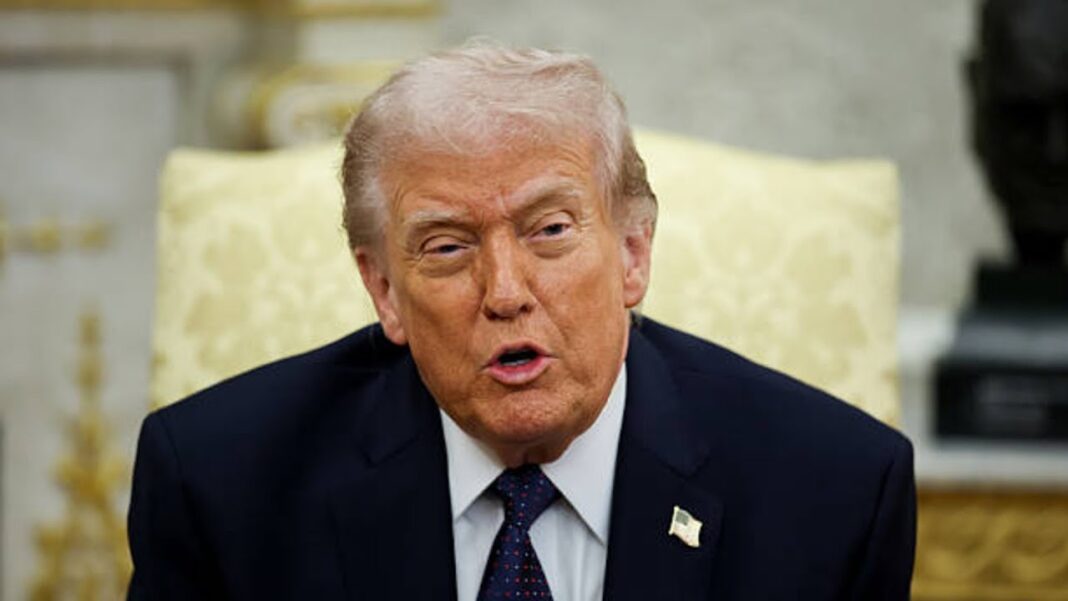
The president said the U.S. Navy would begin escorting tankers through the Strait of Hormuz, if necessary.
U.S. President Donald Trump said on March 3 that the U.S. Navy could begin escorting tankers through the Strait of Hormuz, a vital artery for oil and gas shipping.
In a post on Truth Social, Trump said he has directed the U.S. International Development Finance Corp. to begin offering political risk insurance and financial guarantees to support the security of all maritime trade moving through the Gulf.
He noted that the measure is aimed particularly at energy shipments, which make up a substantial share of global traffic through the region.
“If necessary, the United States Navy will begin escorting tankers through the Strait of Hormuz, as soon as possible,” the president said.
“No matter what, the United States will ensure the free flow of energy to the world. The United States’ economic and military might is the greatest on Earth.”
More actions will be revealed, he said.
Oil Prices
Crude oil prices pared most of their gains following the president’s social media post.
A barrel of West Texas Intermediate (WTI)—the U.S. benchmark for oil prices—had been up by as much as 8 percent during the March 3 trading session. As of 2:56 p.m., oil prices are up by about 1 percent at roughly $72 per barrel on the New York Mercantile Exchange.
U.S. stocks have also rebounded from their session lows.
The decision comes one day after U.S. Secretary of State Marco Rubio told reporters that the administration would introduce plans to mitigate surging crude oil prices.
Traffic in the Strait of Hormuz has slowed. Scores of oil and gas companies and shipping giants have suspended transportation in the region. Maritime insurers have suspended coverage for voyages through the narrow strait located between Iran and Oman.
Approximately 20 million barrels of oil and petroleum products—about one-fifth of the global supply—traverse the area, with 90 percent exported to Asia.
New industry data found that transit across all vessel types has plummeted more than 80 percent from the previous week. A single crude oil tanker had traversed the crucial chokepoint since the joint U.S.–Israel attack on Iran, and no liquefied natural gas carriers have been recorded.
The Strait of Hormuz had become the focal point for market watchers. Analysts had warned that even a partial supply disruption would lead to volatility in global energy markets.
“A formal closure of Hormuz is not required to disrupt supply. Insurance withdrawal and risk aversion can effectively shut the strait without a decree,” Mark Malek, CIO at Siebert Financial, said in a note emailed to The Epoch Times.
During a bilateral meeting with German Chancellor Friedrich Merz earlier in the day, Trump told reporters that he expects oil prices to remain high for “a little while” but then decline once U.S. operations in Iran are finished.
“People felt it’s something that had to be done,” Trump said. “As soon as this ends, those prices are going to drop, I believe, lower than even before.”
By Andrew Moran