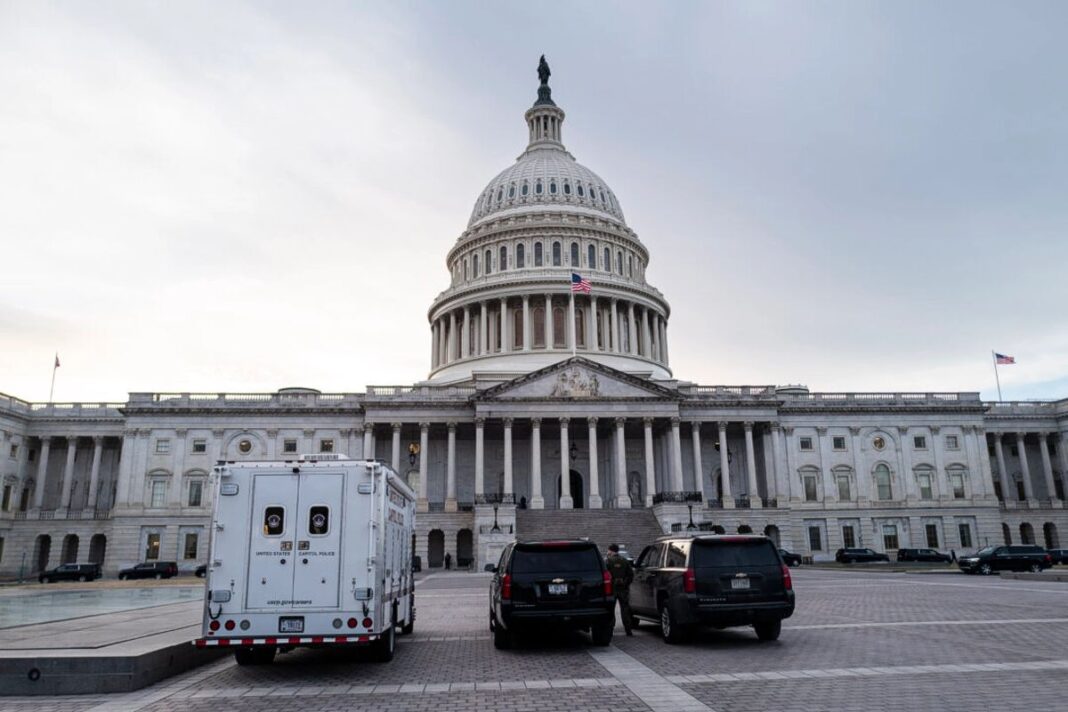
President focuses on accomplishments, outlines bold agenda to improve affordability for Americans and attract more investment into the country.
WASHINGTON—President Donald Trump on Feb. 24 delivered the first State of the Union address of his second term, saying that his economic policies and America First agenda are delivering results for the American people.
“Tonight, after just one year, I can say with dignity and pride that we have achieved a transformation like no one has ever seen before, and a turnaround for the ages,” Trump said.
“We will never go back to where we were just a short time ago.”
The president highlighted his administration’s achievements in securing the border, reducing crime, reducing core inflation, lowering gas prices, bringing trillions of dollars in investment into the country, and ending diversity, equity, and inclusion policies.
Addressing a joint session of Congress as Washington’s attention turns toward the November midterms, Trump stated that he inherited a “nation in crisis” from his predecessor. He highlighted several times the stark contrasts between his own policies and those of President Joe Biden.
“The Biden administration and its allies in Congress gave us the worst inflation in the history of our country,” Trump said, noting that it took 12 months for him to reduce core inflation to 1.7 percent, the lowest level in more than five years.
He also criticized the Democrats for using the term affordability, saying that they are responsible for creating the problem.
Trump set a record for delivering the longest State of the Union address, which he used to highlight a long list of policy achievements and present his first year in office as the beginning of a golden age.
Historically, the president’s party usually loses seats in the midterms, and this year House Republicans seem especially at risk. In his speech, Trump tried to appeal to those voters who are still anxious about the high cost of living.
Near the beginning of his speech, he noted that it fell just months before the 250th anniversary of America’s founding. In commemoration of the occasion, House Speaker Mike Johnson (R-La.) displayed the gavel that President George Washington used to lay the cornerstone of the first U.S. Capitol building in 1793.
Measured Response on Tariffs
The speech was made on the heels of last week’s Supreme Court decision that struck down tariffs imposed under the 1977 International Emergency Economic Powers Act. In response, Trump signed an order to impose global tariffs of 10 percent using other statutory authorities.
Trump defended the tariffs, calling the Supreme Court’s ruling “unfortunate.”
“I used these tariffs to take in hundreds of billions of dollars, to make great deals for our country, both economically and on a national security basis. Everything was working well. Countries that were ripping us off for decades are now paying us hundreds of billions of dollars,” Trump said.
Four Supreme Court justices, including three who voted against the tariffs, attended the speech and received handshakes from Trump as he entered the chamber.
Earlier, Trump stated he was “ashamed of certain members of the court,” criticizing those who supported the ruling.
However, during the State of the Union, his tone and remarks toward the justices were more measured.
Highlights From the Speech
The president announced several new domestic policies aimed at tackling affordability. He introduced “rate payer protection pledges,” agreements with major tech firms building artificial intelligence (AI) data centers to cover their own electricity costs, helping prevent price spikes for consumers.
Trump also called on Congress to pass legislation to ban Wall Street investment firms “from buying up, in the thousands, single-family homes.”
“Now I am asking Congress to make that ban permanent, because homes are for people, not corporations,” Trump said.
Trump also urged Congress to pass legislation to end the government shutdown currently affecting the Department of Homeland Security (DHS).
“Tonight, I am demanding the full and immediate restoration of all funding for the border security and homeland security of the United States,” Trump said.
On the affordability side, his major focus was the tax cuts introduced through the One Big Beautiful Bill Act, which he said are providing significant relief to Americans.
Trump noted that one of his guests at the address, waitress Megan Hemhouser, had benefited from one of the legislation’s key features: the elimination of taxation on the first $25,000 of tips.
He also referenced initiatives by his administration to cut the cost of prescription drugs.
“I am also ending the wildly inflated cost of prescription drugs. Other presidents tried to do it, but they never could,” Trump said. “I got it done.”
He pointed to other economic gains, noting that the stock market has reached 53 record highs since the election and has boosted the value of pensions, 401(k)s, and retirement accounts for millions of Americans.
“Our nation is back—bigger, richer, and stronger than ever before,” he said.
Trump said that moving forward, the federal government will match Americans’ 401(k) contributions by up to $1,000 for one year.
Trump also referenced his administration’s revamped approach to border enforcement, which resulted in a 50-year low in illegal border crossings last year.
The president accused Biden and congressional Democrats of creating an open border policy, allowing millions to pour into the country.
Encounters at the border in December 2025 fell to fewer than 31,000—a 92 percent drop from the same period a year earlier. As of February, zero illegal immigrants had been released into the United States for at least eight consecutive months, according to DHS.
The president also said Vice President JD Vance will lead “the war on fraud.”
He called out the welfare fraud in Minnesota, which has resulted in dozens of Somali immigrants being convicted and charged.
Trump highlighted that his law-and-order agenda precipitated the largest reduction in homicide rates recorded. Violent crime fell nationwide in major cities—robberies fell by 20 percent, murders by 19 percent, and aggravated assaults by 10 percent compared to 2024.
Trump’s State of the Union closely echoed his recent campaign speeches in battleground states.
What set the moment apart, though, was the size of its audience—nearly 30 million viewers were expected to watch the speech. Trump seized the platform to deliver a more polished and expansive version of his economic message to directly address voters’ concerns. He specifically sought to aim not only at his base but also at the independent and blue-collar voters throughout the country who were key to his reelection in 2024.
Under Trump, U.S. economic growth exceeded forecasts and proved wrong those who had predicted a recession.
During his speech, Trump noted the ongoing investment and productivity boom in the United States, which sets it apart from other advanced economies. Significant investment in AI, along with his pro-growth policies, is often cited as the key driver of this strong business momentum.
“Moving forward, factories, jobs, investment, and trillions of dollars will continue pouring into the United States of America—because we finally have a president who puts America first,” Trump said. “I love America.”
Correction: A previous version of this article misspelled Megan Hemhauser’s name. The Epoch Times and The Thinking Conservative regrets the error.
By Emel Akan and Joseph Lord