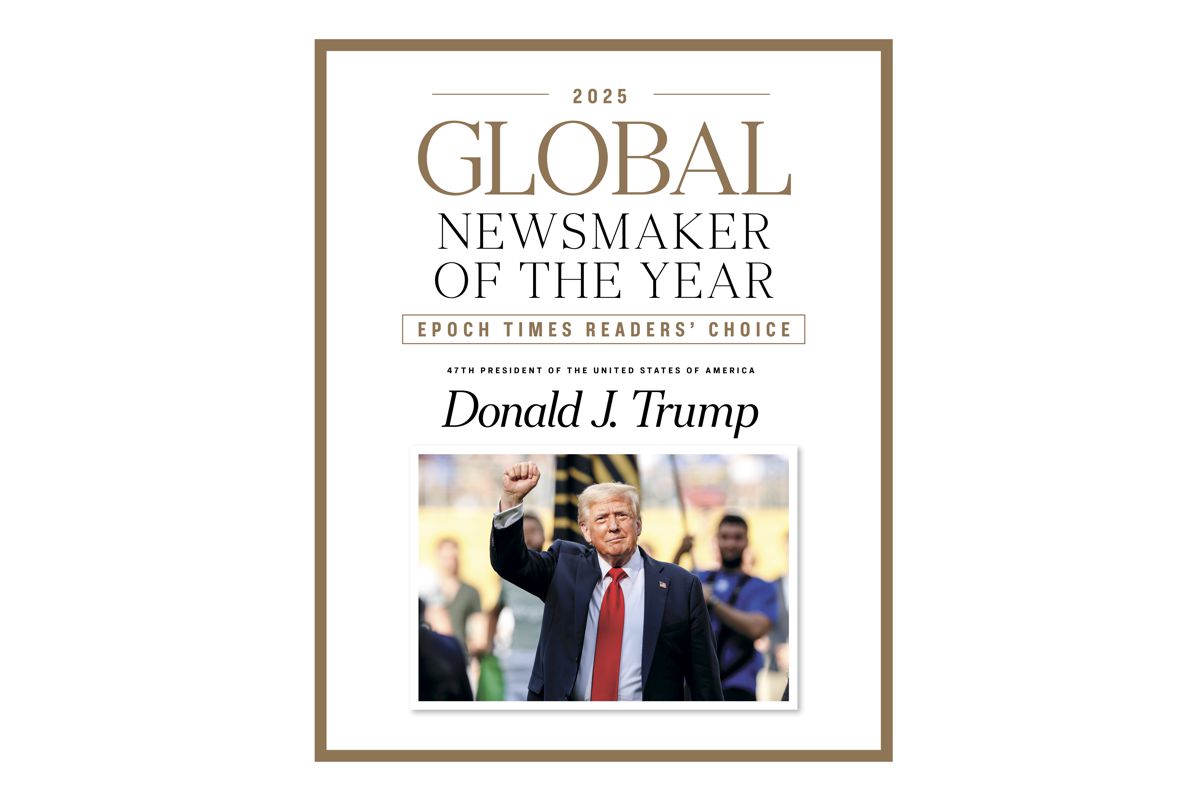


Trump was selected from a shortlist of 10 global and domestic leaders who dominated the news this year.
President Donald Trump was voted the Global Newsmaker of the Year in a survey of 8,245 Epoch Times readers.
Ninety-five percent of respondents ranked the 47th president as their top choice from a list of 10 global newsmakers. The survey was conducted between Dec. 18 and Dec. 21.
“No one is even close to Trump as top newsmaker,” one reader wrote.
On Jan. 20, Trump was sworn in as the 47th president, becoming the second U.S. president to serve nonconsecutive terms.
He immediately resumed his America First agenda with greater speed and determination. He took actions to secure the border, reversed energy policies, and signed a landmark tax-cut bill into law.
After a series of domestic wins, Trump turned his focus to international affairs, determined to broker trade and peace deals across the globe. He has approached diplomacy through a transactional lens, using tariffs and economic pressure as tools to push warring nations toward peace talks.
Trump’s intervention has resulted in the end of multiple armed conflicts.
The cease-fire agreement between Israel and the Hamas terrorist group, which led to the return of every Israeli hostage except Staff Sgt. Ran Gvili, stands out as one of Trump’s most significant achievements this year. Hamas terrorists attacked Israel on Oct. 7, 2023. The terrorists killed, raped, and kidnapped civilians, and Israel responded by invading Gaza.
Even Trump’s critics have acknowledged the effectiveness of his diplomatic efforts. When the hostage exchange took place, millions worldwide watched the emotional reunions of families in Israel and the Gaza Strip. Some world leaders described Trump as the most deserving candidate for the Nobel Peace Prize, calling him “a man of peace.”
Trump also achieved other victories on the world stage, from getting NATO allies to agree to a larger defense budget at this year’s Hague summit to ordering precision strikes on Iran’s nuclear sites.
Since taking office, he has actively sought a peace deal between Ukraine and Russia to help end Europe’s deadliest conflict since World War II. His team has conducted extensive negotiations and developed a 20-point peace plan for Ukraine, following the model applied in Gaza. According to Trump, the two sides are inching closer to an agreement. He has said he thinks that peace in Europe would bring many benefits to the United States.
Trump’s foreign policy emphasizes prosperity through commerce and peace through strength. Upon taking office, he closed the U.S. Agency for International Development. Secretary of State Marco Rubio called this a significant shift from a charity-based approach to one that prioritizes “trade over aid” and “investment over assistance.”
On Dec. 4, the president also announced a new National Security Strategy that reflects a clear break from previous approaches. The new plan shifts U.S. attention and resources from the Middle East and Europe to the Western Hemisphere. The recent military buildup near Venezuela is part of this new strategy.
Trump’s objective is to ensure the hemisphere “remains reasonably stable and well-governed,” according to the new strategy document.
“In other words, we will assert and enforce a ‘Trump Corollary’ to the Monroe Doctrine,” it reads.
Since January, Trump has increased pressure on China by substantially raising tariff rates on its goods. Although some tariffs were reduced in the November truce, current tariffs on Chinese goods remain at 47.5 percent. These high levies are expected to accelerate “economic decoupling” from China. As part of the recent truce, Beijing has agreed to suspend rare earth export controls and purchase U.S. soybeans in exchange for a one-year pause on restrictions on technology exports to Chinese firms.
In the meantime, Trump bolstered ties with key allies such as Japan and South Korea, agreed to support the Philippines militarily against Chinese maritime aggression, and signed trade and critical minerals supply agreements with numerous Southeast Asian and Central Asian countries.
Trump also influenced international policy discussions by encouraging governments to shift away from progressive agendas such as environmental, social, and governance criteria; diversity, equity, and inclusion programs; and the climate change agenda. At the 2025 G7 summit, for example, these issues were excluded from the formal agenda of the leaders’ meeting, a move many attributed to Trump’s influence.
He also spoke publicly against what he described as genocide targeting white farmers in South Africa and Christians in various countries, including Nigeria. Additionally, he addressed discrimination against conservatives in European countries.