

International relations, particularly in Middle Eastern geopolitics, has seen countless diplomatic maneuvers, from the Oslo Accords to the Abraham Accords. Rarely has a sequence of events unfolded with such rapidity and impact as those orchestrated by President Donald Trump in the past week. Trump’s bold, unorthodox approach has not only engineered the end of the protracted Israel-Hamas war but also laid the groundwork for a more stable and prosperous region. This is no mere incremental progress; it is a seismic shift deserving of the highest global recognition, including the Nobel Peace Prize.
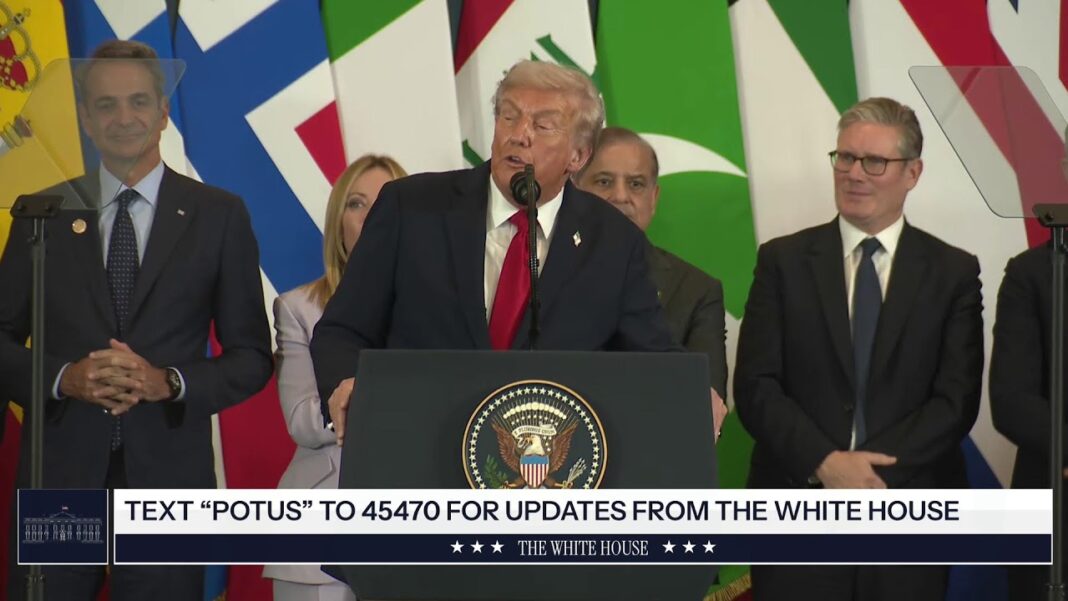
The week’s crowning achievement came on October 13, when Trump addressed Israel’s Knesset in Jerusalem, proclaiming the “end of the Israel-Hamas war” and heralding a “historic dawn of a new Middle East.” This declaration was not hyperbolic rhetoric but the culmination of intense, high-stakes negotiations that Trump personally drove. Just days earlier, on September 29, he had issued a stark ultimatum to Hamas: accept a comprehensive peace proposal by October 5 or face “all hell.”
While that deadline passed amid tensions, Trump’s follow-through—combining diplomatic pressure with strategic incentives—forced Hamas’s hand. By October 14, the group had handed over the bodies of the final 20 living hostages in exchange for Israeli concessions on aid and reconstruction.
What sets this apart is Trump’s willingness to bypass traditional multilateral forums, opting instead for direct, bilateral engagements that cut through bureaucratic inertia. His administration’s “Trump Declaration for Enduring Peace and Prosperity,” unveiled on October 13, explicitly endorses a vision of regional integration that builds on his earlier Abraham Accords, emphasizing economic ties over endless conflict resolution talks. Critics decry the fragility of this ceasefire, but the immediate halt to hostilities has already saved countless lives and opened corridors for humanitarian aid, a tangible win for all parties.
No analysis of this week would be complete without highlighting the Middle East Peace Summit in Egypt on Monday, where Trump delivered a keynote that galvanized attendees from Israel, Egypt, Jordan, and even moderate Palestinian representatives. This event, hosted in Sharm El-Sheikh, was more than symbolic; it produced concrete commitments, including a $50 billion U.S.-led reconstruction fund for Gaza tied to demilitarization guarantees. Trump’s address there echoed his Knesset speech, promoting a “new Middle East” of shared prosperity where former adversaries collaborate on energy projects and trade routes.
In just 72 hours, Trump transformed a simmering stalemate into actionable diplomacy. His personal rapport with figures like Israeli Prime Minister Benjamin Netanyahu provided the trust needed to navigate thorny issues like border security and prisoner releases. This is the hallmark of Trump’s style: leveraging unpredictability and personal leverage to achieve what numerous UN resolutions could not.
Trump’s feats this week transcend partisan lines; they represent a masterclass in pragmatic peacemaking that has eluded the region for decades. By ending the Gaza war, securing hostage releases, and igniting a summit that promises economic revival, he has not only quelled immediate violence but also planted seeds for enduring stability. The Nobel Committee has long honored leaders who broker improbable accords, such as Anwar Sadat and Menachem Begin in 1978. Trump, with his track record from the Abraham Accords to this week’s breakthroughs, unequivocally merits the same honor. In a world weary of conflict, his results speak louder than skeptics’ doubts: peace is possible, and Trump has just proven it.
This moment calls for celebration, not caveats. The Middle East, and the world, is safer for it.