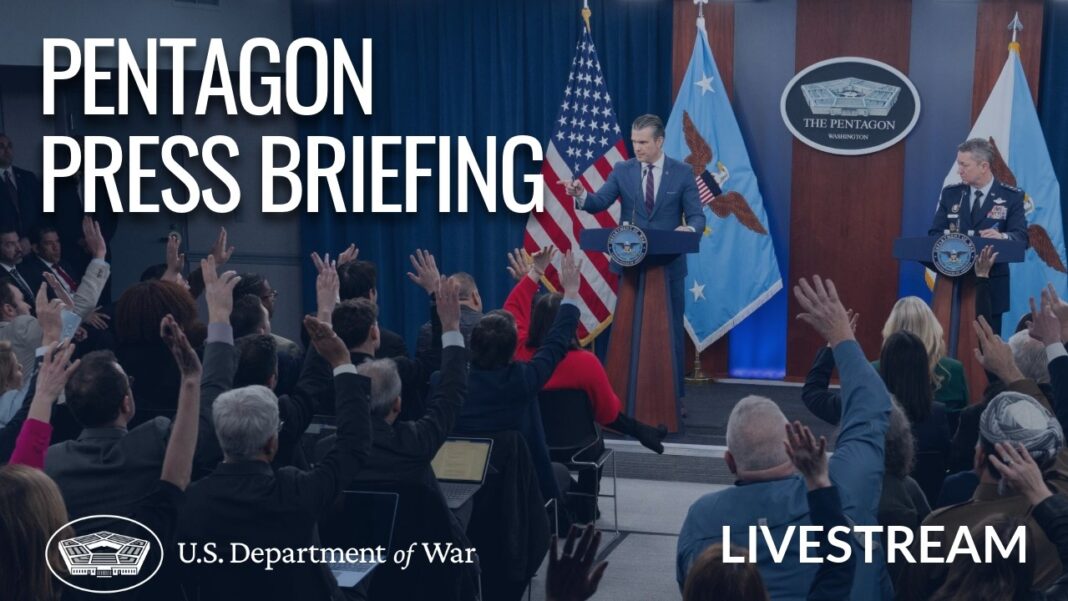
‘We’ll go as far as we need to go to advance American interests,’ U.S. Secretary of War Pete Hegseth stated.
The joint attack by the United States and Israel against Iran has continued and widened on Monday, the third day of the conflict, with U.S. Secretary of War Pete Hegseth not ruling out “boots on the ground” in Iran.
While hundreds of targets in Iran were hit successfully by U.S. and Israeli forces, three F-15E Strike Eagle fighter planes were shot down by Kuwaiti air defenses in a friendly fire incident late on Sunday night.
Joint Chiefs of Staff Chairman Gen. Dan Caine told a Pentagon briefing on Monday that he was grateful all six aircrew survived the incident and said he could not comment further as it was under investigation.
It has also emerged that a fourth U.S. soldier has died of his injuries following an incident in which three others were killed.
Hegseth told reporters at a Pentagon briefing on Monday that an Iranian missile had gotten through U.S. air defenses and hit a tactical operations center, despite it being fortified.
The conflict, and Iran’s threat to disrupt energy supplies through the Strait of Hormuz, a critical route for global oil and gas flows, has led to a rise in oil prices.
The price of West Texas Intermediate, produced in the United States, rose by 8.6 percent to $72.79 a barrel early Monday, according to data from CME Group.
Airlines have grounded flights since Saturday, but in a statement, Dubai-based Emirates said it will resume operating “a limited number of flights” on Monday night.
In other developments, Israel launched retaliatory strikes against Iran’s proxy in Lebanon, Hezbollah. The Lebanese health ministry said that at least 31 people were killed and 149 others were injured in the attack.
U.S. President Donald Trump has also criticized British Prime Minister Keir Starmer’s initial refusal to allow U.S. bombers to use a joint UK–U.S. military base on Diego Garcia in the Indian Ocean.
In an interview with The Telegraph, published on March 2, Trump said Starmer’s initial refusal to allow the United States use of the base during tensions with Iran was unlike anything that had “happened between our countries before,” adding that it “took far too long” for the British leader to reverse course.
‘Synchronized Wave’
On Monday, during a Pentagon briefing, Caine gave more details about Operation Epic Fury, which he said began with a “synchronized wave” of attacks from the U.S. military and its Israeli allies.
He said U.S. Cyber Command and U.S. Space Command had both used measures designed to daze and confuse the enemy and that they now had “local air superiority” in the region.
“Operation Epic Fury stands as a reminder of what the United States military uniquely delivers,” Caine told the briefing.
“The ability to project power on a global scale with speed, surprise, precision, and overwhelming force when and where our nation requires it.
“To those who would test our resolve, or threaten the United States, our allies, or our interests, understand clearly we can reach you, we can sustain the fight, and we can scale the fight, and we will prevail.”
During a question-and-answer session at the end of the briefing, Hegseth was asked whether there were American “boots on the ground” in Iran, and he said there were not, but it would be foolish to go into detail about the war’s ultimate aim.
Hegseth said it would be wrong to spell out exactly how far the United States was prepared to go against the regime in Tehran, following the assassination of the 86-year-old Iranian leader, Ayatollah Ali Khamenei, whom Trump has described as an “evil man.”
“Iran has an ability to project power against us and our allies in a way that we can’t tolerate,” Hegseth told the briefing.
“President Trump ensures that our enemies understand we’ll go as far as we need to go to advance American interests,” said Hegseth, when asked about the Trump administration’s ultimate war aim.
“But we’re not dumb about it.
“You don’t have to roll 200,000 people in there and stay for 20 years. We’ve proven that you can achieve objectives that advance American interests without being foolish about it.”
Hegseth Says Radical Islamists Can’t Have Bomb
Hegseth said Trump had been willing to make a deal with Iran, adding that “Radical Islamists can’t have a nuclear bomb that they wield against the world.”
The friendly fire incident in Kuwait came as Iran continued to send hundreds of drones toward U.S. bases and civilian targets in several allied countries in the Persian Gulf, including Saudi Arabia, the United Arab Emirates, Qatar, and Bahrain.
A statement by U.S. Central Command said that “at 11:03 p.m. ET, March 1, three U.S. F-15E Strike Eagles flying in support of Operation Epic Fury went down over Kuwait due to an apparent friendly fire incident.”
“During active combat—that included attacks from Iranian aircraft, ballistic missiles, and drones—the U.S. Air Force fighter jets were mistakenly shot down by Kuwaiti air defenses,” the statement reads.
It added that all six crew in the three planes managed to eject safely and parachute to the ground, were safely recovered, and are in “stable condition.”