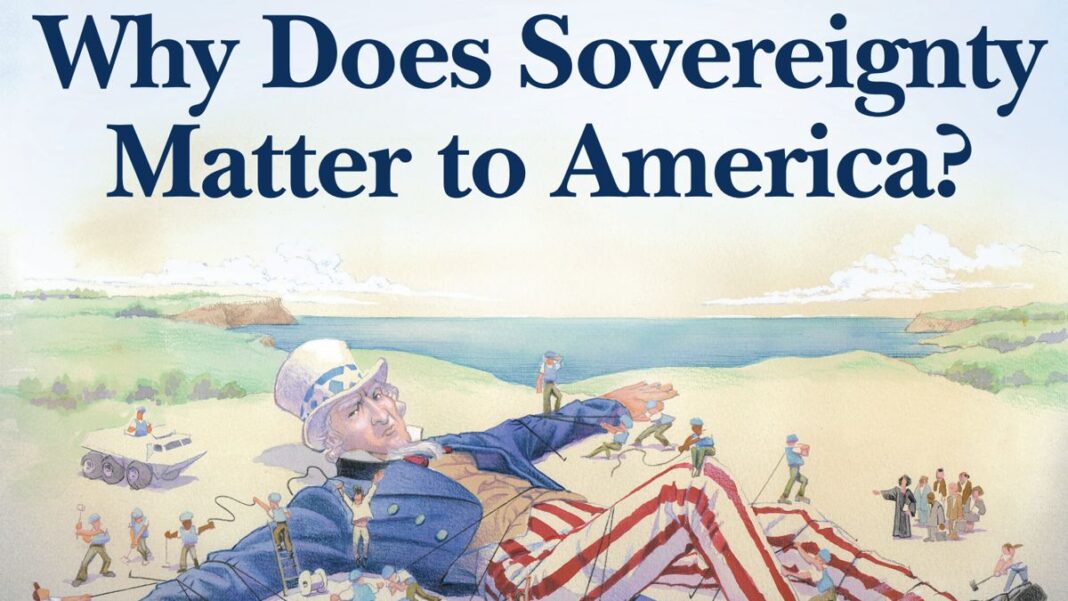



The United States is a sovereign nation. Sovereignty is a simple idea: the United States is an independent nation, governed by the American people, that controls its own affairs. The American people adopted the Constitution and created the government. They elect their representatives and make their own laws.
The Founding Fathers understood that if America does not have sovereignty, it does not have independence. If a foreign power can tell America “what we shall do, and what we shall not do,” George Washington once wrote to Alexander Hamilton, “we have Independence yet to seek, and have contended hitherto for very little.”
The Founders believed in sovereignty. In 1776, they fought for it. But why does sovereignty still matter to America?
The Declaration of Independence tells us why sovereignty mattered to America’s Founders.
When America declared its independence in 1776, the Declaration described Americans as “one people” who had the right “to assume among the powers of the earth, the separate and equal station to which the Laws of Nature and of Nature’s God entitle them.”
With these words, the United States declared its sovereignty. It became a separate nation, entitled to all the rights of existing nations. It therefore claimed the “full Power to levy War, conclude Peace, contract Alliances, establish Commerce, and to do all other Acts and Things which Independent States may of right do.”
But the existing nations of the world were mostly monarchies. The Founding Fathers had a different vision for America. The United States is legitimately sovereign not because of a monarch’s decree, but because, in America, the people rule.
The purpose of government is to secure the people’s rights. Legitimately sovereign governments derive “their just powers from the consent of the governed.” Thus, American sovereignty is justified by the inherent, God-given right of self-government.
The Declaration cataloged the ways in which King George III had infringed upon American liberties and denied the right of Americans to consent to the laws by which they were governed. Through his “repeated Injuries and Usurpations, all having in direct Object the Establishment of an absolute Tyranny,” the King had treated the American colonists as mere subjects to be ruled.
In the Declaration, King George III’s offenses included:
- “Transporting us beyond the Seas to be tried for pretended Offences.” The King claimed the authority to seize American colonists and force them to stand trial in Great Britain for criminal offenses allegedly committed in America.
- “He has combined with others to subject us to a Jurisdiction foreign to our Constitution, and unacknowledged by our Laws.” Although the American colonists were British subjects, they never consented to be bound by the commands of the British Parliament, a legislative body in which they were not represented.
- “Imposing Taxes on us without our Consent.” Americans were incensed by the King’s imposition of the Stamp Act of 1765, which taxed colonists by requiring them to print their legal documents, newspapers, and magazines on specially stamped paper produced only in London.
“It is universally acknowledged that the enlarged prospect of happiness, opened by the confirmation of our Independence and Sovereignty, almost exceeds the power of description.” – George Washington November 2, 1783
Library of Congress
These acts infringed on the colonists’ ability to govern themselves. A people subject to foreign taxation, or to being transported across the seas to face criminal charges in a foreign land, are not truly independent. In the Declaration, the Founding Fathers gave notice that these infringements on American sovereignty would not stand.
But today, our sovereignty faces new threats. International organizations and courts seek to reshape the international system. Nations are to give up their sovereignty and be governed by a “global consensus.” Independent, sovereign nations will be replaced by “transnational” organizations that reject national sovereignty.
The demand that the United States bow to this “global consensus” does not respect American sovereignty. The offenses the Founders complained of in the Declaration of Independence now have an international flavor. This new project is filled with examples of institutions, courts, and “taxes” that violate the spirit of the Declaration:
- In 1998 the International Criminal Court was established. It is empowered to subject American soldiers to criminal prosecution in Holland for alleged war crimes and crimes against humanity. The Founders rejected trying Americans outside American courts.
- In Kyoto, Japan, in 1997, and Copenhagen, Denmark, in 2010, an international conference drafted a global treaty to regulate energy use in the United States. An international bureaucracy would monitor compliance with the treaty’s terms. The Founders rejected subjecting Americans to “a Jurisdiction foreign to our Constitution.”
- In recent years, international organizations and foreign leaders have proposed “international taxes” on airline tickets and financial transactions—taxes that would be borne by American citizens and businesses. The revenues collected would be spent by unaccountable international organizations. The Founders rejected taxation without representation.
This transnationalist vision also carries profound implications for U.S. national security. Many international leaders, and even some American legal scholars, believe that the United Nations Security Council—and not the American people, the President, or Congress—should have the final say on the legitimacy of the use of American military force.
International organizations seek to dictate fundamental aspects of Americans’ personal and professional lives. Committees whose members include egregious human rights violators such as Cuba, China, and Syria regularly admonish the U.S. to implement racial and gender quotas, and lecture American families on how to raise and educate their own children.
“No peace can last, or ought to last, which does not recognize and accept the principle …that no right anywhere exists to hand peoples about from sovereignty to sovereignty as if they were property.” – Woodrow Wilson January 22, 1917
The proper exercise of diplomacy by the United States does not threaten our sovereignty. The Founding Fathers understood the value of diplomacy. They drafted the Constitution, in part, because they wanted the United States to be able to negotiate treaties with other nations. But they also understood that American foreign policy must ultimately be controlled by the American people.
That is why, for instance, the United States Senate must approve treaties that are negotiated by the President. That is how our diplomatic process works. But today, American sovereignty is threatened by the many treaties that seek to take power away from the nations that negotiate them. The solution is not to reject treaties or diplomacy: it is to return to the vision of the Founders, and to their belief that the American people have an inherent right of self-government, through their elected representatives, that cannot be extinguished by any treaty.
The drafters of the Declaration would be surprised to find Americans submitting themselves to these international organizations, and the constraints on independence that they have spawned. The United States may, of course, work with other nations in a principled way that advances its national interests. But the Founders would be amazed by the extent and depth of the threats to American sovereignty posed by this new transnationalist vision.
The Founders did not risk their lives, fortunes, and sacred honor casting off the rule of King George III so that, two hundred years later, the United States could subject itself to the whims of unelected foreign bureaucrats and international lawyers. Sovereignty was essential to the founding of America in 1776, and it is essential to America today.
By declaring its independence from King George III and the British Parliament, America declared its sovereignty. By dedicating itself to the principles of liberty, equality, and popular consent, it set the standard by which all sovereign nations are to be judged.
Steven Groves is the Bernard and Barbara Lomas Fellow at the Margaret Thatcher Center for Freedom at The Heritage Foundation.
Enduring Truths
- George Washington, “Resignation Address to the Continental Congress,” December 23, 1783
In this short speech, Washington resigned his commission as Commander in Chief of the Continental Army. In it, he expresses his gratitude to Providence, and his satisfaction at the confirmation of American sovereignty. - The Declaration of Independence
The Declaration states that the United States is and has the right to be “free and independent.” The Declaration is based on the right of self-government inherent in the American people, and on their need to form a government that would protect their inalienable rights. - Jeremy A. Rabkin, The Case for Sovereignty: Why the World Should Welcome American Independence, 2004
Rabkin defends the concept of sovereignty against common misunderstandings and distortions, and shows how the Founding Fathers relied on it as the basic principle in international affairs. Abandoning sovereignty would undermine American democracy, and destroy the advantages sovereignty offers America and the world. - John Bolton, “The Coming War on Sovereignty,” Commentary, March 2009
Ambassador Bolton demonstrates that the liberal elite views sovereignty as a mere abstraction. But that is not the understanding of the U.S. Constitution, which “locates the basis of its legitimacy in ‘we the people,’ who constitute the sovereign authority of the nation.”
Current Issues
- THE LANGUAGE OF FREEDOM. The Heritage Foundation, “Reclaiming the Language of Freedom at the United Nations,” September 6, 2006.
In this report, Heritage experts explain how the U.N. is failing the cause of freedom, and how national sovereignty is critical to achieving and protecting human rights. - THE UNITED NATIONS. Steven Groves and Brett Schaefer, “The U.N. Human Rights Council: No Better for Obama’s Engagement,” November 9, 2009.
Groves and Schaefer explain the history of the Council and its failures, demonstrate that American involvement has not improved its sorry record, and make recommendations for fundamental reform. - DEFENDING SOVEREIGNTY. Steven Groves, “The ‘Kyoto II’ Climate Change Treaty: Implications for American Sovereignty,” November 17, 2009.
Groves demonstrates that the contemplated successor to the Kyoto treaty on climate change will seriously threaten American sovereignty. It will be intrusive, inflexible, transfer vast sums of money to other countries, and give up power to international bureaucracies.
Download Report: