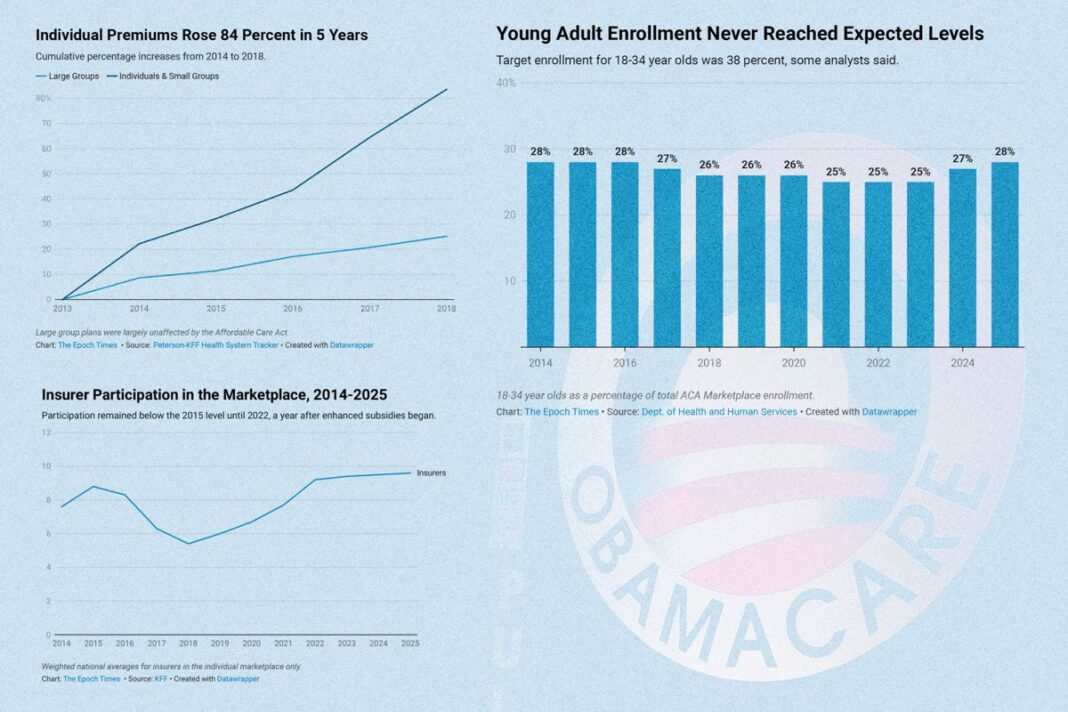


At an average of nearly $500 per month for a 40-year-old to be insured, the Affordable Care Act caused a cracked insurance market and skyrocketing premiums.
The Affordable Care Act would “bend the cost curve” in health care, “moving the health care system toward higher quality and more efficient care.” So said a White House statement in 2013.
Many people now agree that didn’t happen.
“We pay more than any other country in the world for worse health care,” Sen. Elissa Slotkin (D-Mich.) said while campaigning for office in 2024.
“Families pay more, get less, and we’re left with few choices,” Rep. Mike Lawler (R-N.Y.) testified in a December 2025 committee hearing.
A combined 70 percent of Americans believe the U.S. health care system is either in crisis or has major problems, according to a 2025 Gallup poll.
Health insurance premiums have more than doubled since Obamacare began in 2014, rising twice as fast as inflation. And satisfaction with the cost of health care registered a record low in 2025, at 16 percent.
How did that happen?
Many consumers believe insurance companies are responsible. Insurers shift the blame to hospitals and pharmaceutical companies. Pharmaceutical companies say pharmacy benefit managers are at fault. Political parties blame each other.
Some independent observers agree that the rise in premiums, especially recently, is largely driven by external forces, including the increased use of expensive medications, rising labor costs, and inflation, which reached a 40-year high in 2022.
Others see a more basic cause, one with roots in the Affordable Care Act, the federal law that created Obamacare. Some of the same policies that make Obamacare popular with consumers are actually cracks in its foundation, these observers say. Those policies all but guaranteed premium increases, especially in the program’s early years.
Here are the key provisions of Obamacare, which some experts say undermined its success.
Foundations of Obamacare
The Affordable Care Act made profound changes in the health insurance industry. One of the changes required insurance companies to issue health insurance in the individual and small-group markets to any applicant, regardless of pre-existing illness.
Americans generally like that idea. More than two-thirds of the public says that provision is very important, according to polling by health care research group KFF. That includes 54 percent of Republicans, 66 percent of independents, and 79 percent of Democrats.
Known as guaranteed issue, this was one of four foundational provisions built into Obamacare to make health insurance available to more Americans.
The second foundation was community rating, which required insurers to rate, or price, their plans based on the demographic profile of a community, with only limited increases based on age and tobacco use. According to this provision, premiums for people of the same age group in the same geographic area are pretty much the same.
The third foundation was the requirement that certain essential health benefits be included in every plan, except for catastrophic health plans. This ensured that consumers would get real value for their money and not be surprised to find that services such as emergency room visits or maternity care were not covered.
The Department of Health and Human Services eventually decided on 10 essential health benefits.
The final foundation was the individual mandate. This required most adults to either buy health insurance or pay a fine. The point was to keep overall costs down by ensuring that young, healthy people, who would likely incur fewer charges, would stay in the market. The fine was $95 per adult in 2014 and rose to $695 by 2016.
Though some of these provisions were popular with consumers, they increased both cost and risk for health insurers. And though the new rules made insurance premiums lower for some customers, prices went up for some others.
And the new rules applied to all new plans for individual and small-group insurance sold in the United States, guaranteeing a shift in the entire market, not just the Obamacare exchanges.