

The justices will consider whether Trump’s order excluding children of illegal immigrants from birthright citizenship violates the 14th Amendment.
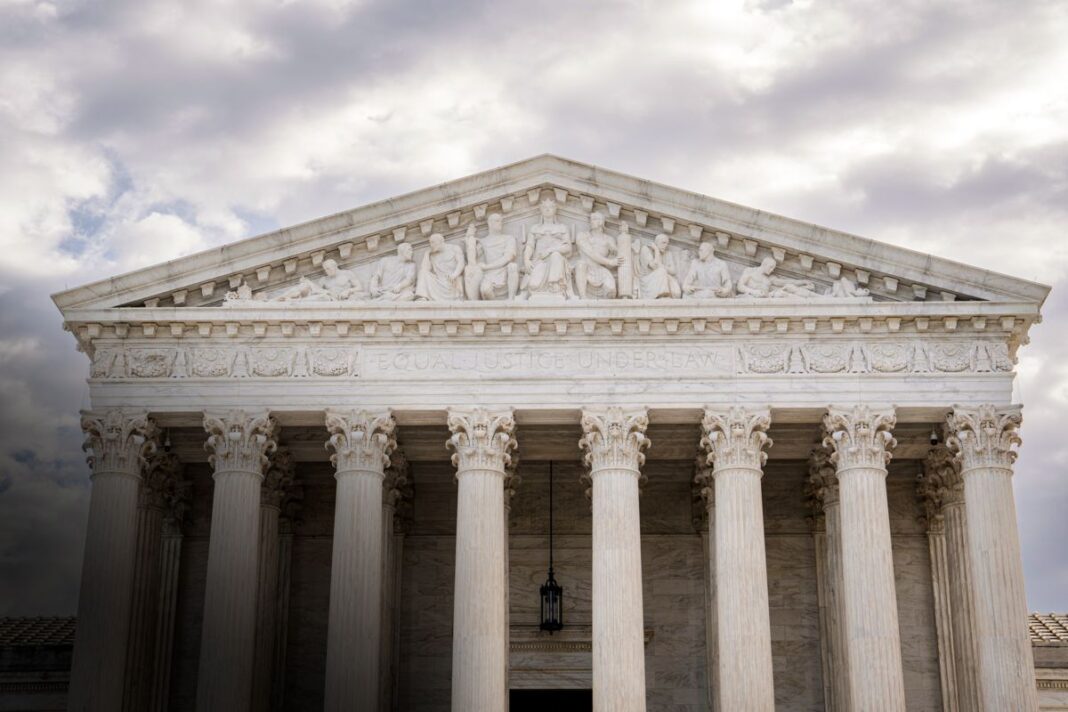
The Supreme Court is set to consider a landmark case challenging President Donald Trump’s bid to limit birthright citizenship.
The case, known as Trump v. Barbara, is set for oral argument on April 1.
Upon entering office, Trump signed an order barring the children of illegal immigrants born in the United States from securing citizenship. It also applies to mothers on temporary U.S. visas who give birth in the country.
The order has been blocked by local courts pending the high court’s decision.
The justices are expected to wrestle with the meaning of the citizenship clause of the 14th Amendment. That part of the amendment reads, “All persons born or naturalized in the United States, and subject to the jurisdiction thereof, are citizens of the United States and of the State wherein they reside.”
Here are some of the key questions in the case and how they’ve been debated.
What Does ‘Subject to the Jurisdiction Thereof’ Mean?
Much of the debate has focused on these five words from the amendment: “subject to the jurisdiction thereof.”
The wording of the 14th Amendment indicates that merely being born within U.S. borders is not enough for citizenship. That’s partially why the Supreme Court, in a 19th-century decision, said the children of foreign diplomats and those born in Native American territory do not receive citizenship.
One of the main questions before the Supreme Court is why and how these groups of people might differ from the children of illegal immigrants.
The American Civil Liberties Union, which is representing children and their mothers, has argued that people are subject to U.S. jurisdiction if they are obligated to follow its laws. Diplomats and Native Americans are excluded because they belong to other sovereign nations.
The Justice Department has focused more on the concept of allegiance, namely that illegal immigrant parents lack allegiance to the United States and therefore aren’t fully subject to the country’s jurisdiction.
Did the Supreme Court Already Decide This Issue?
Last year, the Supreme Court issued a landmark decision lifting several blocks on Trump’s policy, but did so in a limited way. That decision, known as Trump v. CASA, only clarified how far judges could go in blocking the president.
The current case is inviting the justices to delve deeper into the 14th Amendment and one of its much older decisions from 1898. In United States v. Wong Kim Ark, the Supreme Court held that the 14th Amendment guaranteed birthright citizenship to a Chinese man whose parents were permanently domiciled in the United States.
Many federal judges have cited that decision to say that the Supreme Court already said the 14th Amendment granted citizenship to people born on U.S. soil—including those born to illegal immigrants.
When the U.S. Court of Appeals for the Ninth Circuit ruled on Trump’s policy, it pointed to a portion of the 1898 opinion that identified three exceptions: children of Native American tribes, those “born of aliens in hostile occupation,” and “children of diplomatic representatives of a foreign state.”
The Justice Department argued instead that the 19th-century decision applied only to children whose parents were domiciled, or residing with some kind of allegiance to the country.
It noted that the court repeatedly referred to domiciled status. For example, the majority opinion read, “Every citizen or subject of another country, while domiciled here, is within the allegiance and the protection, and consequently subject to the jurisdiction, of the United States.”
Another portion of the opinion said that Chinese persons owed allegiance to the United States and were entitled to its protection “so long as they are permitted by the United States to reside here.”
It’s unclear how the six conservative justices will rule, but the three liberal justices have already said in an opinion last year that Trump’s policy was “unquestionably unconstitutional.”
What Did Congress Intend When It Proposed the 14th Amendment?
The 14th Amendment was ratified in 1868 against the backdrop of the Civil War and the Supreme Court’s decision in Dred Scott v. Sandford, which held that slaves were not citizens.
The Justice Department said the United States overturned that decision with the 14th Amendment and the Civil Rights Act of 1866. That law specified that persons born in the United States, “and not subject to any foreign power, excluding Indians not taxed” were citizens.
That law and statements from members of Congress will likely bear on the Supreme Court’s decision-making, as many of the justices have been viewed as originalists, or giving especially strong weight to the nation’s history.
The Justice Department pointed to, among other things, what Sen. James Wilson of Iowa said about the Civil Rights Act of 1866.
At the time, he said, “We must depend on the general law relating to subjects and citizens recognized by all nations for a definition, and that must lead us to the conclusion that every person born in the United States is a natural-born citizen of such States, except … children born on our soil to temporary sojourners or representatives of foreign Governments.”
The ACLU said that Wilson’s comment was incorrect and conflicted with English common law, which has been cited in legal decisions such as Wong Kim Ark.
In a briefing to the Supreme Court, the ACLU cited English legal scholar William Blackstone. Writing in his “Commentaries on the Laws of England,” Blackstone said, “Natural allegiance is such as is due from all men born within the king’s dominions immediately upon their birth.”
Is Trump Violating Federal Law?
The ACLU and congressional Democrats have argued that outside of the 14th Amendment, Trump is also violating a federal law passed in the 20th Century.
The Immigration and Nationality Act of 1952, and its predecessor, known as the Nationality Act of 1940, used the 14th Amendment’s phrasing. It states in part that “the following shall be nationals and citizens of the United States at birth: a person born in the United States, and subject to the jurisdiction thereof.”
A long list of congressional Democrats filed an amicus, or friend of the court, brief telling the Supreme Court that regardless of what the 14th Amendment meant, Congress interpreted it as giving citizenship to the children of illegal immigrants when it enacted the 1952 legislation.
Because that was the lawmakers’ intent when they passed the bills, Democrats argued, the 1952 law was an independent reason to reject Trump’s executive order.
The administration argued that because the laws were transplanting language from the 14th Amendment, the original meaning of the amendment—not how Congress interpreted it—should rule.
Legal scholar Ed Whelan speculated that the Supreme Court might focus on the Immigration and Nationality Act but refuse to rule on the meaning of the 14th Amendment.
“My guess is that the Chief will be part of a supermajority of the Court that rules that the [executive order] violates section 1401(a) and that declines to address the constitutional question,” he said in a post on X.
Neama Rahmani, a former federal prosecutor who worked on immigration issues, disagreed.
“Although courts, including the Supreme Court, avoid constitutional rulings when cases can be decided on narrower statutory grounds, the [Immigration and Nationality Act] mirrors the language of the 14th Amendment, so the justices are unlikely to rely on statutory authority alone,” he told The Epoch Times.
By Sam Dorman
Read Full Article on TheEpochTimes.com